yuzurujenn Posted July 1 Posted July 1 Info: https://www.amazon.co.jp/gp/product/4635908240/ https://www.yamakei.co.jp/products/2826908240.html CONTENTS [Cover Photo Feature] Yuzuru Hanyu Special Gallery [Exclusive Interview] Yuzuru Hanyu Part 1: "Putting all my thoughts and soul into my body and skating" Part 2: "Thoughts on 'ICE STORY 4th' and Ryuichi Sakamoto" [Speaking about Yuzuru Hanyu] David Wilson: "An encounter of destiny and passion" MIKIKO: "The joy of infinitely expanding expression" Marihiko Hara: "Sound and color that melt together on the ice" [Special Dialogue] Tohoku Youth Orchestra Aiko Chiba x Minami Suzuki : "A soulful performance that resonates on the ice" [Special Roundtable Discussion] Behind the scenes of "REALIVE" and "Prequel" video production Eri Sado x Mamoru Inagaki x Yosuke Sato: "To tell the story" [Event Report] Yuzuru Hanyu notte stellata 2026 Yuzuru Hanyu “REALIVE” an ICE STORY project Disaster memorial song "Ikue" - Figure skating special program [Photo & Column] Yoshiki Kogaito "Reflecting the heart" [Special Feature] Unpublished Photo Gallery from "Photon Yuzuru Hanyu Photobook" [Special Guest] Yoshiki Kogaito "The Works Have Begun to Breathe" [Online Lecture] Taketoshi Hara "The Charm of the Absolute Champion Seen from a Designer's Perspective" [Special Essay] Naoko Utsunomiya "'Dear Yuzuru Hanyu' Postscript: About That Day"
Wintek Posted 18 hours ago Posted 18 hours ago [2026.07.14] *Machine translation from Japanese to English, inaccuracies exist and some nuance and tone might be lost. Please read the notes for better context* [P. 36-51] Special Interview Part 1 Yuzuru Hanyu Entrusting all of my thoughts and soul to my body and my skating After an approximately eight-month "maintenance period," professional figure skater Yuzuru Hanyu returned to the spotlight on the ice. In March 2026, marking fifteen years since the Great East Japan Earthquake, he served as the lead performer of the ice show Yuzuru Hanyu notte stellata 2026, offering prayers for the repose of those lost in the disaster while also lighting a beacon of hope for the affected regions. The day after the final performance, Hanyu sat down for an exclusive interview, in which he spoke about the fifteen-year path he has walked together with skating and his thoughts about what lies ahead. Spoiler Interview and text by Mitsuru Tanaka (Sports Writer / Professor, Shobi University) Photos by Yoshiki Kogaito (Sports Nippon) "To honestly be able to say, 'That was perfect' about a performance... truthfully, there's never been one." — First of all, you designated the 2025 season as a "maintenance period." How should we understand what that means? Hanyu: It was because I wanted to become even better than I am now. And also, as I continue to be involved with skating going forward, I felt that at some point I needed to make the time to look back at my skating once again, reexamine it, and rebuild my "position"[1]—or rather, establish where I stand again. So, as I was thinking about my future, I felt, "This is the moment." — During the media interview after notte stellata, you mentioned that during this maintenance period you changed from relying on what you'd been doing intuitively—or in your own way—to using your body based on scientific principles. To be honest, considering everything you've already accomplished and the level of technique you've established, one might think that doing things "your own way" would be enough, wouldn't it? Hanyu: When I look back at my performances up until now... honestly, there haven't really been many where I could sincerely think, "Wow, I'm really good." Of course, there were performances where I thought, "The quality was good." Like, "The jumps were really good that time," or "The spins and step sequences were well executed." There have definitely been moments like that. But to be able to say, "That was perfect," or "That was unbelievably good," from the bottom of my heart... truthfully, there hasn't been a single performance where I've felt that. I'm always looking for flaws somewhere. After every performance, all I can really see are the things I still need to work on. And when it comes to motivation... rather than actively thinking, "I want to become better," what was constantly in my mind was, "I can't let people see a performance that's this poor." That's what kept driving me all this time. I'm someone with an incredibly strong tendency toward negative thinking, so I've often approached things that way. I think I took this maintenance period in order to work through those kinds of issues. — Specifically, where did you feel the shortcomings of your self-taught approach were? Hanyu: Right, of course. You want to hear the concrete parts. (laughs) I also wonder whether it'll really come across, but... I'll start with the weaknesses. I've mentioned this before, but one of my weaknesses is that my hips are extremely tight. I have a limited range of motion in my hip joints, so I often compensated by moving my lower back instead, kind of using it as a substitute to create the necessary positions and maintain my balance. Also, because I've had so many ankle sprains, the stability of my ankles has inevitably become weaker. And if I add one more thing, in figure skating you're always moving while centrifugal force is acting on your body, so surprisingly, your balance when simply standing on one leg actually isn't that good. When people say a skater has "good balance," it's really balance against centrifugal force. So during the training I did throughout the maintenance period, when I actually tested those positions, one of the biggest things I realized was just how weak my one-leg balance really is. I think that if I strengthen my body to address that weakness in single-leg balance, my performance can improve even further. As for my strengths, my back has always been naturally flexible. I realized that I'm actually very good at connecting that flexibility in my back to my rotational movements in skating. At the same time, I've also come to understand that whenever I'm unable to use that movement effectively, that's when I'm not skating well. Until now I'd been doing all of that instinctively, in my own way, so now I'm thinking that I also want to train in a way that develops those strengths even further. If I can keep expanding those strengths, I feel I'll be able to refine the kind of movement that feels most like me—smooth, effortless movement with very little sense of forcing it—and make it even more polished. — So, by addressing your weaknesses while further developing your strengths, how will the things you've discovered about your skating evolve through your training? Hanyu: It really comes back to what I mentioned earlier about "establishing my position in skating." I went back and reconsidered the very foundation of how I build my body. For example, someone would quickly say, "Try this position." If I could do it without much difficulty—or rather, if I felt, "I have plenty of room to spare here"—then the next step would be, "Alright, now try this." And if I could do that easily too, we'd just continue the process of building the next position. But then I'd watch other people doing something and think, "Wait... I can't even do that?" There were positions like that. Through that, I started realizing things like, "So this is where I'm unusual," or "Because I was different in this way, that's why my jumps worked as well as they did," or "That's why I was able to create those particular body lines and shapes." I've also come to realize that precisely because those are my strengths, they're things I should develop even more. — You mentioned that balancing on one leg isn't actually a position that's required in figure skating. But by training it and becoming able to do it beautifully, do you think your performances will evolve further? Hanyu: Without a doubt, they'll change. I also think it'll reduce the likelihood of ankle sprains. As for my ankles, because I've had injury after injury, I think the ligaments have inevitably become weaker. Even so, I've realized that I'm simply not very good at using them. Just looking at this one aspect, it's something that everyone else can do, yet, surprisingly, I couldn't. That was something I found myself thinking. — I'd also like to ask about notte stellata, which you performed after this maintenance period. In previous years, the show's special guests have all been remarkable figures—Kohei Uchimura in 2023, former Takarazuka top star Mao Daichi in 2024, and Kyogen performer Mansai Nomura in 2025. This year, however, that important role was taken by the Tohoku Youth Orchestra. Its members are about the same age as you were when you experienced the earthquake fifteen years ago. Could you tell us what you wanted to convey through performing together with this younger generation? Hanyu: For me, I want notte stellata to be something that gives people a reason—a starting point. People who come to Sendai, or to Rifu where the venue is, can enjoy the local food. This year, not only were there products from Tohoku, but there were also stalls from the Wajima Morning Market in Ishikawa, selling crafts and local specialties from Noto. Through the show, people are able to support those communities in many different ways. That's certainly one aspect of it. But I've always hoped that my own presence can become an opportunity for people to think about the earthquake, about reconstruction, and about many other related things. In that sense, notte stellata is also a kind of mechanism created for that purpose.nThe members of the Tohoku Youth Orchestra have carried on their activities under the name "Tohoku" all this time. I think that, for them, the very name of the orchestra itself carries the weight of the earthquake. At the same time, though, the very weighty title and role of the "Tohoku Youth Orchestra" and the role of Yuzuru Hanyu's notte stellata aren't things that can be ranked against one another.nAnd although we're all performers, I imagine that each individual member has their own way of thinking about the earthquake. Still, I hoped that performing together—and notte itself—could become something that would, in one way or another, change their music going forward. In fact, before performing Happy End and Yae no Sakura, I had the opportunity to talk with the conductor, Takai-san (Yuki), and the others about the feelings I have while skating those programs. I could see members nodding as they listened, and after that, there were many moments when the performance itself changed dramatically. The feelings we wanted to convey, the message we wanted to deliver—I think that, in one way or another, it reached the people who came to the venue, and of course also those who weren't there in person but watched through the livestream or other broadcasts.I feel that something reached them. "Music and skating don't have a language barrier. That's why I believe they can easily cross national borders." — That expression—'something'—feels very much like something you would say. Hanyu: Thank you. Of course, for every program, I have a very clear message within myself. But if I were to impose that message on the people watching, I think it would become self-indulgent. And this isn't limited to skating. The same is true when reading a novel or listening to song lyrics or music. Every person receiving it has a completely different background, the life they've lived and everything that comes with it. Because of that, I think each person will feel something different. In fact, I think that's only natural, and I believe it's important that it be that way. The same goes for the earthquake. Even if younger generations didn't experience the disaster themselves, they've grown up seeing many of the records and memories that it left behind. So I think that, through this collaboration, they may have been able to feel something different from what I feel, or from what people who actually experienced the disaster feel. There were also elementary school children and very young children among the audience. I think that this program reached them too, in one way or another. — Before his passing, Ryuichi Sakamoto, who served as music director of the Tohoku Youth Orchestra, told its members, "There are things that can only be expressed through music." It feels as though that overlaps very strongly with the way you are today—as someone expressing that there are things that can only be conveyed through skating. Hanyu: Music and skating don't have a language barrier. That's why I think they can easily cross national borders. At the same time, even if I pour my feelings directly into the music—or, in my case, into a skating program—when it's a nonverbal form of expression, it feels as though the person receiving it has their own filter, or perhaps their own space[2] through which they receive it. For me, that expression takes the form of movement through the body. In figure skating, we move across the ice with speed, with rapid rotations like jumps and spins—movements that simply don't exist in everyday life. There is a landscape that can be seen from there—a landscape that can only be seen through figure skating. I'm sure music has something similar. Precisely because it is music, it can convey powerful messages without relying on words. It exists, I think, so that those messages can be delivered in a gentle way, without sharp edges. — The two new programs you performed were both set to music by Ryuichi Sakamoto. When we met in October 2024 for the photo shoot for my book Yuzuru Hanyu Through the Lens (Yama-kei Publishers), you were standing in front of photographer Yoshiki Kogaito's camera in a very quiet space, and you told me, "Ryuichi Sakamoto's piano music is playing in my head." Hanyu: Yes, of course. I remember that. — It feels as though Sakamoto's music has long been something close to you. What kind of presence has he—and his music—been in your life? Hanyu: That's right. To me, he's both a pioneer of Japanese music and, at the same time, a classic. Of course, there's his extraordinary ability to construct music—to the point that he was called "Professor"—but beyond that, I think he approached music with all kinds of intentions about what he wanted to communicate, and he explored it in so many playful ways, in the best sense of the word. This is just my own impression, but when I listen to his music, I feel that calculation and emotion are always coexisting, and that he continued to embody a kind of golden ratio in the balance between the two. At the exhibition Ryuichi Sakamoto: Seeing Sound, Hearing Time—which was based on the concepts he left behind before his passing and centered on the themes of "sound" and "time"—there are works that are expressed using nothing but the sounds of nature. It may seem avant-garde, but by focusing on the sounds that exist in everyday life, they're also "sounds" that have been continuing all along. — Looking back over your life, is there one piece by Sakamoto that has influenced you the most? Hanyu: There's one I'd like to use someday... for a program. But... I think I'll keep that to myself for now. — Then I'll look forward to that day. Next, I'd like to ask about the four years since you turned professional. For the first time since becoming a competitive skater, you've spent a four-year cycle without "the next Olympics" ahead of you. What kind of four years have these been? Hanyu: Hmm... it's been a rather strange feeling. It's true that, over these four years, I haven't had the sense of training toward the Winter Olympics anymore. But more than anything, they've been years spent, without that ever changing, facing the challenges that were right in front of me. Like I said earlier, I simply had far too many things I wanted to improve, and I was completely occupied with working through those one by one. "With the same body, with the same soul, I want to continue refining myself more and more." — This year marks fifteen years since the Great East Japan Earthquake. You were sixteen years old when it happened. During those fifteen years, you've won two Olympic gold medals, come to be known as the undisputed champion, and opened up entirely new possibilities as a professional skater. Compared to the person you were back then, what has changed—and what hasn't changed—in the way you approach skating and life? Hanyu: I think... before the earthquake, I simply loved skating more. Or rather, back then I wasn't carrying so many things on my shoulders. I was only sixteen. I'd just won the silver medal at the Four Continents Championships, right? My quadruple jumps were starting to become more consistent, and I was finally able to land them reliably. Just seeing myself improve like that made me happy. I was beginning to feel that my abilities could compete on the world stage, and... it was simply fun. Back then, I loved skating, and all I could see was the future. Compared to that time, I came to carry the earthquake with me. I came to carry Olympic gold medals with me. Little by little, more and more things came to rest on my shoulders. In that sense, there is a part of me that can no longer enjoy skating with that same pure simplicity. But, if you look at it another way, that also means my sense of responsibility has grown stronger. As for what hasn't changed… I suppose it's my body. My body, and my heart. Everything that makes me who I am hasn't changed at all. And I think that's something that will remain true going forward as well. With the same body, with the same soul, I want to continue refining myself more and more. — Finally, after this maintenance period and now that you're looking toward what's next, would you write your current feelings on this shikishi board? Hanyu: Hmm... let's see. (A long silence follows.) What would be good... (...Hanyu quietly gathers his thoughts... Saying "Hmm..." as he searches for the right words, he signs the board first. Looking over with consideration, he asks, "Is today's date alright?" Then he continues murmuring to himself, "What should I write...? Hmm... hmm..." as the seconds tick by.) It's difficult, isn't it? My feelings right now… I realized I haven't really thought about them.I do have an ideal of what I want to become, but… I don't know… Life is just a continuation of everyday days.[3] After a long period of careful thought, he finally wrote these words on the shikishi, in neat, deliberate handwriting: "Entrusting all of my thoughts and soul to my body and my skating." NOTES [1]「位置をつくり直す」Yuzuru literally says position (位置), not foundation or technique. It feels broader than physical position, more like re-establishing where he stands as a skater. [2] 余白 literally means the blank margins of a page or empty space, but in Japanese aesthetics it often refers to the space left for the audience to inhabit or complete themselves. Using "their own space", conveys the idea that meaning isn't fixed but completed by the person experiencing it. [3] 日常の連続なんですよね, literally, "It's a continuation of everyday life." Despite all the milestones people see from the outside, his lived experience isn't a series of dramatic turning points.
Wintek Posted 18 hours ago Posted 18 hours ago *Machine translation from Japanese to English, inaccuracies exist and some nuance and tone might be lost. Please read the notes for better context* ** This interview is being revised by bilingual fanyus to make sure the tone, choice of language and accompanying notes are OK** [P. 52-57] Special Interview Part 2 Yuzuru Hanyu "ICE STORY 4th" and His Thoughts Toward Ryuichi Sakamoto On April 11 and 12, at Sekisui Heim Super Arena in Miyagi, Yuzuru Hanyu presented, in the second part of his first solo performance in approximately one year and two months, Yuzuru Hanyu "REALIVE" an ICE STORY project, the highly anticipated prequel leading into the fourth installment of his ICE STORY series: "Prequel: before the WHITE" ("Prequel"). As anticipation for the next work continues to grow, an exclusive interview with Hanyu was conducted on April 18. Continuing from Part 1, Hanyu spoke about the thoughts he poured into the "Prequel" that leads into his next work. Interview and text by Mitsuru Tanaka (Sports Writer / Associate Professor, Shobi University) Photos by Takaaki Miura Spoiler Before the interview After finishing the second-day performance of Yuzuru Hanyu "REALIVE," an ICE STORY project, Hanyu spoke in detail about "Prequel: before the WHITE" ("Prequel") at the venue, holding a microphone. After revealing that it was "a story about the protagonist discovering the colors of the outside world," he explained: "There are many different colors in the world. There is magenta (a bright and vivid reddish-purple), there is yellow, and actually there is also cyan (a bluish-green color close to light blue, a cool tone). The world appears to us because it is made up of so many different colors. But just as each of you looks at me from a different angle, when you look out at the world, I think that the scenery of the world you each see and the scenery that I see are not the same for a single person. There are truly so many colors overflowing in this world. When you return home to your family, there are warm colors there. And when you are sad, there are black colors too. I hope this can become an opportunity for everyone to feel those kinds of colors." "Color" was also incorporated as a theme in the first part, REALIVE, where he explained it with these words: "For me, the first part, REALIVE, was something very colorful. I intended to express the 'colors' of each program. I feel that I delivered everything I had—I gave it my all—and I would be happy if everyone could take these memories home with them." At the same time, Hanyu revealed that he had written the entire prequel story leading into ICE STORY 4th himself, and that: "I had a desire to try skating to new music created specifically for my own story." Seeking music that would best fit the world he had envisioned, he requested an original composition from composer Marihiko Hara, who created the music for the hit film KOKUHOU. Through their shared enthusiasm, they realized a collaboration consisting entirely of newly written music. Based on this background, this interview explores hints about the new story Hanyu is creating, using "color" as the keyword. — After the first day of the performance, during the press interview, you said, "Hara-san's music added the color of 'tone color'[1]." Do you usually approach sound through the concept of "color"? Hanyu: Hmm... yes, I suppose so. It's not exactly synesthesia, but since I was young, I've often had experiences where seeing colors makes me recall sounds, or makes me recall emotions. I think it was from that kind of place that, this time—as well as with The 4th, which is the continuation—I became particular about using color as a theme for the "Prequel" too. — I feel that at the foundation of the stories you have created up until now, and also the programs you performed during your competitive career, there has been the theme of "life." For example, in Echoes of Life, the protagonist NOVA encounters various "sounds" and faces the philosophical question, "What is life?" Through the story. With "Prequel," you chose "color" as the theme. Does that also connect, at its foundation, to a larger theme? Hanyu: Hmm… That would become a spoiler. (laughs) Wait a moment. Um... color, color… Yes. I think people will understand eventually, but first there was the structure of The (Ice Story) 4th. From there, I wrote the "Prequel." I was thinking about The 4th work through the concept of "color," and because this was the prequel to it, I thought I would make "Prequel" a story about "color" as well. — So why "color" was chosen is something we should look forward to discovering when we see the fourth work? Hanyu: Yes. — After the second-day performance, when you spoke with a microphone at the venue, what stood out to me was how specifically you talked about "color." Cyan (C), magenta (M), and yellow (Y) are known as the three primary colors of printing, and by combining them, various colors can be expressed. Generally speaking, when the three colors overlap, they ultimately become black. However, in "Prequel," the story ultimately settles into white. Hanyu: That's exactly right. "CMY"—although technically there is also "K"— (K refers to black in the CMYK color model used in printing, where black is added to cyan, magenta, and yellow.) Generally speaking, if you think about it as "CMY," you mix them together and they become black, right? Well... how should I put it… Regarding the “Prequel”, I wrote it in a way where the protagonist came to know black before white. Since the theme of the fourth work itself is "white," I was writing the prequel with the feeling that, by knowing black, the story would eventually arrive at white. So at the beginning—the first color shown in the prequel—the way I would describe it is "gray," or rather: white, black, gray... a state where the protagonist doesn't understand any colors at all. From there, the protagonist begins walking and starts to learn about the colors of the outside world. If, in the end, the colors outside are these beautiful colors constructed from "CMY," then the result of "CMY" all being mixed together at once—becoming a jumbled mixture—is that the protagonist first comes to know black, and through that, comes to know white.[2] — Regarding the prequel you wrote based on your deep knowledge of "color" and your own sensations, why did you come to the point where you wanted to skate to original music rather than a piece of music that already existed in the world? Hanyu: First, with "First Pulse" from Echoes (of Life)—the opening piece— (The song was composed for Echoes of Life by Kenji Hiramatsu, a composer active in the world of game music, including Final Fantasy XV, as well as commercial music.) —within myself, I felt that it had been something with a very strong sense of response. It became NOVA's theme, and it also became the theme song of Echoes of Life. The feeling I had at that time was very good, and I felt that it had a strong sense of fulfillment. So I had continuously been talking with the ICE STORY team about how, "Eventually, we would like to try doing all of the music originally created [for the story], wouldn't we?" And as a result, while going through the process of reaching THE 4th, we thought, "Shall we try doing it?" — Was your decision to ask Marihiko Hara to compose the music because you came to feel that he was the person best suited to the worldview of the "4th" work that you had envisioned? Hanyu: Yes. First, I wrote the "Prequel" myself, and then together with everyone on the team, we thought about what kind of sounds would be suitable. This time, I had the impression that there were many natural sounds. For example, the sound of walking on stone pavement, the sound of wind, or the sound of sand being blown around in a place like a desert. I had this feeling that perhaps the story would begin from those kinds of sounds. Along with those sounds, I wanted the melody as a piece of music to have something symphonic, and so, as a "reference"—to share the image—we found several pieces of music that could serve as examples and had the ICE STORY team listen to them. From there, the process became one where we decided that we wanted to ask Marihiko-san. — It has been said that Marihiko Hara was inspired to pursue this path after being deeply moved by Ryuichi Sakamoto's music. Also, Hara-san's "Luminance" (the theme song for the film KOKUHOU) had lyrics written by Sakamoto's daughter, Miu. In March's notte stellata, where you served as the lead performer, you collaborated with the Tohoku Youth Orchestra, which has a connection to Sakamoto. It feels as though there is something within you that resonates with Sakamoto's music. What are your thoughts? Hanyu: For me, there is this feeling like… "When my life reaches its end, I would like Sakamoto's music to be there." I do have a clear moment or experience that became the reason why I came to think that way. It's something that... well, it's not really something to talk about, though. But there is definitely a piece by Ryuichi Sakamoto that makes me think: "I want to listen to this song and close my skating life—and my life itself—with it." [3] That kind of piece exists for me. — In the March interview, you mentioned that there was a Sakamoto piece you would like to skate to someday. Is this that piece? Hanyu: Yes, that's right. In a sense, I think his music has become an axis [for me]. Afterword from the Interviewer The exclusive interview for this issue had already been conducted once in March. A gravure photo shoot was scheduled for April, and I was planning to travel to Sendai in order to report on the process of the shoot. The editor-in-chief of this magazine, Murao-san, had been deeply moved by the "Prequel" presented in the second part of Yuzuru Hanyu "REALIVE," an ICE STORY project, which took place after the March interview. If many readers felt the same way, he wondered whether it would be possible to use part of the time allocated for the gravure shoot for an additional interview about this section, and he made that request to Hanyu's side. In those circumstances, Hanyu agreed to give the interview. While Hanyu is currently developing the concept of ICE STORY 4th, he carefully selected his words as he answered, sincerely engaging with each question from the interviewer. There seemed to be moments when even Hanyu, who usually speaks smoothly and logically, was made to stop and think deeply. Even so, within the limited ten minutes available, Hanyu spoke about "color," his feelings toward Ryuichi Sakamoto, and the process through which Marihiko Hara came to create the music for the “Prequel.” The curiosity about what kind of music by Ryuichi Sakamoto influenced Hanyu only grew stronger. However, I felt that now was not yet the time to hear that "answer." If someday Hanyu speaks about Sakamoto's music, I would like to hear what comes after this interview. For now, I look forward to his activities ahead. Behind the words that occasionally became stuck, I could imagine that deep inside, Hanyu was already envisioning the concept of an ICE STORY that we have not yet seen. Precisely because we were not able to hear a complete answer, I want to enjoy the imagination that has expanded and eagerly await ICE STORY 4th. NOTES Spoiler [1]「音色という色」 ("the color of tone color") In Japanese 音色 (ねいろ / neiro) = tone, timbre, the "color" of a sound; 色 (いろ) = color. When Yuzuru said that Hara-san's music gave it the "color of tone color," he is almost layering two meanings of color: literal visual color and the emotional/qualitative color of sound. [2] 黒を知ることによって、白に行き着こう, literally: "By knowing black, arrive at white." [3] 「自分はこの曲を聴いて、スケート人生もそうだし、自分の人生を閉じたいな」. The use of the verb 閉じる means to close as one closes a book, a story, a chapter. It implies that something has been completed. The meaning of the sentence is closer to: "bring my life to a close," "close the book on my life," "complete my life's story." The original tone has a literary, narrative feeling.
Wintek Posted 18 hours ago Posted 18 hours ago [2026.07.14] *Machine translation from Japanese to English, inaccuracies exist and some nuance and tone might be lost.* [P. 90-95] Special Guest [Talking about Yuzuru Hanyu] MIKIKO The joy of expression that expands infinitely In April 2026, another new legend was carved into the ice. REALIVE, in which Hanyu revived his previous programs as “living beings,” and Prequel: Before the WHITE, the prequel leading into ICE STORY 4th.MIKIKO, who led the direction and production, spoke at length about the intentions behind the works, the process of creating them, and what she felt about “the astonishing evolution of Yuzuru Hanyu.” Spoiler — The recent REALIVE and Prequel exceeded expectations by far. At what stage was the decision made to have two shows with different themes in Parts 1 and 2? MIKIKO: Originally, there was already a concept for ICE STORY 4th, but this time, because Hanyu-san was going to have a maintenance period, it became a decision to hold a one-time-only performance in Sendai. During that process, the concept of: “Reproducing past performances in a new way with his body as it is now” was born. And then we moved in the direction of thinking: “It would be good if this could also be something where Hanyu-san, who has returned after his maintenance period, presents something that points toward what comes next to everyone.” So, when we asked ourselves: “What could it be that doesn’t just revive past works, but allows people to imagine the future?” Hanyu-san already had quite a clear image of The 4th. So we thought: “Then perhaps it would be good if there were something like a prologue that gives a sense of the future, as an encore.” That is where it began. Through that process, the concept of: “Let’s show something as a surprise that gives a feeling of what 4th will be” was created. However, at the beginning, we did not know how long it would become. So, as we continued creating it, the content gradually took shape, and the result was that Part 2 became, in its entirety, a completely new work. — I imagine that creating two shows with completely different themes must have required an enormous amount of energy, both for you and for Hanyu-san. MIKIKO: Yes, that’s true. To be honest, it really was quite a large volume (laughs). But as a challenge, I think having Hanyu-san skate through that length without ever leaving the ice once was perhaps a new way of delivering a message to the fans. That being said, yes, it was certainly about the same volume as creating a normal tour. — First, I would like to ask about REALIVE. The show’s logo used a motif of three circles. What kind of meaning did you put into this mark? I wondered whether it might represent the three ICE STORY works that have been held so far. MIKIKO: The logo for REALIVE also had the aspect of representing the three elements because the theme of Part 2, Prequel, is a story expressed using the three colors of cyan, magenta, and yellow: “Three things come together and become black.” So there was that meaning. But yes, when you mention it, the “three ICE STORYs” also becomes that kind of meaning as well. — So that means the elements of Prequel were incorporated into the REALIVE logo itself? MIKIKO: Exactly. — That’s an amazing bit of foreshadowing. There was also a production where the three circles overlapped in the images on the monitors suspended from the ceiling and transformed into the image of a record. The record was really a key point of REALIVE’s direction. MIKIKO: For REALIVE, I wanted it to feel like a carefully crafted “fan meeting.” I thought it would be nice if we could bring out that warmth of a fan-club-only live event. So I wanted to create that feeling of anticipation: “What song will come next?” and I thought it would be good to have something like a roulette mechanism. Hanyu-san has many records, such as “Japan’s best” and “world’s best,” so we combined the “record” of athletic achievements with the “record” as in the music record that plays the programs’ songs. Then, by also combining the roulette element, the image of something that:“spins round and round” was born. Also, I hear that fans take pictures of the traces of skating paths drawn on the ice. A record also reproduces music by placing a needle into the grooves carved into its surface, so I felt there was a kind of compatibility there as well. — I see. That is very interesting. The label on the record said “Yuzuru Hanyu Archives.” Was this referring to an archive of past programs? MIKIKO: Yes, that’s part of it. But I also wanted to include the meaning of something like a: “living archive.” Because Hanyu-san has skated for such a long time, he has many different records and pieces of music. So I thought it would be nice if it could become something like: “Let’s all look back on these once again!” And I also had the feeling that this could be a project that could continue into the future. — In the images shown on the monitors, the record spun round and round and transformed into gold. MIKIKO: Yes. When we were presenting the production plan for the show, I also had the image of the “Golden Record” that was carried aboard the Voyager spacecraft launched by NASA in 1977. And also, because Hanyu-san himself has won two Olympic gold medals, there was an element of connecting it with that “gold.” — So you are connecting the idea entrusted to the “Golden Record”—“passing on humanity’s achievements to future generations”—with Hanyu-san? MIKIKO: Yes. — Thinking about that, the monitor suspended from the ceiling itself almost resembles the Voyager spacecraft floating through outer space. MIKIKO: Ah, I see! I hadn’t thought that far (laughs). That was a coincidence. I’m glad it was a good coincidence. — I think this screen played a major role as a production device. How did the idea of installing a polyhedral screen on the ceiling come about? MIKIKO: In the ICE STORY productions so far, we had placed a large monitor at the end stage. But thinking about the future as well, I wanted to slightly change the way we presented things and try placing it in the center. At artists’ concerts, it is quite common to have a monitor placed in the center. For example, there are productions where a stage that moves up and down descends below the floor, and at the same time a monitor comes down from above, and then the performer changes costumes there. Something like that. But with an ice rink, you cannot go underneath the ice. So I also wanted to experiment with:m“What would it actually look like if we placed a monitor right in the center of the rink?” — It was a new kind of staging, and I felt it was very effective. MIKIKO: I’m glad. Figure skating has audiences on all four sides of the rink, and the choreography itself is created with 360 degrees in mind. So this was also something I had wanted to challenge: trying this kind of production. “The logo for REALIVE also had the aspect of representing the three elements because the theme of Part 2, Prequel, is a story where ‘three things come together and become black.’” — I would also like to ask about the programs themselves. The ending of REALIVE, where “Utai” transitions into “SEIMEI,” was a groundbreaking structure. I was amazed by how seamlessly the two programs connected, both in terms of their themes and musical compatibility. MIKIKO: Until now, the position of “SEIMEI” within the ICE STORY productions had been something like this: At the encore, Hanyu-san would put on the tour T-shirt and skate it as a final surprise. This time, however, we had the idea that if he properly performed it as a program, and if he skated it wearing the costume from “Utai,” perhaps “SEIMEI” would appear in a new way. However, we were also concerned about the physical demands of skating two programs consecutively. So we calculated that if we turned off the monitor showing the images, and then suddenly “SEIMEI” began playing next, people would have that moment of: “Ah!” — It was truly surprising. Skating the competitive program “SEIMEI” in the “Utai” costume must have been extremely difficult. MIKIKO: Yes, I think so. The way he was able to make the costume his own and handle it naturally was, as expected, impressive. — And then, after the intermission, came Part 2, “Prequel.” There have been many different interpretations, and I think the people who watched it have developed various theories. First of all, the word “Prequel” itself means “a story that comes before,” correct? MIKIKO: Yes. This was Hanyu-san’s idea. It was not a word I was very familiar with either, but he told me that it is used relatively often in the world of games. — So it is a word often used for things like spin-off works? MIKIKO: That seems to be the case. — The story showed the protagonist gradually learning about the colors of the outside world from a monochrome world. What impression did you have when you first read the original story? MIKIKO: I thought: “This feels very Hanyu-san-like.” At the same time, I also thought: “Compared with the works up until now, this has become the most understandable one.” When I say “understandable,” I mean that it is written from perspectives such as: the colors becoming the colors of emotions, and the way things appear being different depending on the person who is looking. Up until now, his works had a stronger aspect of taking things that only Hanyu-san himself could understand—or rather, things like his own “suffering” and “struggling”—and turning them into stories so that the audience could learn ways of living through them. Compared with that, this one was a little more… How should I put it? I’m not sure whether “easy to understand” is exactly the right expression, but… — Indeed, when you hear the concept of “learning colors,” it is easier to grasp the image of the work. In the comment you released, you wrote: “When I read the story, I felt as though I was allowed to glimpse, just a little, the deepest place of his expression.” What specifically did you mean by that? MIKIKO: Previously, when we did something like a dance-training camp, there was a conversation about: “How do you perceive things like emotions or changes in movement intensity?” At that time, Hanyu-san said: “Most of the time, I see them as colors.” For example: “What color is sadness?” “What color is happiness?” Things like that. It was very memorable to me that he said: “When I express something, I first see it as a color.” I think that when he listens to music, or when he chooses costumes, he probably makes associations in that way too. Or he gives colors to the settings. I had a glimpse of the fact that perhaps this is how things exist inside his head. And this time, because the story itself was about: “learning colors by learning emotions,” I thought: “Ah, this is getting close to what he was talking about before.” So I felt, “The conversation is shifting toward something fundamental about expression.” — When you say “the fundamental part of expression,” that is a very interesting way of looking at it. So, within Hanyu-san, there is this sensitivity where he imagines colors from music, and music from colors? MIKIKO: I think so. There are probably people who imagine scenery when they listen to music, but in Hanyu-san’s case, I think his ability to visualize colors is particularly strong. — This time, it was also a new attempt that the music based on the theme of “color” was composed entirely by Marihiko Hara. What was the biggest deciding factor in asking Mr. Hara to compose it? MIKIKO: The range of music that Hanyu-san listens to is actually quite broad. For example, he listens to a lot of J-pop as well, but when I first met him, that was something that surprised me. The kind of music that appears on Japanese hit charts, so to speak, didn’t really match with the image of “Yuzuru Hanyu” that existed in my mind. But after I started working together with him on ICE STORY, I came to think: “Oh, he likes that kind of music too.” So, in that sense, the music that Hanyu-san engages with has a very wide range, and there are unexpected sides to it. Then, when I thought: “What kind of thing would suit Hanyu-san, while also having a different atmosphere from what he has done before?” I felt that going all the way in the direction of someone like Hara-san—someone who writes music with themes such as “strength within quietness”—was perhaps a challenge that could only be done this time. — In Mr. Hara’s comment, he said: “During one of our meetings, when we played music that was still only partially completed, Hanyu-san suddenly raised his hand, and seeing the curves drawn by his fingertips in front of me, I became certain it would work.” Do you remember this moment? MIKIKO: Yes. Actually, when we met with Hara-san in person, we directly communicated things like: “I want this section of the music to be this length,” or: “I want a sound here that becomes an accent at this moment in the choreography.” At that time, Hanyu-san and I had already created choreography based on a sketch-like demo track, so we explained it while actually dancing in front of him. I think Hara-san must have felt something from seeing Hanyu-san’s hand movements and the way he moved right in front of him. — In terms of the process of creating the music, was it that first there was the story and the concept of the performances, and then you requested things like “this part should have this kind of music”? MIKIKO: Yes, that’s right. First, at the stage when Hanyu-san was writing the plot, he selected reference tracks from Hara-san’s previous works. So, after understanding: “The direction is this way,” Hara-san wrote the music following that direction. That was the process. — So while writing the story outline, Hanyu-san was also deeply listening to music and imagining the songs? MIKIKO: Yes. During the first meeting, while listening to the two of them talk, I felt that Hara-san was someone who could really grasp even abstract words. Rather than explaining things by making them very concrete, I felt it was better to communicate through the world of images. So I think I consciously chose words that were closer to that kind of imagery as much as possible. — In the story of encountering “colors,” it begins with “red” (“Magenta Paradox”). What kind of image did you create this with? MIKIKO: It is a performance with red squares as the motif. At the beginning, it is a state where “emotions are broken apart.” Environmental sounds and other fragments exist separately, each as independent sounds. Then, at the moment when it reaches one particular emotion, all the sounds overlap, and they begin to have meaning as a melody. That was the direction we gave it. — It sounds complicated when explained only in words, but the concept of “separate sounds overlapping and becoming one melody” is very clear. MIKIKO: Yes. Each of the five squares drawn on the ice had its own theme, such as: impatience, anxiety, loneliness; and for each theme we created sound images like: piano, cello, electronic sounds, sounds of water. Normally, sounds that should overlap together as a melody are instead scattered into separate squares/rooms. It is like we created it by placing them apart. And then, at the final chaotic moment, where everything mixes together, for the first time the sounds from the five rooms can be heard overlapping. That is the structure. — That really increases the resolution of understanding. The next “yellow” section was titled “Tiny Yellow.” The performance connects with the animation from the beginning. MIKIKO: For this scene, from the very beginning, we had the image of yellow sunlight radiating outward from the eight-sided LED screen. It could possibly be something happening inside a dream. We communicated that kind of visual image to Hara-san, and that became the music you heard. — And in the “blue” animation (“Awaking”), when diving into the water and reaching the bottom, a torii gate and approach path appear. MIKIKO: Here, the question was how to portray something like the torii gate that existed in Hanyu-san’s imagination. With only three colors available, I initially wondered how we could depict the normally vermillion-colored torii. But because the story contained the phrase: “a staircase connecting to the heavens,” we decided to express a vertical world: After descending from the yellow world into the ocean, passing through the torii gate underwater, and climbing the stone-paved stairs, you eventually arrive above the sky. — The next scene uses white fabric extending down from the ceiling. Hanyu-san described it as “an image of wind.” The choreography itself also seemed to have the feeling of resisting something. MIKIKO: Exactly. Things like: “resisting,” and: “the confusion within oneself after coming to know the world” were written into the story. As I mentioned earlier, in a normal artist concert there is a main stage, and various mechanisms can be placed underneath it. But on an ice rink, you cannot go beneath the floor. So I thought: “Could we create some kind of mechanism inside that eight-sided monitor?” Since the only person who can appear on the ice itself is Hanyu-san, we wanted to show the idea of: “struggling within the seeds that he himself planted.” So he intentionally pulls the fabric himself, almost like a ritual, while fighting with himself. Then, at the end, the wind blows it away, and he wins the battle. In other words, I wanted it to look as though he had received permission: “You may go upward now.” This process could have been expressed through video, but I think that within one show, it is important to have some kind of staging using organic materials.So we decided to use the fabric. — I certainly felt that this scene played a major role from a production perspective as well. MIKIKO: Yes, I think so. I’m glad it worked well. — In terms of the story of “Prequel,” the flow was that the protagonist comes to know various colors and eventually arrives at a white world. Normally, when colors overlap, they move closer to black, but in this story, they move toward white. MIKIKO: Yes. — I had the opportunity to speak with Hanyu-san recently, and he said that there was a concept of “knowing black before knowing white.” MIKIKO: This is exactly what I would call Hanyu-style. This kind of paradoxical way of thinking feels very Hanyu-san-like, and I felt that it perhaps connects to a certain kind of purity he has. — The three primary colors of pigment, CMY (cyan, magenta, yellow), become black when the three overlap. But the three primary colors of light, RGB (red, green, blue), become white when they overlap. MIKIKO: I think that, later on, Hanyu-san probably thought about it to that extent when creating it. Because there is the “WHITE” of the fourth ICE STORY, Prequel became the story of: “What exactly is black?” before reaching that point. — That is amazing. It makes me imagine many possibilities for how “WHITE” will develop. The announced title was WHITE……. Hanyu-san said something like “White something-or-other,” so the “……” part must also have some meaning attached to it, correct? MIKIKO: I think that when the story is completely finished, he will probably decide what comes after “WHITE.” — I see. So that is something to look forward to when it is finally revealed. MIKIKO: Yes. — In this “Prequel,” animation was used as part of the production, which was also a new attempt. MIKIKO: This time, Hanyu-san wanted to do it without narration. In the ICE STORY works up until now, the protagonist’s “voice” always appeared in between sections as an explanation. But he wanted to remove that, so we decided to develop it in the “non-verbal” way that is often used in dance performances. At the same time, we decided that we still wanted to show the story properly through visuals. So, in order for even people who do not understand the language to understand it, I thought that perhaps we should strip the expression down, almost like turning the pages of a picture book, something that could reach even children. The idea of using animation existed from the beginning. The concept was: The protagonist standing on the ice is his adult self, and the animation is a recollection of the protagonist from childhood. Then, before finally arriving at the white museum, he returns from the world of memories back into the present world. That was the structure we developed. So, the world inside the animation was an image of childhood, before knowing colors, before knowing emotions. In Hanyu-san’s original script, the phrase “horizontal scrolling” appeared quite often. So we firmly incorporated that idea of: “horizontal scrolling” = “the world of 2D animation” while also deciding that although it would be animation, we would show it using techniques that gave it a somewhat 3D feeling. — A character called “kaku” appears in the animation. How did you perceive this character? MIKIKO: I think he is like the guide in the rooms of the previous “Echoes.” He stays close to the protagonist all the time, teaches him colors, conveys emotions to him, and is someone who travels alongside him. When I first read the original story, I had the image of something like an “imaginary friend” who can only be seen during childhood. — So he is a being who guides him. The moment when “kaku” breaks is painful, but overcoming that and reaching the white world makes one wonder whether it represents the subtleties of life, or hints at something else. MIKIKO: Yes. Because the story is one where, at the moment he breaks, it returns to black again. Perhaps that is what “growing up” means. Or perhaps, in order to take the step toward becoming an adult, he had to let go of “kaku.” — I see. Hanyu-san has also said that he wants to leave room for viewers to think about various things themselves rather than giving the answers directly. So it is okay for each person to have their own interpretation. MIKIKO: I think that is good. In that sense as well, we removed the narration and tried to create a picture-book-like world. I think it is important to trust the audience’s “eyes” and “imagination.” We could make it easier to understand in any number of ways, and perhaps adding narration would have made the answer clearer. But by stripping things away, Hanyu-san wants there to be many different interpretations. “That interpretation itself is you.” That is what ICE STORY is. So, in that sense, I feel that as a method of expression, we were able to come very close to the stories Hanyu-san creates. ――Through this production of “Prequel,” were there any aspects where you felt that Mr. Hanyu had further evolved in terms of his thinking, imagination, or creativity? MIKIKO: Actually, in REALIVE, there was that video saying “today marks how many thousands of days since turning professional,” but when you think about it, that period of time is really very short, isn’t it? In just three or four years since becoming a professional, he has continued to create so many things. I think he is doing it at a speed that is quite rare. When he was competing, I think there were parts of him as an athlete where he had things like unshakable rules or beliefs of “this is something I have to protect.” But over these past three years, I feel those things have gradually been loosened. It feels like a room that he had intentionally made smaller is gradually expanding. However, during his competitive years, I think he was in a world where he could not survive unless he deliberately narrowed that room and prevented distractions from entering. And precisely because of that, I think he was able to make efforts and achieve things that were almost beyond human. Then, little by little, that has loosened. He has come to know the world outside, and he has met many different video creators, composers, and other people, and the number of opportunities has increased. I feel that these three years have almost been like the first time he has truly seen the world. And within this short period of time, his natural intelligence and ability to learn have continued to blossom. Because of that, things that he once thought, “I have to do it this way,” have gradually changed into, “Maybe I don’t need to hold on to this particular thing anymore.” I feel like he has been changing little by little in that way. For example, previously, I don’t think something like going from Utai to SEIMEI would ever have happened. And I also don’t think he would have said, “I want to try performing the second half without leaving the ice even once.” Every single time, I really feel his growth as a person. ――Have there also been changes in terms of choreography and direction? MIKIKO: Of course, he still practices his programs more than anyone else and refines them until they are polished. But originally, even if he skates freely, without choreography, he is capable of creating wonderful expression. With the second half this time, there were moments where you couldn’t tell whether something was choreography or freestyle. I feel that he has reached a place where, without being bound by the “form” of figure skating, he is “using figure skating as expression.” ――So it is as if there is this rare expressive artist named Yuzuru Hanyu who simply happens to be wearing skates and dancing on ice. It feels as though the stage of expression itself has risen several levels. MIKIKO: Yes. He’s in the middle of an explosion, really. (laughs) ――Thank you very much for sharing such valuable thoughts. Finally, could you give a message to Mr. Hanyu? MIKIKO: Yes. I suppose I would say it is the joy of expression expanding infinitely. I think he is currently living surrounded by so many things he wants to do that there is almost not enough time. I can clearly feel that he is growing day by day, so I hope that he will continue researching and grasping expressions that no one has ever seen before — expressions that have never been seen in figure skating, expressions that have never been seen in dance, expressions that perhaps no one in the world has ever seen — and then introduce them to everyone. ――There must still be many things he is imagining and hoping to create, aren’t there? MIKIKO: I think there are. And I think there are also things where he feels, “I still haven’t reached it yet,” or, “The image I have in my mind is more like this.” He only started learning the foundations of dance last year, so I really feel that he still has a lot of talent that he has not yet fully used. While wearing figure skates, he is searching for a form of expression that is both unmistakably figure skating and something new, an expression created by someone who truly understands dance. I think the destination he is imagining is somewhere truly extraordinary. So, in that sense, he is still as frighteningly talented as ever, and I am very excited to see what comes next. Profile MIKIKO Stage director and choreographer. Founder of the dance company ELEVENPLAY. She has choreographed and directed performances for artists including Perfume and BABYMETAL, as well as numerous music videos, commercials, and stage productions. She is also highly regarded internationally in the field of media art and works as a director who transcends genres, collaborating with a wide range of creators while bringing new technologies into the realm of entertainment.
Wintek Posted 18 hours ago Posted 18 hours ago [2026.07.14] *Machine translation from Japanese to English, inaccuracies exist and some nuance and tone might be lost.* [P. 96-99] Special Guest Speaking about Yuzuru Hanyu Marihiko Hara Where "Sound" and "Color" Melt Together on the Ice The theme song and score Marihiko Hara composed for the film Kokuho (National Treasure) received two Japan Academy Awards. Feeling the depth of Yuzuru Hanyu's understanding of his music, Hara gladly accepted the opportunity to collaborate on "Prequel: Before the WHITE." The music he composed specifically for the show is filled with a deep understanding of expression through the body. Having worked with many performers across different fields, Hara speaks here about what makes Yuzuru Hanyu so compelling. Interview and text by Satoko Sawada Spoiler —When you were asked to compose the music for "Prequel: Before the WHITE," what was your honest first reaction? Hara: I was just... completely surprised. (laughs) I never imagined I'd receive a request from Hanyu-san, so it was a very happy surprise—that's exactly what it felt like. At first, I was told it would only be one piece, and I didn't really know what the overall show was going to be. But then Hanyu-san himself arranged an online presentation for me. He explained a PDF document, page by page, and every one of those materials had been created by him personally. He would say things like, "This scene should have this kind of music," explaining everything in his own words. For each scene he had matched one of my previous works, and the selections made me think, "You've listened to my music this deeply?" That made me incredibly happy. From my perspective, if Hanyu-san already had such a clear vision of the world he wanted to create, then rather than composing just one piece, I wanted to contribute as much as I possibly could. —So because you felt that the world Hanyu-san envisioned depended on your music, you wanted to do everything you could to respond to that vision. Hara: Yes. I often compose using natural sounds, sounds that people generally wouldn't even call "music." I was very happy that those kinds of sounds were exactly what was being sought. So I thought, "I definitely want to do this." —Working with natural sounds has been part of your musical approach ever since the beginning of your career. In other words, Hanyu-san was looking for the kind of music that only you could create. Hara: It's always gratifying when someone accepts what you've been doing all this time. When I use traditional Japanese instruments or Persian instruments—classical instruments from non-Western musical traditions—I often ask musicians to perform traditional repertoire, and then I combine those performances with my own music. In a way, this felt very similar. Also, the sound worlds that MIKIKO-san has created in her previous works share something in common with my own. Because of that, working together felt very natural. —How many meetings did you have? Hara: We met remotely about five or six times. Then, once the content had become fairly solid, Hanyu-san, MIKIKO-san, and I met in person for a discussion. There was a sequence involving the cloth that descends from the ceiling, where they needed a specific number of counts, and that's the sort of thing that's difficult to work out over email. So we wanted to discuss it face to face. For example, even if someone says, "Listen for ten drum beats," different people may begin counting from different sounds. Everyone has their own way of counting. To avoid any misunderstanding, we confirmed everything together on the spot. I brought my computer with me and edited the music right there. I don't think everyone expected me to make changes on the spot. But... it's faster that way. (laughs) —You've collaborated with many dancers and performers, including Mirai Moriyama, so I imagine you're very experienced with that kind of process. Hara: Yes. In particular, there's VESSEL, a work by the Belgian choreographer Damien Jalet, performed by Mirai Moriyama. Throughout that piece, the dancers remain bent forward with their heads hidden, so they can't visually check each other's movements. The only cues they have are sound. Because of that, it's extremely important to embed those cues—the sounds that trigger the choreography—into the music itself. If the audience hears a particular sound and immediately thinks, "Ah, that's the cue for the next movement," it breaks the illusion. Instead, the sound should occur naturally within the music, so that musically it feels completely organic. The performer responds to that sound and moves into the next action. That kind of relationship is a very important element when creating dance or other performance works. —In the media release, you spoke about "the moment Hanyu-san raised his hand during one of the meetings." What impression did his artistic sensibility leave on you? Hara: Saying "the atmosphere around him changed" might sound like a cliché… but that's honestly what it felt like. During one of our meetings, we played the music and started counting. Then he simply said, "Ah, so here..." and quietly straightened his back as he checked the choreography. Seeing that, I remember thinking, "Ah... that's wonderful." I also watched the performance during the actual show. In the first half, REALIVE, there are many large, expansive movements. By contrast, Prequel contains many restrained, very small movements. Yet even though he was making these tiny movements in such an enormous skating rink, everyone held their breath and was completely drawn toward him. I even forgot that it was my own music.I was simply captivated. His expressive power—his artistic sense—is extraordinary. For example, on the piano, there are moments when, rather than producing many loud sounds, a single tiny note—like the sound of a droplet falling—feels as though it has a far greater presence. It felt exactly like that. And precisely because of that, when the music swelled toward the end and he began skating broadly around the rink, there was this overwhelming feeling of release. It felt as though the movement of his hands extended across the entire skating rink. —You've worked with many contemporary dancers. Hanyu-san, too, has been opening up new territory in the realm of contemporary expression. How do you see him as someone who expresses through the body? Hara: Contemporary is incredibly difficult. Because there isn't really a fixed kata (form/style/framework), you can express yourself freely. But precisely because there isn't a form to rely on, it also becomes fragile. Hanyu-san, though, has spent all these years competing, and through that he's continuously polished a core within himself. So when he takes on movements that would be called contemporary, he doesn't lose his footing, so to speak. Instead, they become something that works positively as a new means of expression. There's one thing that particularly stayed with me. Hanyu-san said to me, "Hara-san, I think there are probably a lot of skaters who'd like to skate to the music from Kokuho." So I replied, "I'd like to see you dance to it as well." And then Hanyu-san said, "No... but if I were going to do that, I'd first have to properly train in kabuki." At that moment I thought, "Ah... that attitude!" He's always so humble. It's wonderful. —Hanyu-san also said this about you: "Hara-san kept adding more and more colors, in the form of tone, to the story I had written, making it possible to experience the story through hearing. Even for me, it feels wonderful to skate to it." Could you tell us about the process of expressing a story through sound? Hara: How should I put it… When I'm creating the main theme, of course I think about the story and the concept. But the greatest motivation for composing comes from the impression and inspiration I receive when I meet the person. I don't compose immediately after meeting them. Instead, I keep what I felt from that meeting inside myself for a while. It's as though I let it rest inside my body… or allow it to soak in. This time, more than anything, what mattered was that he spoke about the world he wanted to create in his own words. Because I was able to truly take that into myself as well, I think I was able to give the music the kind of tone colors that were pointing in the same direction he wanted. —Did Hanyu-san make many requests once the music had been completed? Hara: Not really. There were practical adjustments, for example, the exact duration of a piece. Things like, "It takes this many seconds to finish skating this section and get over here," or, "It takes this many seconds before the screen finishes descending, so it would be better if this section lasted about this long." We did revise those kinds of things. But regarding the world itself or the artistic direction, there really weren't any requests. Come to think of it… there's a section where I use the sound of the shakuhachi. As I was composing, strangely enough, the atmosphere gradually started to feel a little like Abe no Seimei. Since I live in Kyoto, I bought an omamori charm there and brought it as a small gift to one of our meetings. Hanyu-san smiled and said, "Lately I haven't been able to go there at all." He seemed really pleased. (laughs) —You've described your own music as being closer to "pulling" than "pushing," and therefore especially suited to theatre and stage works. Throughout this project, were you always thinking of it as music for Hanyu-san to skate to? Hara: Of course. At the same time… if you only keep pulling back, the music ends up becoming too much like background. So I was also thinking about moments where it should push, to really heighten the strength of his movement. "His gentle way of speaking in everyday life, and those powerful eyes when he performs on the ice. Having both of those opposites within him, that's part of Hanyu-san's appeal as a person." —At the heart of Prequel was Hanyu-san's ability to experience sound through color. Did you ever sense that in your exchanges with him? Hara: At the beginning, Hanyu-san explained the story to me as one of recovering color in a world where color had disappeared. I immediately connected with that direction—of coming to acquire color. This time I composed a piece called "Chroma"—meaning saturation—which was inspired by color. In music there's also the term chromatic, referring to the chromatic scale, which enriches a piece with greater color and nuance. In that sense, sound and color have a very close relationship. There was also a period in my own life when I naturally associated sound with color, for example, "F major feels light blue." Regarding color, the materials Hanyu-san prepared even included terms like RGB—red, green, and blue. It gave me the impression that he probably enjoys the technical side of things as well. It wasn't only about imagery. What fascinated me was that he also had a technical perspective on the design of the show itself, its colors, its layout, where things were placed. He was always thinking about expression and technique together. I came away feeling that, for him, it's never one or the other. It's both. —That was precisely what made him such a strong competitor as well. Hara: Exactly. His gentle way of speaking in everyday life… and the strength in his eyes when he's performing on the ice. The fact that those opposite qualities exist together,I think that's truly part of Hanyu-san's appeal as a person. —There was also a piece titled "Hiss Coda." "Hiss" means a hissing sound, and "Coda" is an ending. Hara: Right. "Coda" refers to the musical form at the end of a piece. At the end of the show, Yuzuru speaks, and then it connects to what comes next. Since the main story had already ended, we thought, "Let's make it a sound that isn't really music." I imagined something like: the music tape seems to have reached its end, then there's that "sshhh..." of tape hiss, and hidden within that, there's one more voice. With that image in mind, I came up with the title. When they asked me, "Could you give the pieces titles?" I thought, "Am I really the one who should be naming them?" (laughs). But Hanyu-san really liked every one of them. —Before collaborating on Prequel, what impression did you have of figure skating music? Hara: Because everything has to deliver the maximum impact within that very compressed amount of time, I'd always thought of figure skating music as something that pushes, music that supports powerful, dynamic expression, and at times even pulls the performance forward. From that perspective, though, in Magenta Paradox there are scenes where all you hear is the sound of water—just shaa... flowing. In ordinary figure skating, you would never perform while there's nothing but the sound of water. The fact that we were able to do that made me really happy. —Among the performing arts, figure skating is rather unique in that the audience surrounds the rink on all four sides. What did you think about that? Hara: It is unique, isn't it? But honestly, that's the ideal. A proscenium stage—where the audience looks at the performance as though it were a picture inside a frame—is fundamentally oriented toward a front. Ideally, you'd want people to be able to view it from every direction. So I thought that was wonderful. This time, I think we were able to create a precedent by composing an entirely original score for an ice show. I hope that from now on, other composers and skaters will also go on creating completely new works. —Was the actual performance the first time you saw Yuzuru skate to your music? Hara: Yes, the performance itself. Watching him skate, one thing struck me. Even something as simple as taking musical counts—on land, you can stop where you are, but on the ice you keep gliding. You can't simply stay still. So I thought, "The way they count must be different from how you would on the ground." And that's part of the pleasure of watching it. Expressions that seem to move forward while actually moving backward… Those are things only skating can do. It's really wonderful. —From your perspective, what is Yuzuru Hanyu's greatest appeal? Hara: As I mentioned earlier, it's the way he switches from that gentle manner of speaking in everyday life to such a sharp presence once he's on the ice. And then there's another contrast: the technical side—his technique and theoretical understanding—and the artistic side, his expression. Those opposing qualities blend together to make him who he is. When I compose music, I don't think beauty comes only from beautiful sounds. Because there are rough, clouded, even impure sounds mixed in, the beautiful sounds become alive as well. Only when both exist can you create beautiful music in the broadest sense. That's what I find so compelling about Hanyu-san, he possesses both. He's incredibly stoic, and at the same time, he's also very charming. —You've said that your grandmother often told you, "You have to swallow both the pure and the impure together," and that this way of thinking has stayed with you. Do you feel some resonance with Yuzuru there as well? Hara: Seidaku awasete nomu—"to swallow both the pure and the impure"—means accepting both the muddy and the clear. In other words, taking in both the bitter and the sweet. It means that life isn't made up only of beautiful things, you have to accept the difficult parts as well, and take all of it in. I wouldn't apply that expression directly to Hanyu-san. But when I think about the brutally demanding training he goes through—to the point of almost coughing up blood—and then I see that smile… It's because both of those things exist together that I find him so compelling. It's not only the glittering, prince-like image. Behind that is someone who has worked unbelievably hard. That's something shared by people we call true stars. Each of them has a kind of appeal that only they can possess. Watching from the side, I find myself thinking, "How wonderful." It must be incredibly difficult. And I think it's beautiful. —National Treasure portrayed exactly that kind of world. Are those the kinds of themes that draw you in? Hara: They do. I'm also drawn to the murkier, more visceral side of human beings. As for film directors, I really like Gosha Hideo's works. My music can sometimes sound very beautiful on the surface, but if you really listen, there are plenty of parts that aren't like that at all. If you listen repeatedly, or pay attention to different aspects each time, those parts begin to reveal themselves. The music I wrote for Yuzuru also contains quite a few sounds that are rather daring. "I wrote music for Yuzuru to dance to, but while I was watching the show, there were moments when it felt as though Yuzuru was manipulating my sounds. When I saw that, I thought, 'It worked.'" —Perhaps that's exactly what Yuzuru is sensing as he skates. Hara: Yes. I think he understands all of it, feeling it with both his body and his mind. What fascinated me when I watched the performance was how things can reverse themselves. I wrote music so that Yuzuru could dance to it. Naturally, he is dancing to my music. But when I watched the actual performance, even though it wasn't live music but a recorded track, there were moments when it felt as though Yuzuru was controlling my sounds instead. When I experienced that, I thought, "It worked." It was also a very strange feeling. After all, truly first-rate people are free. So it's not only the grand orchestral melodies that they are free with. They're equally free with rough, clouded sounds, with pulses—steady beats—and with environmental sounds. He receives all of those sounds with his body as music. He doesn't have fixed ideas like, "This sound has to be this way." When you collaborate with someone, what matters isn't asking, "So, what shall we do?" The important thing is whether you can look in the same direction together. It's not a matter of saying, "Yuzuru, what would you like to do?" Instead, I look toward the direction he is looking, and write music from there. To me, that's the most important part of collaboration. At the same time, even though my stance is fundamentally one of supporting from behind, I also have to take responsibility myself and be able to say, "This is my music." Those two things seem contradictory, but I think they're both essential. This time I went to the performance with my five-year-old son. He absolutely loved it. He just sat there, completely absorbed in watching the show, and that made me very happy. After the performance, we were able to meet Yuzuru backstage in the hallway. My son did a little spin in front of him, and Yuzuru responded by showing him a jump, saying, "This one's only one and a half rotations, though." (laughs) Everyone laughed and said to my son, "Wasn't that great?!" The whole place became really lively. —Didn't your son say, "I want to learn skating too"? Hara: He did! (laughs) He doesn't really understand what skating involves yet, so when he said he wanted to learn, Yuzuru told him, "It's tough, you know! It'll be Spartan!" (laughs) He had just finished carrying such an incredibly demanding performance, and yet he was still so kind. I'm really glad I had the chance to greet him. —You've also collaborated with the duo Yuzu on the earthquake remembrance song Ikue. Yuzuru is also from Sendai and has devoted himself to disaster recovery efforts for many years. That's another point you have in common. Hara: That was another mysterious connection. (Editor's note: This interview took place before the collaboration on Ikue was realized.) Yuzuru has also performed together with the Tohoku Youth Orchestra, hasn't he? I myself was deeply indebted to Ryuichi Sakamoto, and I also had connections with the Tohoku Youth Orchestra. Yuzuru skated to Happy End, didn't he? And Yae no Sakura as well? It's as though all these different connections have suddenly begun linking together. —Everything seems to be connected. Yuzuru himself has said that Sakamoto's music has had a profound influence on him. Did the two of you talk about that? Hara: Not yet. I imagine we'll end up talking about it someday. For me, it was Sakamoto who inspired me to pursue music in the first place, ever since I was in middle school. As a little aside, I've also worked together with his daughter, Miu. But we only began collaborating after Sakamoto had passed away. It makes me feel deeply moved that these connections continue to spread in this way. Profile Born in Osaka Prefecture in 1983, Marihiko Hara graduated from Kyoto University's Faculty of Education. Inspired by attending one of Ryuichi Sakamoto's concerts while in middle school, he decided to become a composer. His works span a wide range of genres, including the dance production VESSEL by Damien Jalet and Kohei Nawa, as well as the music for the memorial segment of the Tokyo 2020 Olympic Opening Ceremony featuring Mirai Moriyama. He composed both the score and theme song for the 2025 film National Treasure, receiving the 49th Japan Academy Awards for Best Music and Best Theme Song, as well as the 2026 MUSIC AWARDS JAPAN awards for Best Soundtrack Album and Best Film Score.
Wintek Posted 3 hours ago Posted 3 hours ago [2026.07.14] *Machine translation from Japanese to English, inaccuracies exist and some nuance and tone might be lost.* [P. 100-103] Special Talk Talking about Yuzuru Hanyu Video Director Eri Sado × Creative Producer Mamoru Inagaki × Video Producer Yosuke Sato Behind the Scenes of the Video Production for "REALIVE" and "Prequel" To Tell the Story Prequel: Before the WHITE took on a new challenge: an ICE STORY that does not tell its story through words. The reason audiences were able to become so immersed in that world was because every aspect of the visuals had been so carefully conceived. The elite video production team, who built the world Yuzuru Hanyu envisioned through outstanding technical skill, look back on the creative process. Interview & text: Satoko Sawada Spoiler —Thank you very much for taking the time to speak with us today despite your busy schedules. Today we're speaking with Eri Sado, who directed the visual production for Prequel: Before the WHITE; Mamoru Inagaki, Creative Producer; and Yosuke Sato, Video Producer. In previous work with Yuzuru Hanyu, Inagaki-san was involved with GIFT, RE_PRAY, and Echoes of Life, while Sato-san worked on RE_PRAY and Echoes of Life. Sado-san, this was your very first project with Hanyu-san, wasn't it? Sado: Yes. Sato: For Prequel, Sado-san was responsible for the overall visual direction as the video director. Inagaki and I were both producers for REALIVE and Prequel, but Inagaki, as Creative Producer, worked much more closely with MIKIKO-san, who oversaw the show's direction, and with Hanyu-san himself, helping design the project from the planning stage onward. I worked alongside Inagaki, but my role was closer to the actual production on site, as the video producer. —Before working with him, what impression did you have of Yuzuru Hanyu as a skater? Sado: As far as skating goes, I'd only really watched the Olympics on television. But then I saw Hanyu-san practicing in person, and... honestly, I was deeply moved. Watching him skate, I strongly felt that there was something there that couldn't really be expressed in words. So I felt that having the opportunity to work with someone like that would be something I could learn a great deal from, and that it would be a really valuable experience for me. —How did you feel when you received the offer to work on Prequel? Sado: It was a time when I was wanting to challenge myself with different kinds of work. I'd never created visuals for an ice show before, so my first thought was simply, "I'd really like to try this." —I heard it was Inagaki-san who wanted to ask you to direct the visuals. Inagaki: Sato and I talked it over first, and then proposed asking Sado-san to MIKIKO-san and Hanyu-san. Sado-san and I had worked together on an advertising project a little while earlier, and I thought she had both excellent artistic sense and a real ability to solve problems. Overall I just felt she'd be a great fit, so about two months after that project, I reached out to her. —The key visuals had a very different feel from previous productions. Could you tell us about the concept behind them? Inagaki: I've been involved ever since GIFT. For GIFT, the visual image leaned more toward Hanyu as an athlete. With RE_PRAY, we created visuals that matched the concept of its pixel-art world, something that would make people feel, "The show is about to begin." Then came Echoes, where we built the visuals around light. With REALIVE, though, the concept was different. The idea was that he would recreate programs he'd performed in the past, but with the body he has now. Sato: Last year, Hanyu-san deliberately took time for physical maintenance. After going through that period, REALIVE is about expressing those programs again with the body that has been restored. So the goal became to express a Hanyu who had been reborn through this new body. That was why we wanted to completely refresh the visual approach compared with everything we'd done before. Inagaki: Exactly. So the theme became: "Yuzuru Hanyu stripped of everything unnecessary—letting his body speak for itself." We felt that simply showing Hanyu as he is would communicate that idea most directly. There are actually two versions of the key visual. Those two images represented REALIVE and Prequel. —So the two photographs were actually foreshadowing something. Inagaki: That's right. Before the performances began, we only released the visual for REALIVE. Then, after the show had finished, we revealed the visual for Prequel as well. The REALIVE image is almost monochromatic, while Prequel becomes colorful. When it came to expressing color, I'd always loved the way Sado-san used color and built visual worlds in previous projects we'd worked on together. So I wanted her to make full use of that sensibility and really go all out with it. —What is it about Sado-san's use of color that you like so much? Inagaki: (laughing a little) It's a little embarrassing saying this in front of her… But I think there's a very noticeable difference between how color tends to be used in Japan and overseas. When people in Japan hear "red," they often picture a fairly straightforward, solid red. Whereas overseas, there's more of a feeling that "well, there are all kinds of reds." Because Sado-san studied at a university overseas, I've always thought she was someone who uses shifts in color created through light and shadow incredibly well. So when we decided that color itself would become one of the central themes this time, I felt very strongly that I wanted to create it together with Sado-san. —Sado-san, hearing that, what do you think? Sado: I kind of live entirely by intuition, so I've never really been consciously aware of "color" myself. But this time, when I was told that cyan, yellow, and magenta would be the themes, my immediate feeling was, "From a visual standpoint, this is going to be very approachable." So, for example, cyan became water, yellow became trees... that's how I gradually turned them into visual imagery. In that sense, I didn't find that part especially difficult. —Could you tell us a little about your meetings with Hanyu-san? Sado: At the very beginning, there was this novel that Hanyu-san had written, a really long piece of writing. Then, over Zoom, he talked us through what he wanted to express with it. When you actually try to convey something through skating, there are inevitably things that words alone can't fully express, and there are parts that have to become abstract. MIKIKO-san, the rest of us, and I all interpreted those ideas together. For me personally, one line really resonated:“Precisely because the world is unreasonable / unfair / irrational, beauty is not eternal, that is precisely why it is beautiful.” [1] Hanyu-san talked about how “the stars are always there in the night sky, but when there's a blackout, somehow you see them more clearly”. He also said that “our connections with other people are always there, but during the pandemic, we became even more aware of those connections”. He said, "I think it's precisely because the world is unreasonable that it's beautiful." That left a really strong impression on me. So the feeling was very much, "How can I express that through images?" I just worked as hard as I could to find a way. —Was it difficult to turn what existed inside Hanyu-san's mind into animation? Inagaki: (laughs) It's difficult every single time.Every time I think, "His imagination is unbelievable." We'll make our best guess—"Maybe it's like this... or perhaps like that..."—and explain our idea to him. Quite often he'll immediately say, "Ah, yes, that's it." His criteria are very clear. So I always get the feeling that, inside himself, he already has a definite image. Every project becomes an effort to desperately catch up to that image. And when you finally hit it, you get that feeling of, "Yes! We got there!" —So it's almost like searching for something that already exists inside Hanyu-san? Inagaki: That's how we begin. Although… Sometimes it turns out not to be what we first imagined, and he'll say, "Ah, so that's another possibility." He's willing to accept those discoveries too. —Animation played a very important role this time. Could you tell us about how it was created? Sado: I started by drawing the storyboards. From those, I designed the characters and the backgrounds. Then the animators created the animation itself, while I directed the overall production. I'm a filmmaker rather than an animator, but I was responsible for creating the flow of the piece and its world. —Was there anything memorable about Hanyu-san's reaction when he saw the animation? Sado: For me, what I struggled with most was figuring out the right relationship between Hanyu-san's performance and the visuals. At first I thought, "Perhaps the video simply plays in the background like background music while Hanyu-san skates." But through our meetings, and after showing him the storyboards, I realized, "No, that isn't quite it. The visuals aren't background decoration. They have their own role." During the show, I think the audience is experiencing Hanyu-san's inner world almost as if it were their own. The animation serves as the doorway into that inner world. I felt as though Hanyu-san was telling me, "Please do your best to create the entrance." At first, what I proposed was much more abstract. The characters almost dissolved into the background, they didn't really stand out as individual characters. But Hanyu-san wanted something different. He felt it would be better if the audience could clearly see the characters, understand they were characters, and understand what they were doing together. So we shifted toward creating animation where the audience could follow the actions of the characters. —In previous shows, the projection screens were placed at the end of the rink, but this time they were installed in the center. Inagaki: By the time we'd finished Echoes, I felt we'd pretty much exhausted what I'd call the "Inagaki format." If we wanted to keep evolving, we needed to start using the entire arena three-dimensionally. So we started asking ourselves, "What if the screen itself became three-dimensional?" That's how we arrived at placing the monitor in the center. —Watching the finished performance, did it feel like it really opened up something new? Inagaki: In the end… Very much so. But honestly, at first I was a little nervous. Sado-san, Sato, and I kept asking ourselves, "Will it end up looking too small? How will people actually see it?" Turning the monitor into a three-dimensional structure was a challenge even for us. And because the audience is seated all around the arena, we couldn't allow the story to be communicated differently depending on which side someone was watching from. So we handled every transition between images very carefully. —Is that a difficulty unique to ice shows, where the audience watches from all 360 degrees? Inagaki: Rather than being about ice shows themselves, I think it came from our goal of telling a story. If people are simply watching skating, then wherever they're seated, they'll enjoy the performance. But once you're trying to tell a narrative, you have to communicate it clearly from every direction. Otherwise the audience starts wondering, "Wait... what's happening in the story now?" That was probably the hardest part. Sato: When Hanyu-san is skating, the visuals exist as one element that helps turn the entire space into a single stage. But when it comes to the story itself, we wanted everyone in the audience to understand the narrative in the same way as it unfolded. So we'd discuss things with Sado-san: "Let's use all four sides here." "This part should use all eight faces." "Let's rotate these two panels here." We kept exploring different ideas together. Sado: And whenever we were showing something across eight or four screens, if each image contained too many elements, everything would become visually cluttered. So we deliberately kept each individual image very simple. —I imagine the production process was demanding, but also exciting. Sato: (laughing) It's always exciting. This was my third ICE STORY. Every single time, the world MIKIKO-san creates surprises me. We're constantly trying to keep up with it while building the visuals and lighting together. At the same time, though, there's always that lingering anxiety, "Are we actually going to finish this in time?" But once it all comes together… Once MIKIKO-san's direction locks perfectly together with Hanyu-san's skating during the live performance… it's as if the entire venue is completely captivated. Every time I end up thinking, "Ah... now I understand." For example, this time there was that scene where Hanyu-san descended onto the rink and performed inside the monitor. That gave an even stronger sense than before that he had literally entered the world of the story. Inagaki: It really did. Watching it again made me realize all over again just how incredible Yuzuru Hanyu is. Stopping exactly where he needed to… I kept thinking, "Can someone actually do that wearing skating boots?" "Can someone moving at that speed really be this precise?" The accuracy was almost frightening. Honestly, he helped us—the video team—a tremendous amount. Watching it was genuinely moving. It was like, "He's matching himself to the visuals... He can actually do that..." Sado: To begin with, I think Hanyu-san's performance itself is simply extraordinary, it's on another level. Watching it moved me deeply as well. Then MIKIKO-san used the lighting so effectively, and on top of that there were the visuals. I think finding the right balance between lighting and video must have been incredibly difficult. But as spatial staging, it worked beautifully. And within that space, Hanyu-san delivered such an extraordinary performance. I truly thought it was a wonderful show. —This time, unlike previous ICE STORY productions, there were no words. I imagine that made conveying the story through music and visuals especially challenging. Sado: The kind of work I usually do is actually fairly close to Hanyu-san's sensibility. If anything, I think of myself as a filmmaker who prefers abstract forms of expression. This time, from my position, I challenged myself to make visuals that wouldn't become too abstract. But as a whole, because it was a form of nonverbal communication, I really loved it. I think the truly important point is that Hanyu-san's skating itself possesses such an extraordinary level of technique that it conveys things words simply cannot express. Because of that, I think it became a show of a very high level. Sato: Something that really moved me this time was how Hanyu-san came toward the video side as well [2]. Because the visuals and Hanyu-san's performance came together and built the entire space through their synergy, I feel we created something newer than ever before, something none of us had seen before. Inagaki: One of our new technical challenges came during the piece that represents the five phenomena, Magenta Paradox. At the end, where everything turns into this red chaos, the imagery shown on the monitor is actually using live footage of Hanyu-san dancing at that very moment. The red and yellow blend together almost like paint. What we did was analyze and process Hanyu-san's skating in real time, apply effects to it, and immediately project it. It was a new attempt to make what was happening below on the ice dissolve into what was happening above on the monitor. —Listening to you, I can really feel the passion of the production team. During the making of this work, was there anything in your interactions with Hanyu-san that especially stayed with you? Inagaki: To be honest, I was very anxious about committing to a nonverbal form of expression. Until now, we'd always used a monitor at the end stage. The audience would always have Hanyu-san's performance in front of them, with the visuals behind him. This time, however, I worried that if people were looking up at the overhead monitor, they might not be watching Hanyu-san on the ice. On top of that, there would be no words. I kept wondering, "Can we really communicate the story?" "This raises the difficulty on two different fronts." I can't tell you how many times I almost said, "Let's just put text on the screen." (laughs) That's how difficult a challenge it was. But in the end, I'm truly glad we didn't. The audience's ability to receive and understand things nonverbally was incredible. As creators, we're naturally anxious, so we always want to explain things. But every viewer has their own way of interpreting and feeling what they see. Normally, when people are moved by Hanyu-san's skating, they're already experiencing something nonverbal. But this time there was also a story behind it, so we felt a stronger responsibility to communicate. Even so, I think people really did receive it. For me, that was genuinely shocking. It made me feel we'd created a new kind of entertainment. This kind of work can also be enjoyed by people overseas, or by those who don't understand the language. And because there are so many possible interpretations, everyone can experience it differently. Even while being part of the team, I find myself stepping back and thinking objectively, "The entire staff really accomplished something remarkable." Sato: It's easy enough to explain, "This is what the story is about." But the fact that Ms. Sado's visuals, Marihiko Hara's music, the way the space itself was created, everything worked together synergistically to build a single story… I think that became a form of expression from Hanyu-san that we'd never seen before. Every time I work on these productions I learn an enormous amount, and I feel this experience will continue to influence many other things I do. At the very end, Hanyu-san said, "I hope different people each take away something different." That made me very happy. At the same time, though, I also felt that Hanyu-san himself has a very definite message that he wants to convey. Seeing that balance left me with the impression that he's an incredibly strong person. —Lastly, could each of you share a message for Hanyu-san's fans, and for Hanyu-san himself? Inagaki: His fans have incredible passion. And above all, they have exceptionally discerning eyes. Even though Hanyu-san himself is the one carrying the greatest burden, he's also amazingly thoughtful toward all of us on the staff. I'm sure there are still many things he wants to express. I'd like to keep doing my best to keep up with him, helping bring those ideas to life so that many people can enjoy them. In doing so, I'm also continuing to learn as a producer. Sato: Watching Hanyu-san perform continuously for thirty minutes in Prequel… I was simply amazed. He's a top athlete, but at the same time someone who approaches artistic expression with complete seriousness. MIKIKO-san also keeps gathering us together by saying, "Let's create something nobody has ever seen before!" The entire staff gives everything they've got. I truly hope the fans will watch it and that it will become something they remember for a long time. There are things only Hanyu-san can do. What we can do is support him in those things. Being able to witness something new together with Hanyu-san has become one of the great treasures of our lives. Please, above all, take good care of your health. Sado: I would be very happy if people could receive the show through Hanyu-san. During rehearsals, there were times when he looked pale from exhaustion, and I'd find myself thinking, "Is he really okay...?" I truly don't want him to push himself too hard. But at the same time… this is something only Hanyu-san can do. So I hope he'll continue. I hope he'll keep showing us his wonderful physical expression and his extraordinary technique. Profiles Eri Sawatari Film director. Graduated from the University of the Arts London. Works across television commercials, music videos, art films, and short films. Her commercial work includes campaigns for McDonald's, SoftBank, UNIQLO, and Kewpie. In recent years she has increasingly focused on short films, pursuing ways of evoking emotion through silence, negative space, and a sense of distance rather than relying on dialogue. Moving freely between advertising and art, reality and fiction, she continues exploring new ways of transforming the very experience of seeing. Mamoru Inagaki Creative Producer at Geek Pictures. Received the Grand Prix at The One Show, one of the world's three major advertising awards, for the Kenshi Yonezu × PlayStation® campaign "Play Has No Limits." Also received the Grand Prix at Japan's ACC Awards for TOYOTA's ReBORN campaign and the Tokyo Handover Ceremony at the Rio Olympic and Paralympic Closing Ceremony. Produces creative projects across a wide range of genres. Yosuke Sato Graduated from Chuo University and joined Geek Pictures in 2017. Produces visual content across television commercials, music videos, web productions, and live events. In 2022, work he produced for an Attento commercial received the Bronze Award in Category A (Film Division) at the ACC TOKYO CREATIVITY AWARDS. In 2026, the film BANA_ANA, which he produced together with Mamoru Inagaki and stars Goro Inagaki, Tsuyoshi Kusanagi, and Shingo Katori, was released. NOTES Spoiler [1] 「世界は理不尽だからこそ、美しさは永遠ではなく、だからこそ美しい」, the nuance is not simply “beauty is beautiful because it ends” (though that is one interpretation). The structure is more like: “Because the world itself contains unfairness and things that cannot be controlled, beauty cannot last forever, and it is exactly because it is not permanent that it has beauty.” “Rifujin” (理不尽) is stronger than just “unreasonable.” It carries the feeling of things being unfair, not making sense, being beyond human control. It evokes the experience of losing something despite loving it, of things changing despite your efforts, of reality refusing to follow the narratives we want. But then, instead of fighting that fact, the sentence turns: 美しさは永遠ではなく、だからこそ美しい, “Beauty is not eternal, and precisely because of that, it is beautiful.” [2]「羽生さんから映像のほうに寄り添ってくれた」, yorisou (寄り添う) is a gentle Japanese verb tthat literally means to draw close, to come alongside, to accompany, to lean toward someone. It's often used for emotional support. Yuzuru is not simply "adapted to the video”, he is actively moved toward the visual medium as a collaborator; he met the video halfway, adapting as needed.
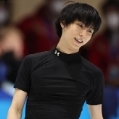
Recommended Posts
Create an account or sign in to comment
You need to be a member in order to leave a comment
Create an account
Sign up for a new account in our community. It's easy!
Register a new accountSign in
Already have an account? Sign in here.
Sign In Now