yuzurujenn Posted December 19, 2024 Posted December 19, 2024 Info: https://www.yamakei.co.jp/products/2824550260.html "Kogaito is a photographer who tries to capture the inner side of his subjects" - Yuzuru Hanyu (from this book) This book features beautiful gravure photos taken especially for this book! Don't miss Yuzuru Hanyu's monologue! Yuzuru Hanyu, who won consecutive Olympic gold medals in men's singles figure skating and continues to shine as a solitary figure even after turning professional. And there is Sports Nippon Newspaper's Kogaito Yoshiki, who has been following Hanyu through his lens and is known as the "god photographer" for his highly artistic photographic expression. Their encounter has dramatically changed figure skating photography in sports journalism. Kogaito's figure skating photos stand apart from the traditional "standard" sports photos. With his fresh sensibility, he creates captivating images. His unique "Kogaito Blue," which emerged after much trial and error, brings out the transparency of Hanyu's presence and has gained immense support from fans. Kogaito passionately stated in an interview, "The world that Hanyu expresses is not only what is visible. By imagining and interpreting what is not visible, I am able to capture the true essence of his performance." This insight into what fascinates Kogaito about Hanyu, along with his beautiful photographs, delves deep into the heart of Yuzuru Hanyu, through the words of sports writer Mitsuru Tanaka. Table of Contents: Photo Gallery Prologue Chapter 1: Indomitable Spirit 1.1 The 2014 Sochi Olympics, during the days covering the (Hanshin) Tigers 1.2 Stubbornly refused to shave his head for the baseball team 1.3 Rejection from joining the club, cancellation of job offer; a series of setbacks at Waseda University 1.4 The path to becoming a sports photographer 1.5 Wanting to take photos unlike anyone else's Chapter 2: Inner Conflict 2.1 After a year and a half of struggle in the editorial department, reassigned to the photography section 2.2 The initiation of a Tigers beat photographer 2.3 After a second stint covering the Tigers, finally heading to Tokyo 2.4 From desk duty at the Rio Olympics to covering the PyeongChang Olympics 2.5 A new "company photographer" in the figure skating world Chapter 3: Resistance 3.1 A photo position looking one year ahead 3.2 The "gaze" of the absolute champion omitted from the Tokyo edition 3.3 A fateful shot taken at the Autumn Classic 3.4 A “miraculous” shot capturing the champion, illuminated by wings 3.5 Photographs of the absolute champion beginning to transform Chapter 4: Determination 4.1 The absolute champion arrives at the PyeongChang rink 4.2 The fighting spirit shown by Hanyu as he draws a bow 4.3 A stunning short program conveyed through expression alone 4.4 Choosing a free-skate photo position based solely on belief in a gold medal 4.5 The moment of his second consecutive victory: The champion's expression beyond imagination Chapter 5: Individuality 5.1 A new era of sports journalism created by social media 5.2 The story behind the creation of a full-page, poster-style photograph 5.3 A “crossroads” in life with the absolute champion 5.4 Pursuing a unique style: "High-Key" and "Kogaito Blue" 5.5 Astonishing shooting scenes where even failures became pictures 5.6 Covering the World Championships despite the COVID-19 pandemic Chapter 6: Compassion 6.1 Hanyu's delicate and fleeting fighting spirit, dyed in blue 6.2 The athletes’ village mixed zone, where I quietly kept waiting 6.3 "Determination" and "solitude" conveyed through his back 6.4 A miraculous one-shot taken immediately after the free skate Chapter 7: Deepening 7.1 A flash of light! Thoughts of disaster-stricken areas that became particles of light 7.2 The sense of distance with the subject, Yuzuru Hanyu 7.3 A soft aura enveloping his determination 7.4 Able to take on any color! The intention behind photographing him in a white costume at the second anniversary of his professional career Special Feature: Yuzuru Hanyu's "Monologue" Exclusive Photoshoot In Place of an Afterword Cover Photo: Yoshiki Kogaito (Sports Nippon Newspaper Company) Stylist: Minako Orihara (Mi-knot Inc.) Styling Cooperation: Taketoshi Hara (Schtik Inc.) Hair & Makeup: Tomomi Kakizaki (Cap) Design: Minoru Suga Proofreading: Ichiro Toba Editor: Tatsuya Murao (Yama-kei Publishers) Author: Mitsuru Tanaka Associate Professor, Department of Sports Management, Shobi Gakuen University, Sports Writer. Born in Kyoto in 1978. Graduated from Waseda University, Faculty of Law. Completed the master's program in Sports Science at Waseda University Graduate School. After working at Sankei Shimbun, he is now in his current position. His specialty is sports media theory. He has covered professional baseball, MLB, figure skating, and more. His published works include 'Portrait of Yuzuru Hanyu' (Yama to Keikokusha), and he co-authored 'Children Who Don’t Play Sports' (Fusosha Shinsho), among others. Photographer: Yoshiki Kogaito Photographer at Sports Nippon Shimbun. Born in 1983 in Mie Prefecture. Graduated from Waseda University, Faculty of Human Sciences, Department of Sports Science. Photographs figure skating, soccer, baseball, etc. He has worked on photo books such as 'Y Yuzuru Hanyu Photo Collection' (Sports Nippon Shimbun) and 'Mao Asada Ice Show Everlasting33 Photo Collection'.
yuzurujenn Posted December 25, 2024 Author Posted December 25, 2024 *Machine translation. Inaccuracies exist* PROLOGUE “A fleeting moment of brilliance.” Spoiler October 18, 2024. This was the answer I received from figure skater Yuzuru Hanyu, who had just finished a photoshoot at a studio in the suburbs of Sendai, when I asked him what he expected from being a subject in a photograph. “In figure skating, a performance is expressed as a 'line,' formed by a series of intricate movements. Photography, on the other hand, cuts out a single instant from that continuous motion as a 'point.' At times, this can even appear ruthless. Flaws that might be concealed within the flow of a “line” can be exposed when captured as a single 'point.'” Yet in Hanyu’s performances, no matter which instant is captured, there is always “expression,” always something that reaches the level of “art.” That is the honest impression from the photographer who has always aimed his camera at Yuzuru Hanyu. From the interview with Hanyu that I was given the opportunity to conduct for this book, I came to realize that photographs of him, capturing a single fleeting moment, are inevitably formed in that way. Hanyu said: "Even if figure skating has beauty as a ‘line,’ if you break it down into very fine segments, each moment is nothing more than a ‘point,’ right? And even those ‘points’ are a continuous series of movements, like tiny particles. No matter how small and particle-like those ‘points’ are, I want all of them to be cool and beautiful, forming a single ‘line.’ If you think about it, time is the same. We tend to perceive it as a ‘line’ connecting the past to the future, but in reality it is nothing more than a continuous series of ‘nows.’ So as a subject being photographed, my ideal is to look cool every time, no matter which moment is captured." —Do you have any particular mindset when you are in front of a camera lens? Even to the author’s vague question, Hanyu responded clearly: “To be in the best possible condition that the photographer wants to capture.” There are two photographs. One shows the absolute champion immediately after a battle, his body fueled by adrenaline and fighting spirit. His intense expression makes it clear that he overcame injury and successfully defended his place at the top. The other, a view of his back, captures a “solitary figure” who, after attempting an unprecedented ultra-difficult jump, has completed his battle with himself. These are photographs taken immediately after his free skate at the 2018 PyeongChang Olympics, where he secured back-to-back Olympic titles for the first time in 66 years in men’s singles, and during the Beijing Winter Olympics, when the International Skating Union (ISU) officially recognized the quadruple Axel (a 4.5-rotation jump) as a competitive element for the first time in history. Both images were taken by sports photographer Yoshiki Kogaito of the Sports Nippon newspaper (Sponichi). At both the Pyeongchang and Beijing Olympics, he continued to point his lens, determined not to miss a single "moment" of the champion. The caption of the first photo reads: “‘I won!!’ Roar of gold medal victory” (Hanyu erupts in joy after finishing his free skate in the men’s individual event at PyeongChang. He wins gold, becoming the first man in 66 years to win back-to-back Olympic titles and earning Japan’s first gold of the Games, energizing the Japanese team = Gangneung Ice Arena, South Korea, February 17.) This photo also won the 2018 Tokyo Press Photographers Association Sports Division Award (Overseas). However, Kogaito pays no attention to external recognition. What matters to him is whether he has taken a photograph he himself can accept, nothing more. Could it have been better? Was the shooting position optimal? Was the color balance right? Because he never feels he has truly captured Hanyu at his “best,” he has never once been satisfied with his own work. That is why he continues to aim for the next photograph to be the best one yet. Kogaito arrives at interview venues ahead of other photographers, waiting with his camera even in places where no one else comes. He questions existing photographs and constantly asks himself, “Isn’t there another way to capture this?” Hanyu was aware of Kogaito’s unwavering stance. During the interview, I had assumed that Hanyu would avoid commenting on a single photographer, given the potential impact of such remarks. However, speaking naturally, Hanyu said this about Kogaito: “Among sports photographers, I really felt that he was the type who leans more toward an artistic style, someone who brings out their own unique color in their work,” he said. Beside him, Kogaito smiled shyly, looking embarrassed. Hanyu continued without hesitation. “There aren’t many like that. Newspaper photographers tend to end up taking more news-style photos, you know? I’m not sure if ‘ignoring that’ is the right way to put it,” (Kogaito nodded when Hanyu looked at him), “but I always felt he had a very strong desire to photograph the scenes and moments he himself thought were good, in his own way.” That was exactly the case. After graduating from university, Kogaito joined Sponichi (a sports newspaper), and never attempted to produce the so-called “standard” photographs that had long been the norm in sports reporting. As a result, his resistance to established conventions likely made him somewhat difficult to handle as an employee. In a newspaper’s photography department, editors wait for photographers to submit their images for publication. What would happen if photographs that deviated from the conventional “standard” format arrived? A fateful encounter awaited Kogaito, who stood outside the bounds of “common sense.” The subject he kept pointing his lens at was Yuzuru Hanyu. In addition to his overwhelming strength as an absolute champion in competition, he occasionally revealed graceful, delicate expressions, and his finely trained body was not merely steel-like, but also possessed a certain softness. The impression of “transparency” fit him perfectly, as he radiated a presence that transcended the boundaries of sport. Even figure skating had its own “standard” photographs. These were shots of jump positions, spins, and other poses that made it immediately clear to readers which sport they were looking at. To achieve this, one of the conditions of such “standard” images was that the subject’s entire body, including the skates, had to be captured in the frame. At figure skating events, in addition to newspaper photojournalists, there are also freelance photographers working for specialized magazines. Top-tier freelance photographers enjoy immense popularity among fans. Their approach, distinct from news photography, freely expresses figure skating through the “filter” of the lens, and is highly regarded. Kogaito began to have doubts. “Is it really fine for figure skating photos in sports newspapers to stay the same as before? As a photographer living in the era of Yuzuru Hanyu, is it enough to simply take ‘standard’ photographs?” That single step led to a major transformation. With smartphones and tablets now widely used across all generations, the shift away from print has become even more severe. It has long been said that “newspapers no longer sell.” In such a climate, one particular sports newspaper stands out. The morning after Hanyu, who had turned professional as a skater, opened his ice show to the media, sports newspapers across the board featured him in double-page spreads. While the articles were noteworthy, the main focus was a single image captured from the show. It is said that the vast majority of Hanyu’s fans are women. Sports newspapers are typically filled with coverage of sports favored by middle-aged and older men, such as professional baseball, Major League Baseball, soccer, golf, sumo wrestling, and even public gambling (horse racing, keirin cycling, boat racing, and auto racing). Normally, this would not appeal to Hanyu’s fanbase. However, the day after Hanyu’s public practices, solo performances, or ice shows in which he appears are made available to the media, sports newspapers sell out at convenience stores and station kiosks around major terminal stations in the host city. Fans' interest lies not so much in the articles, but rather in the photographs of Hanyu published in the newspapers. Sports Nippon (Sponichi) is particularly popular. Fans are drawn to the beautiful shots that capture Hanyu’s expressions and physique, as well as the “transparency” characteristic of his image. These are photographs by Yoshiki Kogaito, who became Sponichi’s “exclusive photographer for Hanyu.” Having challenged the status quo, he eventually came to be called a “god” among fans. Today, even within media circles, Kogaito is widely recognized as the “god photographer.” Sports reporting in print media is broadly divided into two roles: “reporters,” who write the articles, and “photographers,” who capture images on site. For reporters, “pre-interview research” determines the quality of an article. From interviews and press conferences already conducted with the subject, they extract memorable words, and also interview coaches and others around them, incorporating into the manuscript the unseen efforts and trajectory of the athlete—things the athlete themselves may not speak about—in order to convey them to readers. When enough anecdotes are gathered through “pre-interview research,” they are woven into the article for the day, and by adding results and circumstances, the framework of the article is formed. In contrast, what is required of photographers can be said to come down to a single point: whether they were able to press the shutter without missing the fleeting moment as it happened. While reporters can later revisit and re-ask questions, photographers cannot retake a moment that has already happened in the field. Under such pressure, what is Yoshiki Kogaito’s pride as a photographer, having consistently produced photographs highly praised by fans? How did his encounter with Hanyu change his approach as a photographer? And how did he continue to direct his lens toward the brilliance that Hanyu radiated? My motivation for writing this book was to explore "Yuzuru Hanyu as captured by the god photographer," through carefully selected shots from the countless photographs he had accumulated. As I wrote in my previous work, "Portrait of Yuzuru Hanyu II: 4,000 Days of an Absolute Champion as Seen by a Reporter" (published by Yama to Keikoku Sha), I began covering figure skating in the autumn of 2011, when I was working at the Sankei Shimbun. At that time, figure skating coverage in Japan was still largely focused on female skaters. As men’s figure skating grew in popularity, Hanyu emerged like a comet, and men’s skating shifted from an era of many highly competitive top contenders to one defined by a single “absolute champion.” During this period, the mass media, including general newspapers and sports papers, competed through writing. The challenge was how to express skaters on the ice. The main focus was text, while photographs were little more than “supplements.” However, with Kogaito’s emergence, Sponichi’s pages began to undergo a transformation. This was also supported by the strong backing of Yutaka Nagakubo, then head of the photography department, who had long served as a behind-the-scenes pillar supporting Sponichi’s figure skating photography. They introduced a new approach, shifting from the traditional model of “selling through words” to “selling through photographs.” During my time at the Sankei Shimbun, I even felt a sense of envy toward Sponichi’s strategy. Kogaito’s photographs, published in the newspaper and shared on social media, captured Hanyu’s transparency and emotions in a single, fleeting shot. My relationship with Kogaito was limited to exchanging greetings when we met in the field. He was smart, polite, and never pushy. He was quiet and rarely seemed to engage in small talk with other reporters or photographers. In that sense, Kogaito was also a man who was difficult to read. When I conceived the idea for this book, I wasn’t sure he would agree. However, when I explained my intentions, he readily agreed, saying, “That’s a wonderful offer. I’d be happy to cooperate.” I was surprised when I heard about Kogaito’s path since he first set out to become a press photographer. He had by no means taken an elite career path. During interviews, he said this many times: “I don’t have any talent as a photographer.” However, he is stubborn to the point of refusing to conform to the photographers around him. Whenever there is a photograph that has been regarded as good in the past, he maintains his stance of trying to surpass that evaluation from a different angle. He prioritizes giving 100% to his subject over company evaluations. From an organizational perspective, he is by no means an easy photographer to deal with. Having worked for a newspaper myself, I understand this well. So-called “difficult people” are a nuisance, whether they are reporters or photographers. There have been many cases of talented individuals who, despite their abilities, end up being sidelined from the field. In a different era, Kogaito might not have been an exception. However, he encountered Yuzuru Hanyu, the darling of his time and an absolute champion. In the world of figure skating, where sport and art are said to merge, when the “solitary skater” who rose beyond the boundaries of competition to become an absolute presence became his subject, there was a brilliance that conventional figure skating news photography could not match. Seeing Hanyu allowed Kogaito to break free from his own preconceptions. "In the presence of such a skater, in front of Hanyu who continues to take on countless challenges, I can't afford to play it safe." Removing his own limitations, the solitary photographer resolved to take photographs that defied conventional wisdom, photographs that no one else could take. How did Kogaito transform “standard” photographs into images described as “divine”? There were numerous hurdles he had to overcome, both within himself and within Sponichi. This book reveals the details of these challenges. Here lies the life story of a photographer who devoted himself entirely to sports reporting. Please note that honorifics for individuals have been omitted in the main text. In addition, Yuzuru Hanyu is generally referred to without honorifics; however, in the spoken comments of Yoshiki Kogaito and others, he is referred to as “-senshu” (athlete) during his competitive career, and as “-san” after turning professional.
yuzurujenn Posted December 26, 2024 Author Posted December 26, 2024 *Machine translation. Inaccuracies exist* Source: https://weibo.com/1746783312/P5bA7do5T https://weibo.com/1746783312/P5kqt88ne https://weibo.com/1746783312/P5qnA6vJN Excerpts about Yuzu’s sensibility as a subject of photography Spoiler The special photoshoot for Kogaito's book (written by Mitsuru Tanaka) took place on October 18, 2024, in Sendai. The photographer's request for the shoot was "sculptural imagery." "I've always felt that the images created by Hanyu with his body are like those classic sculptural works. With this concept in mind, I wanted to use the imagery of sculptures displayed in an art museum for this shoot." Yuzuru quickly understood the photographer's intention with just the request for "sculptural imagery," and posed one after another. The photoshoot took place in a completely quiet environment and took about half an hour. During the shoot, Hanyu was playing a piano piece by Ryuichi Sakamoto in his mind (though it wasn’t specified which piece). ----------------------------------------------------------------------------------------------- "In front of photographers who want to take life-size photos of me, I show myself in a natural state, without hiding anything in front of the camera. In a sense, it feels like peeking into Yuzuru Hanyu's private life. However, in front of photographers who want to capture Yuzuru Hanyu skating, I want them to see me immersed in the world of the program. There are also photographers who focus their lens on my inner self, or what could be considered the core of my being. Of course, this will vary depending on the shooting scenario, but basically, I adjust my state as the subject according to the photographer's goals and ideas." ----------------------------------------------------------------------------------------------- When Yuzuru Hanyu faces the camera as a subject, the sensitivity cultivated through figure skating is vividly reflected. "Both the changes in awareness and atmosphere are shared with what has been cultivated in figure skating. How to integrate and align with different music in different programs, in that sense, I think photography and figure skating are very similar." On the other hand, in figure skating, as a performer, Hanyu takes an active and subjective approach to his performance, facing an audience. During his competitive era, he also had to consider the judges. So, when Hanyu, as the subject of a photograph, faces the camera, is it a proactive engagement with the lens, or a passive confrontation with the lens that is focused on him? "Hmm," Hanyu paused and shared his thoughts. "How should I put this? Actually, figure skating is like that too. Sometimes, I perform with the image of being objectively observed from the outside (from the perspective of the audience and judges). When performing, I often think, 'What kind of feeling will I present if I look at myself from the outside?' And when I am being photographed, do I have the same feeling?" "Even though figure skating is initiated by me, there is indeed a part of me that stands in the position of the receiver. Although the balance between objectivity and subjectivity, and between active and passive may vary depending on the program, in terms of capturing a moment, it still seems to be an extension of figure skating. "Of course, as I said earlier, when the camera seems to be peeking into my heart, I try not to observe myself from the outside. This might sound a bit abstract, but I feel that in those moments, the photographer is capturing not just my appearance, but my soul as well. So, at those times, it might be closer to completely exposing my untamed side." Unlike the photography in a studio, as a figure skater, Hanyu performs in front of countless cameras. There are moments when he might want to relax. His focus might waver for a brief moment. However, Kogaito says, "Hanyu can always turn into a 'painting' at any time." If that's the case, does Hanyu constantly face countless cameras with heightened awareness? His unexpected response made me nod in agreement. "During a competition, I am not performing for the camera. In my competitive years, my awareness was directed towards the 10 judges. When the judges saw my body from the front, the angle from each of their positions would be around 120 degrees. I performed with the awareness that no matter from which angle they looked at me, it would look great. Now, as a professional, my awareness has become even stronger. For the people watching me, whether they are the audience or the photographers, my goal is to make sure that from any angle, 360 degrees, the performance looks great. As for photos, I believe the photographer captures a moment in a positive sense. So, I also have a feeling that I rely on the photographer’s skill while performing." Although Hanyu is the subject of the photos, he understands photography quite well. During the interview, he also mentioned technical terms. "The ISO sensitivity of the photos, the tone, and the white balance are all influenced by the photographer's preferences, which can vary. You can tell by looking at the photos. Sense is different for each person. For me, there are moments in the program where I hope to capture specific scenes. For example, in SEIMEI, it's the moment when the taiko drum beats 'boom,' and I open my arms and widen my eyes. But depending on the photographer's preferences, some might choose to capture the moment I raise my arms, or others might prefer the dynamic sense of motion. Some photographers might choose to capture the perfect stillness of the hydroblading pose, while for 'notte,' there are those who capture my reflection in the ice, which looks like a calm lake." The different photographers capture a particular "moment" in the performance, which can only be seen at a specific point in time and from a certain angle along the "line" of figure skating. What I always focus on is ensuring that the performance is great from every angle, 360 degrees, no matter where it's viewed from. However, depending on the position of the observer, what they see will be different. And depending on each viewer's individual sensibility, their reception of the performance will also vary. Source: https://weibo.com/6473801248/P5CDvDUZ6 Excerpt about Kogaito's attention to detail Spoiler "Remembering Hanyu’s choreography and deciding in advance the shots I want to take is the 'standard practice' for photographing figure skating. However, I want to capture the spontaneous, improvisational movements of Hanyu that only happen during that specific performance. While there are iconic moves, like hydroblading, there are also many subtle differences in the choreography each time, and that’s what makes Hanyu’s performance unique. If I can capture a move that the audience has never seen before, I believe that will naturally become the most impressive photo of the day." Regarding Kogaito’s attention to detail and his pursuit of capturing "the most brilliant moment of the day," Hanyu expressed his admiration: "In figure skating, where the entire space — left and right, up and down, forward and backward — is used for expression, with both the X, Y, and Z axes involved, I think Kogaito is the kind of photographer who makes you feel, 'Wow, this moment is really cool.' So, it makes me happy that Kogaito is willing to capture the moments he finds 'really good' and 'amazing.'" While being interviewed, Kogaito showed a nervous expression. Noticing this, Hanyu teasingly said: "I've been praising you non-stop!" During the interview, Hanyu described Kogaito as "a photographer who captures the inner core of a person." This statement deeply resonated with Kogaito. Throughout the interview, he seemed particularly concerned about how Hanyu viewed his photos of him. (Excerpt omitted) As introduced earlier in this book, Kogaito tries to communicate with his subject, Hanyu, through his photography. Therefore, he believes Hanyu’s evaluation of his photos is everything. The phrase "a photographer who captures the inner core" contains the best answer Kogaito had been searching for all along.
yuzurujenn Posted December 27, 2024 Author Posted December 27, 2024 Source: https://weibo.com/3406979710/5112353350486583 https://weibo.com/6473801248/P5Ch5dQFo https://weibo.com/3406979710/5112364982865505 https://weibo.com/3406979710/5112372761462522 https://weibo.com/6473801248/5112653044778645 Other Excerpts pt 1 - Kogaito Blue, 2019-2021 Spoiler Kogaito’s considerations in capturing the transparent quality of Hanyu's skin The ice surface reflects light, making objects appear to glow. Therefore, when photographing athletes on the ice, the brightness of the surface can make their figures look dark. If brightness is adjusted, the skin tones and overall photo will appear yellowish. In Kogaito’s view, this doesn’t correctly reflect the "transparency" of Hanyu’s skin: "For a photographer, the basic theory is to faithfully recreate the scene through the lens, but if I can’t capture Hanyu’s transparency, it would be like violating that principle." As a result, Kogaito chose to prioritize faithfully recreating the "transparency" of Hanyu's skin and thought of using high exposure to brighten the overall colour of the image. In the world of photography, overexposure is typically considered an error, but with this setting, the resulting image of Hanyu made his skin tone appear closer to his naturally translucent fair complexion. This is why Kogaito prefers to use overexposure when photographing Hanyu. Additionally, news agency photographers must faithfully reproduce the colours of a scene. During photo reporting, a photography assistant holds a white sheet in front of the camera to allow the photographer to adjust the settings and ensure the white in the image is true white. However, Kogaito sets his camera to make white appear blue, as this better conveys Hanyu’s sense of transparency. By adding a layer of blue tones, the photos more closely resemble Hanyu’s skin transparency, with the rest of the image also taking on a faint blue tint. 2019 GP: At the 2019 Grand Prix in Canada, Kogaito encountered an unexpected event. After the press conference, Kogaito waited in the hallway where the athletes would leave, holding a camera. While other photographers chose to shoot Yuzuru Hanyu during the press conference, Kogaito, after taking some shots from various angles, left the conference room. When he saw the lights illuminating the hallway, the varying strengths of the light and the background inspired his creativity. "I thought that if I could capture a shot of Hanyu walking through, it would definitely make for a very cool photo." After the press conference ended, Hanyu appeared. Just as Kogaito was ready to press the shutter, Hanyu, who was gradually approaching, suddenly spoke to him: "Your photos of (other figure skaters, names mentioned) are really beautiful!" Kogaito never expected to have the opportunity to speak with Hanyu. To him, Hanyu was like the sun, and he himself was merely a sunspot, just another photographer capturing Hanyu’s image through the lens.Even if Hanyu’s gaze lingered on one of the photos, Kogaito thought it was impossible that Hanyu would recognize his face or name. However, it was clear that Hanyu had recognized him and approached him to speak. For a moment, his hand froze on the shutter button. "Even though I’m older than him, it’s embarrassing to admit that I was so nervous I became completely stiff... My heart was pounding, my pulse racing, emotions soaring. I didn’t even know what was going on, but that’s just how it felt (laughs)." Facing Hanyu, who stopped and smiled as he spoke to him, Kogaito couldn’t think of anything clever to say in response. "I just said 'thank you.' Honestly, just managing to say that one word was all I could do." As for why Hanyu mentioned other skaters' names, Kogaito confidently said: "I think those who know Hanyu’s personality will understand. Hanyu is not likely to say things like ‘my photos are so cool’. It is his style to deliberately praise other skaters’ photos! Moreover, Hanyu not only looked at his own photos, but also looked at the photos of other skaters. I was so moved! As a photographer, his words are a huge motivation for me to keep working hard!" Kogaito’s experience at the 2020 All Japan Championships: Due to the pandemic, the 2020 All Japan Championships used a system where media outlets were assigned quotas and selected representatives to take photographs. Kogaito was chosen. However, being selected as the representative photographer meant that the photos needed to be suitable for use by all collaborating media, so they couldn’t emphasize individuality. Despite this, Kogaito decided to forgo compromise and continued to shoot using his signature method of overexposure and blue tones. On the first day the photos were sent out to various media agencies, Sponichi received complaints from other collaborating media because the photos provided by Kogaito didn’t align with the expectations of other outlets, especially non-sports media and local media, for what a sports photo should look like. Kogaito said: "Because I was the representative photographer, I had to consider my colleagues in the media, but I couldn’t give up Hanyu’s transparency. I just couldn’t do it." "The colours that would work for an ordinary people just don't work when photographing Hanyu. But this point is always hard to convey. When I was asked 'Why is the portrait so white?' I was really frustrated." 2021 Worlds & Covid-19: The 2021 World Championships were scheduled to be held in Stockholm, the capital of Sweden, and Hanyu decided to participate. Kogaito also applied to be on-site to take photos, but at that time, the management at Sponichi expressed concerns about the infection risks associated with staff travel and was unsure whether the Swedish government would issue entry permits. In this context, Kogaito looked into various ways to travel to Sweden, including entering via Qatar or Finland. The entry requirements published by Sweden at the time stated that a special reason for entry needed to be provided. Since it was unclear whether reporting work would qualify, Kogaito wrote "short-term language study" as his reason for entry and also looked into language schools in Sweden. At that time, some freelance photographers had already made preparations to depart, and the Yomiuri Shimbun, another news organization, was also planning to send a photographer. Sponichi had decided not to send a reporter but was still deliberating whether to send Kogaito. Despite the delay in decision-making, Kogaito told his former boss, Nagakubo, "Even if I resign from Sponichi, I still want to go to the event." From the chapter "慈爱" (Compassion) regarding the two photos of Yuzuru Hanyu: In the 2021 All Japan Championships, Kogaito had an especially deep impression of Hanyu’s performance. It was his first competition of the season, an unexpected event, and it was also the competition that would decide the Beijing Olympic participation slots. Under such immense pressure, how would Hanyu show his competitive spirit? However, what he displayed was a demeanour that was the complete opposite of fierce determination—an ethereal expression. Kogaito said, "As a figure about to face battle, he looked so fragile and ethereal, almost heartbreaking…" Kogaito’s photos have a tone known as "Kogaito Blue." Regarding this, he explained: "You could say that it’s Hanyu who turned my photos blue. When I create images that suit him, the photos gradually take on a blue hue. It’s not that everything I photograph turns blue; sometimes I aim for a red tone. But during my time with Hanyu, the blue just naturally emerged in my mind. I also thought about why blue suits Hanyu so well. I think it’s because of his posture when he stands there, along with the atmosphere of his performances—so touching, fragile, and almost as if he could disappear at any moment. But at the same time, he radiates a powerful, undeniable presence. When I thought about how to capture that in a photo, I realized that blue was the most fitting colour." Regarding the fighting spirit that envelops Hanyu, he said something very interesting: "Hanyu always displays a seething, blazing fighting spirit, but how should I put it, I feel that this fighting spirit is not 'yang' energy. It's not that red, burning feeling; rather, it's somewhat suppressed. Instead of a fully released fighting spirit, it’s more like it burns in a quiet way.” These two photos were meant to showcase Hanyu’s unique ethereal, serene, deep blue quality, while still embodying a fiercely passionate fighting spirit—his "battle stance."
yuzurujenn Posted December 27, 2024 Author Posted December 27, 2024 Source: https://weibo.com/6473801248/5113031319358140 https://weibo.com/7848586779/P5K9DwMpk Other Excerpts pt 2 - About 2022 Beijing Olympics Spoiler Featuring the touching and somewhat humorous episode of Kogaito waiting for Yuzu in the snow: During the Olympics, there was a mixed zone outside the Olympic Village where athletes and related personnel were accommodated. Photography was allowed here. From this spot, several hundred meters away, was the area the athletes would pass through after they arrived. He was very aware that the chances of capturing a photo of Yuzuru Hanyu were slim. But as long as there was even the slightest possibility, he didn’t want to miss that moment. On the 4th and 5th before the competition, Kogaito always came here. It often snowed, and he would stand there in thick clothing, enduring the sub-zero temperatures. Sometimes there would be other photographers and reporters from different news outlets, but when no one else was around, he would stand alone, waiting with his 600mm telephoto lens for that moment. "Aren't you going to do anything else? Why are you just standing here?" a female staff member curiously asked. "I'm waiting for Yuzuru Hanyu!" he replied. The staff member nodded in understanding and said, "You're gambling on the chance of photographing a superstar! I hope you succeed!" She smiled and encouraged him. For a photographer, when the subject doesn’t show up, it’s called “waiting in vain.” Day after day, the “empty wait” continued. "It seems like he’s not coming today either." His conversations with the female staff member slowly faded. Nevertheless, believing in that small possibility and waiting was part of the job. He checked all the flights that had arrived in Beijing, calculated the travel times, and estimated that Hanyu might pass through this area sometime between the evening and 7 PM. Once he thought of it this way, he miraculously stopped feeling tired. Other photographers from different outlets had already started shooting other events at the Olympic venues, but since Kogaito was the only photographer from Sponichi assigned to Beijing, during his wait for Hanyu, Sponichi didn’t receive any photos from Beijing. About 4A Did he succeed...? However, in the next moment, Hanyu's right ankle injury finally gave way, and he collapsed onto the ice. His right ankle had already been overstrained. During the official practice the previous day, he had fallen while attempting a quadruple jump, resulting in a sprained ankle. Despite being advised to rest for ten days, he concealed the injury by using painkillers and insisted on taking to the ice for his free skate. This highly difficult manoeuvre, which embodied the king’s will and pride, was not fully successful, but Hanyu made a historic attempt on the ice. His quadruple Axel was officially recognized by the International Skating Union (ISU) as a technical element, making him the first athlete in figure skating history to attempt this jump. But this was not the end of the performance. Hanyu's expression was full of determination. He quickly got back up, and his eyes revealed a resolve: no matter what happened, he would complete his performance of Heaven & Earth. Even though the gold medal was now out of reach, that no longer mattered. Kogaito, fully focused, pressed the shutter, and his heart swelled with excitement and emotion. "Hanyu was determined to finish the program, and I couldn’t relax because of the result of the quadruple Axel. I told myself not only to capture this moment in full, but also to precisely capture every detail that came after, because this was the most important part of Hanyu’s story." Hanyu poured his soul into the free skate. On the ice, he gazed up at the sky for a long time, lost in silence. In a subsequent interview, he shared the emotions deep within him: "That movement symbolized ‘heaven’ in Heaven & Earth, and it expressed the image of my soul rising to the heavens. Actually, when I was 9 and skating to ‘From Russia with Love’, the final move was the same. The past me and the present me overlapped, and many complicated emotions stirred within me. It wasn’t until I finished that movement, ‘sheathing my sword,’ and left the ice that I felt it was the complete story of my performance." After completing the symbolic gesture, Yuzuru returned to the edge of the rink and gently touched the ice. He then cupped the ice particles in his hands and brought them to his face, as if thanking the rink, and perhaps also marking the end of his own story. As Kogaito continued to press the shutter, a sense of regret surged within him: "If I had been in the ideal photographic position, I would have been able to capture Hanyu’s expression more clearly. Perhaps even the strength with which he clenched his fist, or the ice particles left in his hand. That moment could have been portrayed in a more delicate and perfect way." At the PyeongChang Winter Olympics, Kogaito had captured the moment Yuzuru raised his arm in victory after winning the gold. But this time at the Beijing Winter Olympics, his lens recorded the story of this champion from the ‘back’.
yuzurujenn Posted December 27, 2024 Author Posted December 27, 2024 Source: https://weibo.com/7848586779/P5KjPiB3T https://weibo.com/7848586779/P5M21rKVI https://weibo.com/3406979710/5112742656606736 Other Excerpts pt 3 - After turning professional Spoiler What a warm angel! Regarding that SharePractice of Yuzuru Hanyu, Kogaito particularly mentioned a scene that left a deep impression on him: "In the live broadcast, viewers flooded the comments, and Hanyu smiled when he saw all the comments coming in. I remember it was near the end of the practice, and as he looked at the comments, he seemed to be softly saying something. He covered his mouth with his left hand, joyfully chasing after the comments. This scene symbolized the interaction between him and his fans, and it was one of the highlights of the event. So, I published this photo of Yuzuru in colour on the page." Soon after, Kogaito received a surprising invitation—to be the official photographer for the ice show notte stellata, which would be held in Hanyu’s hometown of Miyagi Prefecture in March 2023. "Although I was the official photographer, the organizers didn’t impose many restrictions. They told me, 'We want you to take photos in your own style, feel free to express yourself.' Hearing such an invitation was truly shocking. At the same time, because the theme of the ice show involved 'earthquake disaster,' I felt a huge amount of pressure. But if my photos can convey Hanyu's charm, I would be immensely grateful. I know that I’m not the main character; my role is to use my camera to convey Hanyu’s story to those who follow him." Being the official photographer, a role that goes beyond traditional reporting, was a precious experience for Kogaito, allowing him to expand his horizons. "I feel like this gave me the opportunity to step onto a new stage, which filled me with great anticipation." In the past, Hanyu was always the subject of reports, and there seemed to be an "invisible wall" between them. However, being the official photographer meant crossing that "wall" and entering a different level. Kogaito described it: "In this new position, I’m no longer just an external observer. I now feel like I am helping to create this performance together with him. From this perspective, I also realized that I am part of this ice show." The time and opportunities for shooting increased many times over compared to the past. He was able to observe Hanyu more closely and learn more new details, which made him, as a photographer, even more eager to capture Hanyu’s charm. During this collaboration, there was one particular moment that Kogaito will never forget. During the rehearsal for the ice show, Hanyu proactively approached Kogaito, who was photographing. The show featured a performance between Hanyu and Kohei Uchimura, who is known as the "King of Gymnastics." Hanyu specifically asked about details of the performance, particularly about the visual effects of the curtain behind Uchimura's performance area, and asked for Kogaito’s opinion. Such interaction not only surprised Kogaito, but also made him feel that his role in the ice show was more than just that of a recorder. He was part of the entire creative process. This deeper involvement made him more invested in his task and gave him a deeper understanding of Hanyu’s story. "Will this scene be captured clearly?" In response to Hanyu's question, Kogaito honestly replied, "The brightness difference between the ice and the curtain is too great, it’s hard to capture it clearly." Hanyu responded with professional photography terminology, "It’s an issue of exposure difference." From this exchange, Kogaito deeply felt how much Hanyu, as the director, was paying attention to the details of the entire performance. He was not only concerned about his own performance but also considering the presentation of the entire ice show from all angles. Centered around Hanyu, the other skaters also blended into the performance, creating a highly accomplished show. Kogaito focused on using his camera to turn this wonderful ice show into a series of moving photographic works. SOI 2023 During the 2023 SOI Ice Show, Kogaito, as the official photographer, decided to capture behind-the-scenes images of Hanyu. Beforehand, he was conflicted about whether his presence would affect Hanyu, intruding into a side of him that he didn’t show to the public. However, when he finally started shooting, he realized that the backstage Hanyu was completely consistent with the public-facing Hanyu. From warm-up to the opening of the performance, all the way to the end, there was no "off" state. Hanyu was always fully engaged, and no moment was unsuitable to be seen. Even backstage, where normally no one would pay attention, Hanyu unconsciously carried an awareness of being observed, and every movement was worthy of being captured. Notte & Danny Boy Another miraculous work, Danny Boy. The glowing light dots from fans' wristbands perfectly match the ice show theme, “A Sky Full of Stars”! Kogaito paid special attention to Hanyu's new program, Danny Boy. "I personally feel that Hanyu is very well-suited to piano pieces. Since Introduction and Rondo Capriccioso, it’s been a long time since he performed a piano piece. Therefore, I had very high expectations for this program." During the rehearsal, Kogaito briefly exchanged pleasantries with Hanyu. He didn’t say much because he believed it was more appropriate to maintain a proper distance between himself and the subject. In the field of sports journalism, many media professionals enjoy forming personal relationships with athletes, even taking pride in it: "I’ve had meals with a certain athlete." "I have a great relationship with a particular competitor." Kogaito, however, is not interested in such practices. "Perhaps I lack that effort to actively get closer. So, I don’t deny journalists or photographers who build relationships through personal contact. However, I believe there is another way for performers and photographers to communicate—through the work itself. Through my photos, I want the subject to understand and recognize me. This is the kind of exchange I’m aiming for." For Hanyu, who is often referred to as the "Sun," Kogaito always maintains boundaries. He doesn’t want to step into areas outside of figure skating. He feels that the photos he takes may not always be the best, but if Hanyu can recognize him through them, that is enough. Therefore, even in the rehearsal space where official photographers can move freely, he remained silent, focused entirely on the camera, and shot every frame with utmost dedication. Regarding Danny Boy, Kogaito began thinking about how to capture the unique aura that Hanyu radiates while wearing his pure white costume, considering angles and composition. Once the performance officially began, an unexpected image became the key inspiration. In the opening program notte stellata, countless tiny light points appeared behind Hanyu. These points of light came from glowing wristbands held by the audience. "I didn’t know such a scene would happen during the rehearsal. I never expected such beautiful light to pour down from the audience." These unexpected glimmers added a new dimension to Kogaito’s lens, allowing him to capture a moment that was both dreamlike and emotional. This not only showcased Hanyu’s stage charm but also perfectly matched the ice show theme, "A Sky Full of Stars." Each of those light points may not have been particularly bright, much like the faint stars in the distant night sky. However, when the light from numerous fans gathered together, it resembled "A Sky Full of Stars," enveloping Hanyu in a soft, twinkling glow. Behind Hanyu, a large spotlight shone like a full moon. Typically, on a full moon night, the stars are obscured. However, the light points from the fans seemed to create a starry sky under the full moon. This scene became the best photographic spot inspired by notte stellata. One year later, the fans in the audience created another "A Sky Full of Stars" with their light, as if responding to the starlight that Hanyu had presented the year before. Kogaito recalled: "This is my imagination, but I think that for Hanyu, that 'sky full of stars' may be the presence of fans. After the Great East Japan Earthquake, he might not have been able to continue his beloved figure skating. But in the night sky of the evacuation center, he saw a ‘sky full of stars,’ which seemed to infuse him with the light of hope, almost like guiding the direction of his future. Now, in his professional career, Hanyu has faced many challenges, but the constant support of his fans has turned into "sky full of stars" and always surrounds him. In the photos from that day, I felt this scene—like a response from the fans to the ‘sky full of stars’ created by Hanyu a year ago." Kogaito has his own creed when it comes to photography: by capturing every movement and expression of Hanyu, the audience can naturally feel his emotions and expression. Therefore, he believes that Hanyu’s response to the fans’ "A Sky Full of Stars" is not accidental. Furthermore, he noticed a change in Hanyu’s expression in his second year of professional career. "I felt a kind of loving tenderness. His expression was peaceful, and the entire performance seemed to wrap people in 'goodwill,' leaving a deep impression."
yuzurujenn Posted January 14, 2025 Author Posted January 14, 2025 Source: https://weibo.com/7848586779/P5M9GoGd9 Other Excerpts pt 4 - 2nd anniversary as a Professional Spoiler On July 12, 2024, Kogaito met Yuzuru Hanyu face-to-face in a photography studio in Sendai. This interview and photoshoot were to commemorate the two-year anniversary of Hanyu's transition to a professional figure skater, coinciding with a special feature by Sponichi. Kogaito worked alongside Hanyu's exclusive reporter, Hiroaki Yamato, to handle the task. Despite a very busy schedule, Hanyu made time to spend an hour and a half for interviews and a photoshoot with Sports Hochi and Sponichi. At the beginning of the session, Hanyu participated in a 10-minute joint interview, followed by 40 minutes with each media outlet for exclusive time. Sports Hochi focused on a more in-depth interview with Hanyu, while Sponichi allocated the remaining time entirely to Kogaito for a special photoshoot. For this session, Kogaito chose "white" as the theme for the photoshoot. The two-year milestone of Hanyu’s professional skating career is not only an important achievement but also marks the beginning of a new chapter in his third year. Hanyu continuously strives for evolution and embraces new challenges. In Kogaito's view, white symbolizes infinite possibilities; it can be infused with any colour, just as Hanyu continues to explore new areas in his skating career. Therefore, Kogaito chose "white" to represent Hanyu's state—both a starting point and a pure colour full of potential for creating a future. "White is the starting point and fusion of all colours, symbolizing the infinite potential and freedom Hanyu possesses. He can always assign new meanings to himself," Kogaito explained his photographic philosophy. This photoshoot not only documented Hanyu's professional journey over the past two years but also served as a pure and hopeful symbol for the start of his third year. To complement the white costume Hanyu wore, Kogaito personally selected white lace fabric. He carefully chose the lace at a fabric wholesale market in Nippori, Tokyo, to find the one that best suited Hanyu's image. After changing into the shoot costume, Hanyu stood face-to-face with Kogaito. This was the first time they had a 1-on-1 photoshoot since Hanyu's first year as a professional skater during the SharePractice event at Sendai Ice Rink. At that time, Hanyu had allocated exclusive time for each media outlet, and Kogaito was impressed by his creativity. During that photoshoot, Kogaito had suggested: "Like in The Phantom of the Opera or Masquerade, try placing your hand in front of your face." Upon hearing this, Hanyu immediately visualized the scene and struck several poses that met the request. Kogaito was amazed, saying, "He responded to my request with minimal direction and even showed me images beyond what I imagined." This time was no different. Once the set was ready, Hanyu asked, "Do you want a bright style?" Kogaito responded, "Please express a soft and profound feeling." Hanyu stood barefoot behind the white lace fabric, which hung from the ceiling. Following Kogaito's suggestion, he draped the lace over his head like a veil, partially obscuring his face, and responded to several specific shooting instructions. During the photoshoot, Hanyu also selected and played background music from his phone that matched the atmosphere, adding a layer of delicate emotional expression to the shoot. Through this photoshoot, Kogaito once again felt that Hanyu is not only a genius in figure skating but also possesses a strong sense of the camera and artistic expression. Every movement and glance he made accurately conveyed the photographer’s vision and even elevated it.
Martina Posted September 21, 2025 Posted September 21, 2025 On 12/25/2024 at 5:47 PM, yuzurujenn said: There are two photos here: one shows Hanyu, adrenaline fully flowing, posing as the absolute champion after completing his challenge. He shows a deeply serious expression, a moment where he overcame his injuries and was certain he could defend his honour. The other photo shows him from behind, challenging an unprecedented skill and ending his battle with himself, reflecting his solitary existence. The background of these photos corresponds to two monumental moments: the first, after his victory in the 2018 PyeongChang Olympics where he defended his Olympic title, a feat not accomplished in 66 years; the second, when the ISU recognised him for attempting the first-ever quadruple Axel at the Beijing Olympics. The photographer of both images was Kogaito of Sponichi. Hi, I bought the digital version of the book while I was in Japan. These are the photos mentioned in this passage. https://drive.google.com/file/d/1v1GUo2AwhCt8-SjkHye9Vn9zfwN7ckBa/view https://drive.google.com/file/d/1YYbqfpka2z9vdShg6t9F6akfBhkxUwT_/view I have no idea if there are better ways to share images on this site. I haven't read the other messages yet, so I don't know how complete your translation is, but I can always take more screenshots if needed.
yuzurujenn Posted Wednesday at 04:42 AM Author Posted Wednesday at 04:42 AM *Machine translation. Inaccuracies may exist* Chapter 1: Indomitable Spirit 1.1 The 2014 Sochi Olympics, during the days covering the (Hanshin) Tigers Spoiler February 14, 2014. In Sochi, Russia, a new chapter was written in the history of Japanese figure skating. Competing for Japan in the men's singles event at the Sochi Winter Olympics, Yuzuru Hanyu won the gold medal, becoming the first Japanese man ever to claim Olympic gold in figure skating. At 19 years and 69 days old, he was also the second-youngest men's Olympic figure skating champion in history. That season, Hanyu achieved his first victory at the Grand Prix (GP) Final held in Fukuoka in December 2013, surpassing Patrick Chan (Canada), who was a three-time world champion. He then secured victory at the All-Japan Championships at the end of the year, earning his place on the Olympic team. At the Sochi Olympics, he competed in the short program of the team event before the individual event. The team event, a new competition introduced at the Sochi Olympics, featured 10 teams competing in four disciplines: men's and women's singles, pairs, and ice dance. Representatives from each country/region competed to showcase their nation's overall strength. For Japan’s men’s team, besides Hanyu, Tatsuki Machida and Daisuke Takahashi were also selected. As a result, Hanyu competed in the short program and Machida in the free skate for the team event. In the men's short program of the team event, Hanyu competed on the same stage as his childhood idol, Russia's Evgeni Plushenko, and scored a remarkable 97.98 points, the highest overall. Riding that momentum into the individual event, he delivered a sensational performance to "Parisienne Walkways" in the short program. His score of 101.45 points not only made him the first skater in history to break the 100-point barrier in an ISU-sanctioned competition, but also set a new world-record score at the time. Going into the free skate in first place, he made some mistakes but still held off his challengers to claim the title. On March 11, 2011, Hanyu was practicing on the ice when the Great East Japan Earthquake struck, and he and his family were forced to live in an evacuation center. Even so, he continued to skate in the face of adversity. In March 2012, he won the bronze medal in his debut at the World Championships, establishing himself as a strong candidate for the Olympic team. The following season, he moved to Toronto, Canada, to train under Brian Orser. There, he refined his beautifully executed quadruple toe loop and Salchow, often regarded as textbook jumps, as well as his triple Axel (a triple-and-a-half rotation jump), known for its exceptional height and distance. During the 2014 Winter Olympics, Kogaito was busy working as a photographer covering the Hanshin Tigers baseball team at the Sponichi Osaka headquarters, far away from Sochi, Russia. Sports newspapers differ greatly between their Tokyo and Osaka editions. In the Osaka edition, regardless of the publisher—Sponichi, Nikkan Sports, Sankei Sports, or Daily Sports—the front page is, as a rule, dominated by coverage of the Hanshin Tigers. The only exception is Sports Hochi, which primarily focuses on the Yomiuri Giants. Unlike general newspapers delivered to homes, sports newspapers are not only distributed by subscription but also compete heavily in the “instant sales” market at station kiosks and convenience stores. Targeting mainly office workers, they are often quickly picked up during busy commutes, drawn in by eye-catching front-page headlines. The front page of a sports newspaper is, in effect, the “face” of that day’s edition. In the Kansai region, almost all readers are interested in the results and developments of the Hanshin Tigers. Reporters and photographers assigned to cover the Hanshin Tigers, who attract strong reader attention, are known as “toraban” (Tiger beat reporters). Top-tier reporters and photographers in this role often become well-known even among general readers. Kogaito was also one of these “toraban.” Day after day, he followed Hanshin news and kept pressing the shutter, aiming to capture photos worthy of the front page. Hanyu’s gold medal at the Sochi Olympics was featured day after day on news programs and sports broadcasts across Japan, especially in Tokyo, sparking a nationwide frenzy. However, Kogaito only has a faint memory of such excitement in Osaka. “It felt somehow distant, like something from another world,” he said. To reiterate, “toraban” reporters and photographers are among the most coveted positions in Osaka’s media circles. However, Kogaito admits, “Back then, I was struggling.” In Hanshin Tigers coverage, exclusive scoops on star players, as well as trades and personnel decisions, quickly make the front page. As a result, competition among “toraban” reporters is fierce. I myself once covered the Hanshin Tigers for the Sankei Shimbun. During that time, I witnessed a young sports reporter being reprimanded the following morning by the “toraban” chief simply for failing to file a brief comment from a player. It is not uncommon for boys who grew up as Hanshin Tigers fans to dream of becoming newspaper reporters, only to become “toraban” staff and then request a transfer because the job is not a good fit for them. Kogaito, too, was removed from the “toraban” beat not long after joining the company. However, he fought his way back and was beginning to establish himself as a respected figure within the organization. It wasn’t that he wanted to run away. He simply couldn’t stand staying where he was. That is why it was so difficult. “If you become a toraban reporter or photographer, there are various stories about Hanshin every season, and in Osaka they are widely covered. Having your photo appear on the front page is deeply rewarding as a photographer. But for me, I found it difficult to constantly photograph the Tigers. I have tremendous respect for colleagues who continue shooting Hanshin and build their reputations that way. It is by no means easy to keep doing it. But I am the type of person who seeks different kinds of stimulation, and I wanted new challenges. I wanted to take on not only the Olympics and the FIFA World Cup, but also other professional baseball teams besides Hanshin, Major League Baseball, and international tournaments like the World Baseball Classic (WBC) as a photographer. If I had originally chosen to become a toraban photographer, I might have maintained higher motivation. But when I decided to become a photographer, covering a specific beat was not something I had in mind, and that may have influenced things.” 1.2 Stubbornly refused to shave his head for the baseball team Spoiler Kogaito was born in 1983 in Tsu City, Mie Prefecture. From elementary school through junior high school, he was a sporty boy who was passionate about basketball. Influenced by his baseball-loving father, he also played softball in elementary school, and even during junior high school, he would go to a nearby batting cage with his father after basketball practice. He was said to have been good at academics. His best subjects were Japanese, art, and physical education, and he also enjoyed writing. Overall, including other subjects, he ranked among the top students in his local junior high school. He went on to Mie Prefectural Tsu High School, one of the prefecture’s top-ranked academic schools. At that time, perhaps to fulfill his father’s wish for him to play baseball, he joined the school’s baseball team. However, Kogaito would leave the team after only a year and a half. The reason, which would later connect to Kogaito’s sense of pride as a photographer, was that he could not adapt to the old-fashioned atmosphere of the team. The baseball team at this academically competitive high school had no connection to the Koshien tournament and was considered a weak team. Despite this, its practices were no different from those of other schools. He grew weary of the meaningless shouting and had lost the joy he once felt for baseball when he used to go to the batting cages. A decisive incident occurred in the spring of his second year. One of the upperclassmen moved to change the previously unrestricted hairstyle rules. “If we’re aiming for Koshien, we’ve gotta have a buzz cut, right?” Those with the loudest voices set the tone, and everyone else had no choice but to follow. However, Kogaito was not convinced. Would shaving his head really guarantee a trip to Koshien? He grew fed up with such simplistic thinking and the oppressive atmosphere of conformity. Before he knew it, he was the only team member who still showed up to practice with long hair. One day, the senior who insisted on a buzz cut and the team captain summoned him to the club room next to the field. “Why won’t you cut your hair? Shave it right here and now.”But the more they tried to pressure him with force, the more stubbornly he refused to shave it. The discussion went nowhere, and before long it was past 11 p.m. The only people left at school were the coach, who was turning a blind eye to the players being forced to shave their heads, and the three of them who were still continuing the argument. Just then, the familiar sound of a truck engine approached the field. “Let my son out (let him go home)!” Kogaito knew immediately. “Dad’s here.” His father, a plasterer, hated anything dishonest or unjust. Having vaguely known that Kogaito was refusing to shave his head, he had come to check on him, worried about his son being late getting home. Kogaito saw the coach rush out of the staff room onto the field. In the end, the coach intervened for the first time, and it was confirmed that shaving one’s head was not mandatory. However, he felt uncomfortable in the club and soon chose to quit. After quitting the baseball team, Kogaito began to follow his own path. He dedicated himself to soccer, a sport almost the complete opposite of baseball. Although Kogaito had been passionate about basketball and baseball during elementary and junior high school, his true “companion” during the time he spent alone after school was, in fact, a soccer ball. Because his father worked as a plasterer and his mother as a nursery school teacher, both often came home late around 6–7 p.m. Because of the age difference with his older sister, who was eight years older, they never played together. Due to his mother’s educational policy, there was no television at home, and he had never played video games or been interested in them. “All I could do was read books or play outside,” he said. “Basically, I liked being alone. It was easier for me to play by myself.” Even as a photographer, Kogaito prefers not to socialize in groups, which likely stems from this innate personality. Practicing wall-bouncing with either a baseball or a soccer ball against a nearby wall was part of his daily routine. Even after his parents came home and dinner was finished, he would head to the wall under the overpass, calling it his “night sessions.” Relying on the light of streetlights, he would sometimes play alone until around 11 p.m. “That’s why I’ve been playing with a soccer ball since the lower grades of elementary school.” In addition, from first grade onward, he would run more than 5 kilometers almost every day at night to build endurance. He enjoyed running and would also run alone around the school grounds during breaks and after school. “Of course I had friends. But I was more suited to working on things quietly on my own. In elementary school, if you’re good at sports, people respect you, right?” In fact, Kogaito was popular at school and even served as student council president. There was another reason he kept running. “I’m extremely competitive.” In a marathon held in first grade of elementary school, he came in first place. At the time, he felt the result simply came from running with all his might. However, he hated the idea of finishing second or lower in the annual marathon year after year, so he kept running seriously. He didn’t want to give up first place to anyone. He held onto the top spot for six years. Having chosen baseball over basketball, Kogaito turned to soccer after that path closed off to him. He looked for a team that would accept him despite his lack of experience. His research led him to a youth club team in Aichi Prefecture, adjacent to Mie Prefecture. The train ride from his home took about 1.5 to 2 hours each way. Nevertheless, he kept going, determined to continue playing soccer. At first, he was looked down upon by his teammates. He motivated himself by calling himself “street soccer–bred,” having honed his skills through wall practice, and made up for it with his stamina and speed. Gradually, he began to get playing time. He played as a forward and continued until his third year of high school. In his final match before retirement, they faced a strong team from the same region. They suffered a heavy defeat, but the team’s only goal came from Kogaito’s foot. “I scored the last goal myself in the end.” Along with a sense of accomplishment, it sparked in him a desire to continue playing soccer in university. He went on to enter Waseda University’s School of Human Sciences, Department of Sport Sciences. He chose it partly because he wanted to become a trainer responsible for athletes’ physical care in the future, and also because he wanted to continue playing soccer at university. 1.3 Rejection from joining the club, cancellation of job offer; a series of setbacks at Waseda University Spoiler After knocking on the door of the athletic soccer club (Waseda University Association Football Club), Kogaito once again experienced a setback caused by a seemingly unreasonable situation. This prestigious club, which has produced J-League players, includes a group of “sports-recommended admissions.” Other first-year students, including Kogaito, were required to pass a selection process. The selection method consisted simply of running. Endurance runs and cross-country runs in a park beside the training ground were conducted, and anyone who failed to finish within the designated time was disqualified. For Kogaito, it felt like a perfect opportunity. For first-year students aiming to play soccer in the athletic program at Waseda University Association Football Club, even those without recommendation status, Kogaito was at a disadvantage if judged on technical ability since he had no prior club experience. However, he did have something to rely on: endurance, built up since his elementary school days. Around him were players who had been regular starters at strong high school teams, as well as those who had played in J-League youth academies. About 30 candidates took part in the selection process, but one by one, many of the promising players dropped out. In the end, Kogaito survived the race, and only fewer than ten freshmen were ultimately accepted into the club. “So they even accept amateurs.” He came to like the open atmosphere of Waseda University Association Football Club even more. However, when Kogaito received the membership application form, he was troubled. There was nothing to write in the section for his soccer experience. In the end, he had no choice but to list his experience in other sports and submit it. He was then called in by the captain. “Have you never been part of a soccer club?” “No.” “In the history of our club, we have never taken someone like that before. We cannot allow you to join.” Kogaito was deeply shocked. “In hindsight, if I had bowed my head and begged them to let me in, saying I would work hard, I might have been accepted. But at the time, I was disappointed, or rather, I accepted it, thinking, ‘So Waseda is like that too.’” Kogaito joined a soccer circle made up mostly of students from the Faculty of Human Sciences. It was not part of the athletic program, but rather a group that simply played soccer for enjoyment. Events such as welcome parties for new students, summer training camps, Christmas gatherings, and farewell parties for graduating members were central to the circle’s activities, with drinking parties forming one of its main pillars. Kogaito, who was not comfortable in group settings, was never at the center of the circle and instead remained a somewhat detached participant, simply taking part in activities in a passive way. Meanwhile, his preparations to pursue a career as a trainer were going well, and he also took part in an internship at a well-known gym in Japan. Through the “e-School” distance learning program, he also gained experience working part-time as an “educational coach,” supporting students in their studies. During this period, several “connections” that would later lead him toward becoming a sports photographer began to emerge. For example, one of the students he worked with in class was Yukari Nakano, who was competing at the top level of women’s figure skating in the world. At his internship, he also happened to meet a photographer from the major publishing company Kodansha, who was there for a photography assignment. On his first day of training, Kogaito accidentally dropped a 10-kilogram barbell plate onto his foot, breaking his little toe. He had come for a trainer internship, yet ended up needing rehabilitation himself. It was this photographer who smiled and encouraged the dejected Kogaito. As a fourth-year university student, Kogaito began his job search in earnest while exploring the possibility of becoming a sports trainer. Around that time, he received a job offer from a pharmaceutical company. Later, he was also informally offered a position as a trainer at the gym where he had interned. With his future suddenly opening up, Kogaito decided to stay true to his original goal and informed the pharmaceutical company that he would decline the offer in order to pursue a career as a trainer. In the summer of his fourth year, as he prepared for employment, he underwent training through an internship as a trainer. The job offer he received was from a regional gym far from Tokyo and also distant from his hometown of Mie. This period was also marked by a wave of anxiety about working as a trainer and living in a rural area all at once. “I was feeling a bit nervous myself.” Perhaps sensing his state of mind, a shocking incident followed. In December, just before graduation, he received an email from the gym cancelling his job offer. No clear reason was given, but it was certain that his planned career as a trainer had fallen through. As a result, his post-graduation path was suddenly left undecided. At that time, the term “second-time job seeker” had not yet become common, and job hunting favored students who were still expected to graduate over those who had already graduated. Kogaito therefore felt he could not afford to graduate as things stood, and had no choice but to repeat a year in order to remain enrolled at the university. 1.4 The path to becoming a sports photographer Spoiler With his future plans suddenly back to square one and the unexpected prospect of a fifth year at university, Kogaito decided not to devote himself solely to job hunting, and instead began to entertain some unconventional ideas. With an extra year of student life, his passion for football reignited. “I couldn’t play soccer in the university athletic club, and I wasn’t a central figure in my circle activities either. I always had this lingering feeling of dissatisfaction, that I hadn't fully committed myself to soccer or sports in general. With my university life extended by a year, I didn’t want to just go through job hunting again. Before entering the workforce and becoming a working adult, I wanted to achieve a sense of fulfillment, something that would make me feel I had truly given it everything I had.” Kogaito had his eye on a certain team, a professional beach soccer club in Okinawa that had once experienced becoming Japan’s best. He was determined to somehow play there. With no connections whatsoever, he reached out to the team anyway. They replied, “Just come down and give it a try.” Delighted by those words, he made his way to Okinawa. He was practically a novice at soccer and had no experience at all in beach soccer. His feet kept getting caught in the sand, which presented a different kind of difficulty compared to a dirt pitch. He started out by picking up balls, but little by little, his progress in training began to be recognized. He never had the chance to appear in official matches, but in the end, they arranged a practice match just for him. He played in an attacking position, like the forward role he had played in high school, and ran desperately across the sand. “I guess I really didn’t have talent after all (laughs). But I was able to take on the challenge and bet on my potential. I can’t say I have no regrets, but I was able to end my soccer career with a sense of satisfaction.” Kogaito had begun exploring job opportunities again from December of his fourth year at university. He no longer aimed to become a trainer; the disappointment of having that path taken away had also left him unmotivated. Even so, he still wanted to be involved in sports and was researching what kinds of fields might exist. During a period when he still couldn’t decide on a direction, he confided his worries to a photographer from Kodansha whom he had met during an internship. “Aren’t you interested in photography?” It was a world he had never even considered before, but Kogaito, who had always been good at art and liked it as a subject, began to feel a slight interest. Then the photographer gave him a film camera and a digital camera. There were also five or six lenses, covering different focal lengths. “You can pay me back when you make it. Just give it a try.” Kogaito immediately set out on a journey with his camera in hand. He traveled around Japan and overseas as he pleased, continuously pressing the shutter. He particularly focused on photographing children, as well as the Moai statues on Easter Island in Chile and Inti Raymi in Peru, known as one of South America’s three major festivals. It was during this time that he truly experienced the simple joy of taking photographs. When he pointed the lens, the camera became a medium through which communication with children emerged. As that communication deepened, the photographs themselves began to change. Moreover, the joy of expressing what he had captured as finished works, and the act of aiming the lens while anticipating the next moment, gave him a sensation similar to playing a sport. Looking back now, this became the very foundation of him as a photographer, his original landscape, so to speak. Drawn to the world of photography, Kogaito came to want to become a sports photographer who connects sports and cameras. It is said that many photographers at major newspaper companies, what are known as general newspapers, come from art universities or have been active in photography clubs during university. He felt that he could not compete with such people in terms of experience. At that time, the photographer from Kodansha whom he had consulted advised him, “Sports newspapers probably don’t care as much about experience.” He realized: he could photograph sports. Sports newspapers, in fact, felt like the perfect workplace for him. Nikkan Sports, his father’s favorite newspaper, and Sports Nippon, which he often saw at train station kiosks, came to mind. He requested application forms from these two companies and began his second round of job hunting. He decided he would do everything he could. He contacted Yukari Nakano and asked if he could photograph her figure skating practice sessions. Nakano welcomed him warmly, and they even created a photo book. Fumie Suguri, also a Waseda University alumna who trained at the same rink, also allowed him to take photographs. This was in 2006. Suguri had placed fourth at the Turin Olympics, and Nakano was also active as a top-level skater at the time. “When I look back at them now, they’re just ordinary practice photos with nothing distinctive, and it’s really embarrassing. But it was an incredibly valuable experience, and I’m truly grateful to the two of them for their cooperation.” The hiring exams for sports newspapers were for general-track positions, covering reporters, photographers, and back-office staff such as HR and general affairs in a single recruitment process. Kogaito strongly emphasized his goal of becoming a sports photographer and succeeded in securing a job offer from Sports Nippon. He was a reserve candidate for Nikkan Sports. Depending on the outcome of that result, the landscape of figure skating photojournalism might have been significantly different. 1.5 Wanting to take photos unlike anyone else's Spoiler “I became a photographer because I wanted to take photos that are different from others.” From the very beginning, Kogaito’s aim was to pursue an “independent path.” In the world of sports photojournalism, there are certain “standard” types of photographs that are valued within the profession. For example, in figure skating photography, it used to be that for male skaters, the key moment was the instant they were performing a jump, while for female skaters it was the spiral position. From the skaters’ perspective, even if their jumping posture looks beautiful, the facial expression during rotation is often a moment they would prefer not to have photographed. Such photographs have become less common due to criticism from readers. However, there were also other “essential elements” that were required, such as making sure the skates are visible, or that hand movements clearly convey that the skater is dancing. To put it bluntly, even if a photographer captured a great expression, it was not uncommon for them to receive a harsh phone call from the desk editor responsible for selecting images for the next morning’s newspaper, saying, “You can’t even tell what sport this is from this photo.” Of course, there is also logic specific to sports reporting. While television conveys the results of competitions through video footage, newspapers must tell the story with text articles and only one or two photographs. In an era when fewer people are reading newspapers, the “entry points” for those who do look at the page are the headline and the photograph, which tell readers what sport the article is about. Only then do interested readers proceed to the article itself. Therefore, headlines must be impactful, and photographs are required to instantly make clear which sport the article is about. “Clear and simple.” Sports photographers have long been evaluated based on their ability to consistently capture such images in any situation. As a model of sports photojournalism accumulated over many years, this approach was taught by senior photographers, practiced by themselves, and passed on to juniors. Kogaito, who now photographs figure skating, says: “The photographs used in sports reporting that have been passed down since long ago serve the role of conveying information to a wide readership. Sports newspapers are media that primarily focus on sports reporting, but depending on the sport, the coverage is not always very in-depth. In professional baseball, for example, where a long history has been accumulated over many years, articles that appeal to knowledgeable readers are often preferred. However, when covering a general sport such as figure skating, it is necessary to create a broad, accessible, and easy-to-understand layout, like a 'general sports newspaper.' But I think that also means sports reporting articles and photographs have not been updated. It’s like, ‘Since it’s figure skating, it’s jumps, right? Photos of them skating are good, and the whole body, including the skates, should be shown.’ That ‘standard format’ was treated as the norm, and I think no one sought change.” Yutaka Nagakubo, who was the head of the photography department at the time and a close confidant of Kogaido, reflects: “I started photographing figure skating on-site a little before the 1998 Nagano Olympics. Back then, there were no digital cameras, and everyone used 36-exposure film. There was no time to change film during a performance, so everyone was competing over what they could capture within 36 shots. You had to take 5 or 6 shots at the beginning of the performance, capture skating movements as the routine got underway, and still save 5 or 6 shots for the final celebratory moment. That meant you could only actually photograph about 15 shots of the performance itself. At that time, Takeshi Honda was a top male skater who could perform quadruple jumps, so jumps became the main theme for men. And for women, it was the visually elegant spiral. Back then, even scenes of falls and mistakes were considered picturesque, and such images were often featured in newspapers. The photos themselves were what Kogaito called ‘standard-format’ photos—vertical shots showing the full body, which was considered the norm. The internet was still not widespread, and there was no social media, so there was no way to hear the voices of fans or readers.” Subsequently, jump photos fell out of favor with the skaters, and other shots began to be used instead. Photographs capturing skaters’ expressions of joy began to be featured more often than moments of failure. However, it did not lead to a dramatic change. It was in this context that Yuzuru Hanyu emerged. In figure skating, which was often referred to as a “women’s sport,” he established the status of male skaters. As a skater whose high-difficulty quadruple jumps, outstanding artistry, and even off-ice expressions all became “photogenic,” he earned high acclaim not only in Japan but also in North America and Europe, and further created new fan bases across Asia, including China, Taiwan, South Korea, and Thailand. And the fan base drawn to Hanyu’s appeal also began to turn their attention to sports newspapers. For the newspaper industry, which had been suffering from declining circulation and where efforts to cultivate new readership were often regarded as unrealistic directives from upper management, this was an unexpectedly favorable situation. In this way, Kogaito’s work, which clearly set itself apart from conventional sports photography, came to gain support. Kogaito himself acknowledges this. “I was fortunate with the era I worked in. I thought that mass-appeal photos don’t generate real excitement, and in an age overflowing with information, I don’t think broad, superficial reporting captures people’s interest. Photos that are easy for everyone to understand, in reality, may not reach anyone’s heart. When true fans pursuing Hanyu’s appeal began buying sports newspapers, I thought that if we couldn’t produce photos targeting the core figure skating audience, sports newspapers would not survive. Normally, if an inexperienced person like me said something like that, no one in the company would accept it. But there was Hanyu, a once-in-a-generation skater, as the subject, whose images could not be captured within the usual ‘standard format,’ and fans were also seeking different kinds of photos. That’s why I think my ideas, despite being somewhat unorthodox, were accepted.” In fact, Kogaito acknowledges that events featuring Hanyu, such as competitions and ice shows, have an impact on the sales of sports newspapers the following morning. For example, when an ice show is held in Sendai, sports newspapers are displayed in unusually large stacks at kiosks inside JR Sendai Station and at surrounding convenience stores. Kogaito focused on a core fan base, pressing the shutter with the intention of creating deeply impactful and striking photographs. “It’s very encouraging to know that there are new readers who pick up a sports newspaper even just a few times a year. Seeing spectators holding a copy of Sponichi around venues where Hanyu performs makes me happy and boosts my motivation. It’s a moment when I feel that my photographs are reaching people’s hearts.” Of course, the decline in reading among younger generations is serious, and even if sales temporarily increase when articles about Hanyu appear in the paper, it does not stop the steady downward trend in newspaper circulation. Amid this situation, newspapers have also begun to turn their attention to new content businesses. One approach is enhancing articles and photographs on their websites. And what Sponichi, with its “god photographer” Kogaito, is focusing on is Yuzuru Hanyu photo books. Not only the photographs published in the newspaper itself, but also emotionally perceptive images of the subject drew in a new readership. The path to this point was far from easy. It took more than ten years after joining the company for Kogaito’s work, which was considered nothing more than “different” within sports photography for not adhering to “standard formats,” to come into the spotlight. *Alternative CN translations: https://m.weibo.cn/status/5113237508720695 https://m.weibo.cn/status/5113281584824326 https://m.weibo.cn/status/5113353293532836 https://m.weibo.cn/status/5113362285596028 https://weibo.com/7848586779/P5sqYw3fW https://m.weibo.cn/status/5113386819914480
yuzurujenn Posted Wednesday at 10:35 AM Author Posted Wednesday at 10:35 AM *Machine translation. Inaccuracies may exist* Chapter 2: Inner Conflict 2.1 After a year and a half of struggle in the layout department, reassigned to the photography department Spoiler April 2007. Kogaito's first assignment after being hired by Sponichi was in Osaka. The Osaka edition of Sponichi, published from the company's Osaka headquarters in Umeda, Kita Ward, Osaka, features the Hanshin Tigers professional baseball team prominently on its front page, along with articles on professional soccer teams like Gamba Osaka and Cerezo Osaka of the J.League, as well as high school baseball tournaments held in spring and summer. Focusing primarily on Kansai-related stories, it is produced as a separate edition with a different content mix and page structure from the edition published by the Tokyo headquarters. Kogaito's first assignment was to the newspaper's Layout Department. The department's job was to write clear, reader-friendly headlines for articles submitted by field reporters and to arrange articles and photographs on the page. Editors also considered the paper's visual appeal, experimenting with headline fonts and incorporating data and graphics where appropriate. This is why a layout editor's talent is often said to be measured by two things: headline writing and page composition. As the first readers of a manuscript, they examine it to understand what the news is and what the reporter wants to communicate, then come up with a headline. For sports newspapers, front-page stories and photographs, which are crucial for immediate sales, and the clear headlines that accompany them can significantly influence daily circulation. “You don’t buy paper when you buy a newspaper; you buy information. Therefore, after a day has passed, a newspaper containing information everyone already knows is essentially trash.” For that reason, unsold copies must be avoided at all costs. This is why highly skilled front-page layout editors are considered the stars of sports newspapers. Of course, having a sense for headlines alone is not enough. Every day, editors must decide the importance and placement of articles submitted from the field, and even low-priority news must be included if it is necessary. It is impossible to publish every article, but forcing too much into the page would make it look cluttered and unattractive, discouraging readers from picking it up. Unlike internet search, where readers choose which articles to read, newspapers select and publish only the stories they deem important, and they convey the importance of the news through differences in size and placement. Layout editors design the page while considering things like photo size and headline emphasis as they build the overall layout. Since it was for the next morning’s edition, there was no time for leisurely reflection. Moreover, news that arrived at the very last minute before printing still had to be squeezed into the layout. As deadlines approach, the layout department becomes extremely intense, sometimes erupting into shouts like “Hurry up and replace that copy!” It is said that even reporters who go out into the field benefit greatly from experience in the layout department, because those who have worked in layout can write articles while considering what kind of headlines will be effective. In such a demanding environment, Kogaito was gradually fading into obscurity. After starting to live alone in Suita City, Osaka Prefecture, near the head office, Kogaido would arrive at his workplace in the editorial bureau of the Osaka headquarters at 2:30 p.m. He learned the fundamentals of newspaper production through Sponichi’s evening edition at the time. His first assignment was not on highly visible pages such as the front page or the back page (the final page), but on pages covering topics like horse racing, which are found inside the newspaper. Compared with coverage such as that of the Hanshin Tigers, where night games often run right up against the morning edition deadline, these pages are relatively low-profile. Because it is an evening edition, circulation is also smaller. Often considered a “stepping stone for young staff,” these sections have more generous deadlines, and those who can create effective headlines and handle page layouts well, while considering the size of photos and headlines, are eventually entrusted with Hanshin Tigers coverage. However, Kogaito struggled with page composition and hit a wall. The process of handing pages over from the layout desk for printing is called “going to press” or “sending the pages to press.” “We’re going to press now.” “Page 2 is going to press.” While other section editors one after another checked in with the layout desk and department head to report their pages as finished, Kogaido’s pages were often still left blank, with the layouts unfinished. Pages had to be sent to press by 6 p.m. As the deadline approached, the desk editors would often gather around his computer screen and give instructions on how to assemble the page. Even so, he sometimes went past the deadline and was often scolded. Three trainees from his intake group were assigned to the same department, but the other two quickly adapted and were moved to the morning edition team, known as the “main edition” (honban). “I was the only one who didn’t improve at all; it was a painful, difficult time.” After sending the evening edition to press, he would spend his days helping prepare the morning edition. Keenly aware of his lack of aptitude as a layout editor, Kogaido began to worry, “Maybe working at a newspaper isn’t for me,” and admits, “Honestly, there were times when I seriously considered quitting.” On his only days off, Kogaito would go to a nearby hill and run sprints to clear his mind and work up a sweat. “I sometimes found myself wondering what would have happened if I had kept playing beach soccer. Looking back, I think I was using those thoughts as a way to create an escape. It wasn’t realistic, of course. I spent a year and a half in the layout department, but after a while I started seriously thinking about how I could get out of there.” There was only one job that truly gave him a sense of fulfillment: being assigned as a photographer, the job he had always wanted. To that end, he made time to attend a ballet class run by an acquaintance. He was asked to photograph rehearsals and performances, and began taking pictures as a hobby. As he started photographing ballet, he noticed something. He realized that there was such a thing as a “standard” type of photograph. Ballerinas had long favored traditional photographs that were well established in the world of ballet. In terms of angles, a frontal shot was considered the “standard.” His acquaintance told him he was free to shoot however he liked. Kogaito of course took the standard front-facing shots, but he also began to think about what kind of photos he could get by changing the angles. He took photos from the sides of the stage and from backstage, and even when shooting from the front, he changed the height and angle. What kinds of photos could be taken if he didn’t stick to the “standard” composition? The alternative shots that differed from the traditional image were well received. Simply by adjusting the angle, the overall impression of the photographs changed completely. Kogaito refers to the camera work he developed at this time as his “starting point.” He was thanked by his acquaintance and the ballerinas, and also received payment for his photography. It was the first time he had ever been paid for taking photographs. Whether or not his efforts had been noticed, a transfer order came in October 2008. He was assigned to the photography department at the Osaka headquarters. His long-awaited wish had finally come true. And so, his career as a sports photographer began. 2.2 The initiation of a Tigers beat photographer Spoiler That year, the Hanshin Tigers were on a dominant winning streak, leading the league from the start of the season, but were caught by the Yomiuri Giants in the final stretch. They had a lead of up to 13 games, but were overtaken in the final stretch of the season. After losing a game in Yokohama on October 10 and missing out on the championship, manager Akinobu Okada decided to resign, taking responsibility for the result. It was around this time that Kogaito became a photographer at the Osaka headquarters of Sponichi. Naturally, the Hanshin Tigers became the focus of his work, and Kogaito was absorbed into the “Toraban” team covering the Tigers. As the Osaka-based media closely tracked Okada’s movements, Kogaito received a call from the company on his mobile phone. “Go to Shin-Osaka Station.” The next day, on the 11th, his assignment was to capture Okada’s expression as he returned from the road trip to Yokohama. In Osaka sports newspapers, it is often said that “win or lose, it’s always Hanshin on the front page.” If a manager announces his resignation, that photograph will undoubtedly be on the front page. Assigned such an important task despite being newly posted and still inexperienced, Kogaito photographed Okada’s expression without really knowing what he was doing. After sending the photos from his laptop and returning to the office, he was reprimanded by the desk editor. "There's a rule about how photos should be taken right after a manager announces their resignation. Memorize that." Even after that, he thought he had a rough understanding from old newspaper clippings, but the photos he took of players’ off-season training sessions and contract renewals never came out as the desk editors had envisioned. “There’s a standard format in sports photography.” Finally getting his long-awaited assignment as a photographer, he found himself constrained by the “standard formula” approach. A particularly painful incident came during the 2008 autumn draft meeting, held under new manager Akinobu Mayumi. It was only natural that Hanshin’s first-round pick would be front-page news. Just before the draft, sports newspapers coordinate which reporters and photographers will be assigned to which players’ draft-day locations. This is because drafted players hold press conferences at their respective high schools, universities, or affiliated companies. Hanshin’s top first-round candidates are closely tracked by each outlet’s amateur baseball reporters and Tigers beat writers, with articles prepared in advance. Top-tier photographers are also assigned to the press conference venues. Kogaito, however, was assigned to cover a university player whom Sponichi believed would not be selected in the first round. However, fate intervened. Hanshin’s first-choice pick overlapped with another team, and they lost the lottery. Their next pick also overlapped, and they lost the draw again. By the time they reached their “fallback first-round pick,” Hanshin was the only team left, meaning they could select any player and automatically secure exclusive negotiating rights. When Kogaito heard the name of the player Hanshin had selected, he was probably the most surprised of all. Hanshin’s first-round pick was a player from the university Kogaito had been assigned to cover. “Is Kogaito going to be okay?” Even within Sponichi, there was a stir. Kogaito was at the press conference venue in a relaxed state and did not yet fully understand the “standard formula” for draft coverage. The first-round pick is lifted up by his juniors in a celebratory pyramid-like formation. A photographer from another company has the student at the very front of the group put on a mask of new manager Mayumi. This kind of staging is a “standard formula” in draft photography, allowing viewers to immediately recognize that it is Hanshin’s first pick by showing the manager’s face in the frame. Kogaito made a costly mistake. Although he captured the first-round pick smiling and raising his arms in celebration, the new manager’s mask was not in the frame. Given that all the media outlets were shooting simultaneously, one might expect at least one shot to have captured it. But in the tension and confusion of photographing a first-round selection, his attention never even reached the mask. As soon as he sent the photos, the company called him. “Is there no lower part of this photo?” “Isn’t someone wearing Mayumi’s mask?” It was an angry call from the desk editor, who had checked other outlets’ photos online. Just like in reporting, a photo that only one’s own company manages to capture is highly valued in the world of photography as an “exclusive scoop.” On the other hand, when only one’s own company misses an important shot, it is called a “missed scoop,” and harsh consequences await. The next morning’s edition featured the celebratory photo of him being lifted up on his teammates’ shoulders on the front page, but the “missed scoop” of Mayumi’s mask led to him being repeatedly reprimanded even after returning to the office. However, the Sponichi desk gave him another chance the next day. The first-round pick was scheduled to pitch in a practice game, and all the outlets were going to cover it. Kogaito was assigned as the photographer for the assignment. Kogaito was able to capture both the “standard formula” shot of the pitcher on the mound and softer, more relaxed images of the player’s expression. Photographers from other outlets were also shooting similar moments. Photographers from other outlets, who had the “standard formula” firmly in mind, seemed satisfied with getting acceptable shots and headed back. However, Kogaito had one more frame he was aiming for. So he stayed behind alone. Actually, in a game before the draft, he had noticed that the brim of this player’s cap had the words “Japan No. 1” written on it. After confirming that no other photographers were around, he cautiously called out to the player. “May I take some photos?” The player readily agreed. Kogaito crouched low, positioning himself at an angle where the “Japan No. 1” written on the brim of the cap would be visible, and captured the player playing catch. He felt he had gotten a good shot. After sending the photo to the office, the desk editor called him. “That’s a good photo.” For the first time since being assigned to the role, Kogaito felt a sense of fulfillment. And he thought to himself: “There are photos that can be valued even if they don’t follow the standard formula. I’ll try to compete with this approach” However, pursuing his own independent style carried a high risk when it didn’t work out. He went out to assignments and shot from his own positions and angles, but kept having days where nothing “clicked.” He should have at least secured the standard shots, but he wasn’t even doing that. He couldn’t get the photos he was told to take, nor the ones he aimed for… Even his seniors began to distance themselves, saying, “I don’t want to teach you anymore.” He was increasingly being labeled within the company as a difficult photographer to work with. Even so, Kogaito stubbornly refused to change his style. “I suppose I was being stubborn. I’m naturally competitive, so I couldn’t bring myself to change my own approach after making mistakes and being criticized. Since I was made a sports photographer, if I had just gotten used to handling the lens properly and gone into the field with the standard shots and basic formulas in mind, I probably wouldn’t have made any major mistakes. And yet, despite lacking the necessary skills, I was a stubborn photographer with high aspirations. But somewhere deep down, I kept thinking, ‘Just you wait and see,’ with the mindset that I would capture photos only I could take, and I always went into the field with that in mind.” After a little over a year since being assigned as a photographer, Kogaito was removed from the Tigers beat and reassigned to horse racing coverage. Horse racing is also one of the popular, high-profile subjects in sports newspapers. However, within the Osaka media world, a young photographer being moved from the Tigers beat to horse racing coverage was by no means considered a promotion. “I was shocked.” In his disappointment, Kogaito began spending his days commuting to the Ritto Training Center, a Japan Racing Association facility in Ritto City, Shiga Prefecture. 2.3 After a second stint covering the Tigers, finally heading to Tokyo Spoiler The Ritto Training Center, frequently visited by Osaka-based horse racing reporters, is a major media hub for covering the sport, housing numerous racehorses and featuring track-style training facilities. In Osaka-based media, known for its “Hanshin supremacy,” the horse racing desk has a somewhat more relaxed atmosphere. When Kogaito was removed from the Tigers beat and, in disappointment, began commuting to Ritto, he was warmly welcomed by a veteran photographer from another newspaper. Even in horse racing coverage, there are various unique rules. To avoid startling the horses, one must not stand behind them, must not move suddenly, and must not put them under stress. Reporters and photographers covering Ritto can be seen as a closely knit group working almost as one. Within this kind of close-knit community, it was this photographer who meticulously taught the youngest and most inexperienced Kogaito the unwritten rules of Ritto. He was also highly skilled as a photographer. While photographing horses, his images captured the changing seasons of Ritto and carried a remarkable sense of artistry. For Kogaito, who disliked being spoken to in a forceful, overbearing manner, this senior photographer rarely said much, yet still took him along to various assignments. Above all, he was soft-spoken, but possessed a strong sense of professional pride and determination. Many of the photos he took left Kogaito deeply impressed, but unlike the “formulaic” shots he had been forced into during his time on the Tigers beat, each one was full of originality. Of course, even sports newspaper photography of horse racing has its own “formula.” For example, during training sessions, the standard shot is basically a horse running. However, this senior photographer did not seem to be bound by that. His photos made the horses’ coats appear to shine, and he was also particular about “exposure,” the amount of light captured by the lens. How can a horse be made to look beautiful? Even when the horse isn't running, even when it's walking or just standing, a beautiful photograph of a horse can still stand out on the page. For Kogaito, he was a photographer he wanted to emulate. In fact, the photos Kogaito took with careful attention to lighting and background were accepted within the Sponichi company, even if they were not the standard “running” shots. While being inspired by the senior photographer, he gradually regained trust within the company through the photos he produced. Then, in January 2012, Kogaito was called back to the Tigers beat once again. On his second stint as a Tigers beat photographer, he resolved to change his approach. “At first, I was far too reckless. I wondered why sports photography had a ‘formula’ in the first place. Before deciding whether it was good or bad, I realized I needed to understand that ‘formula’ first. In reality, those ‘formula’ shots are by no means easy to take. They require skill and experience, and they are a tradition passed down continuously by senior photographers. At the beginning, I was rejecting something I couldn’t even do myself. I realized that was wrong. I don't dislike my rebellious side, but I decided I wanted to become a photographer who could do the basics properly and still take photos that were different from others. To build that ability, during my second stint on the Tigers beat, I focused entirely on shooting ‘standard’ shots.” Tigers beat photographers work as a team. They are divided into four positions: behind the backstop, first base side, third base side, and center field back, each aiming for the perfect shot. As Kogaito continued to take "standard" photos, he began to gain a certain level of recognition within the company. This gave him a sense of ease. With a touch of playfulness, he started to incorporate photos that deviated from the "standard" into his submissions. These photos gradually increased in number. On June 1, 2013, about a year and a half after returning to the Tigers beat, the moment came when he decided to take a gamble. That day, Kogaito was positioned behind center field, aiming his lens from the center-field-back shooting position. The primary role of the center-field-back photographer is to capture the batter using a telephoto lens. Rather than pointing the lens at the ball, the mission is to continuously track the batter and keep the lens focused on him. From the center-field position, the batter can always be kept in view. The other three photographers are able to operate independently on the assumption that there is coverage from the center-field-back position. At one point, a sharply hit ground ball from the opposing team’s batter was driven between second base and shortstop. Kogaito’s assigned role was to continue photographing the batter as he ran after the hit, starting from the moment of contact. However, after capturing the moment of contact, Kogaito immediately shifted his focus to the direction of the ball. Hanshin shortstop Takashi Toritani made a diving leap to make the catch. The camera locked perfectly onto Toritani’s dynamic, full-of-motion display of grit. In truth, it was against the rules. If the batter had tripped and been injured while running, Sponichi would not have been able to capture that moment. However, he took the shot despite the risk because he had repeatedly practiced his camera work in advance, anticipating this exact moment. “If I’m going to do it, it’s now or never.” Kogaito made up his mind and broke free from the “standard.” The photograph taken from the center-field camera position, capturing the moment the shortstop made his diving leap, was something even the company’s veteran photographers could not recall ever having seen before. The decisive shot was used as a two- to three-page spread in the next morning’s paper. Even the desk editor acknowledged it, saying, “You finally did it.” “Once you’ve built up a track record, it becomes easier to aim for the next thing. The kinds of photos I go for are also more readily accepted. Before, I think I was too stiff and trying too hard, even though I hadn’t achieved any results.” In 2014, he devoted himself to covering the Hanshin Tigers. As a Tigers beat photographer, he continued to deliver the “standard” shots without fail, while also getting some of his more distinctive work published. In February of that year, the Sochi Winter Olympics were being held. About two months before the start of the professional baseball season, Kogaito only vaguely recalled seeing in the newspaper that Yuzuru Hanyu had won Japan’s first-ever Olympic gold medal in men’s figure skating, and regarded it as news from a distant world. However, the photographers who were making their mark at the Sochi Olympics were mostly of the same generation as him. A mix of envy and the sense that “this has nothing to do with me” swirled within him as he tried to face the Hanshin Tigers in front of him. As long as he continued working as a photographer in Osaka, being assigned to the Tigers beat was also proof that his abilities were recognized. However, it was also true that he was gradually losing interest in the routine of professional baseball, which began with off-season contract negotiations and voluntary training, followed by spring training, exhibition games, the regular season, and, if the team advanced, the postseason. “I think photographers who keep covering the Tigers for a long time are amazing. But I’m the type who constantly seeks new stimulation. That’s why it became hard for me to keep covering the Tigers all the time. When I joined the company, there were reporters and photographers who aspired to be on the Tigers beat, but I wasn’t one of them.” He wanted to see other worlds. Gradually, he began to feel confined by the “village-like community” of the Tigers beat reporters. “I thought that if I stayed in Osaka, I’d have fewer chances to cover events like the Olympics or the FIFA World Cup. That’s why my desire to go to Tokyo, to take on the challenge in Tokyo, grew stronger.” He kept writing “Tokyo” in his transfer requests. However, nothing changed for a long time. In May 2015, he once again told his superior that he wanted to go to Tokyo. Finally, the company responded to the determination of Kogaito, who had built up a track record on the Tigers beat. In the regular personnel reshuffle effective October 1 of that year, his wish was finally granted. 2.4 From desk duty at the Rio Olympics to covering the PyeongChang Olympics Spoiler At the Tokyo head office, he initially had no fixed assignment and joined a group known as the ‘roving unit,’ which was dispatched to understaffed locations as needed. In fact, on New Year’s Eve in 2015, Kogaito unexpectedly had his first opportunity to photograph Yuzuru Hanyu. It was customary for young photographers to be assigned to cover the year-end NHK Kohaku Uta Gassen. Kogaito was assigned to this event, and when he arrived at NHK Hall in Tokyo, he found Hanyu appearing as a guest judge, dressed in a hakama (traditional Japanese formal attire). "So this is the young Olympic champion." Kogaito pointed his lens at him with admiration. At the time, however, he had no way of knowing that Hanyu would later dramatically change the course of his career as a photographer for the better. Assignments and postings at sports newspapers typically change in January each year. For the three months leading up to January 2016, Kogaito worked as a roving reporter, covering a variety of assignments. Compared with his time in Osaka, when he had focused exclusively on the Hanshin Tigers, the scope of his reporting expanded considerably. Soon after his transfer in 2015, he made his first overseas reporting trip, covering an international baseball tournament held in Taiwan. As 2016 began, the Rio de Janeiro Olympics were fast approaching that summer. It was the first time the Olympics would be held in South America, and Kogaito secretly hoped to be sent to Rio. His decision to request a transfer was driven in part by his desire to get to Tokyo as early as possible with the Rio Olympics in mind. The editors at the Tokyo headquarters probably had their doubts as well. What kind of photographs would Kogaito produce, and could a photographer who had spent almost all his time covering the Hanshin Tigers be trusted to handle other sports? They likely wanted him to gain experience at a variety of assignments as a roving reporter so they could assess the quality of his work and determine what he was capable of. Reflecting on Kogaito at the time, Nagakubo said with a wry smile, “He was a capable photographer, but I didn’t see much individuality in him. Maybe he was still holding back.” For Kogaito, covering a new sport for the first time was refreshing. Before going to a shoot, he had to familiarize himself with the rules and characteristics of the sport. He would research the movements and traits of athletes likely to be featured in articles, their specialties and preferred strategies, their individual quirks, and past data. He would then internalize what positions to take, what angles to shoot from, and what moments to capture. Of course, he also had to be prepared for unexpected moments in the field, but preparation beforehand was just as important. In January 2016, Kogaito was not selected as a member of the on-site reporting team for the Rio Olympics. He felt a sense of frustration, wondering if he had been judged as not yet capable of handling sports other than baseball. He also felt a sense of inferiority about his limited range, having only really photographed baseball and horse racing. Compared to himself, who had come from Osaka, photographers of his generation in Tokyo who were active across the world seemed dazzling. Being selected for an Olympic reporting team is, in a sense, the most prestigious assignment for a sports newspaper photographer. You wouldn't be selected unless you were highly regarded within the company. In fact, one of the photographers originally scheduled for the on-site reporting team was a colleague of his generation. However, that colleague ended up resigning before the trip to Rio. Even so, Kogaito was not chosen as a replacement. Instead, the role went to a veteran photographer with extensive Olympic experience. “I think there was still no room for newcomers like me yet,” he said. Until the summer of 2016, qualification tournaments for Japan’s Olympic team for the Rio Games were in full swing domestically. Kogaito was also sent to cover events such as swimming and women’s soccer. Looking back at the photos from that time, Kogaito reflects: “Hmm. I was still shooting like a baseball photographer. It was more like sports photography focused on specific scenes. Goals, key moments you absolutely can’t miss, what you might call ‘defensive photography,’ I suppose. Now I have more room to aim for photos that focus on the drama and stories of the athletes, but back then my photos were simply about documenting what was happening on the field. At the time, I thought I was just as good, that I could take decent photos if selected, but looking back now, I realize I still had a lot to improve on. I suppose the company’s decision was probably correct,” he says with a laugh. What does it mean to photograph a story? “For example, in soccer, the scene of players celebrating after a goal is a standard shot, but it still makes for a great picture. It’s a classic “template” image, and if you capture that alone, it can complete a newspaper page. If you get that shot, you won’t be reprimanded by your editor; conversely, if you miss it, you’ll be in trouble. In a sense, it’s an essential part of sports newspaper reporting. But nowadays, when I point my camera at a soccer match, I’m not only focused on goal scenes. I also shoot players warming up, or the moment they step onto the pitch as the match begins. Being on-site allows me to capture a wide range of moments, and as media, we can also photograph things that ordinary spectators never get to see. I think that the expressions on the players’ faces there, revealing their inner determination and resolve, carry a kind of story.” What thoughts and feelings do athletes carry as they step onto the Olympic stage to face competition? Their sporting careers are filled with emotions that cannot be put into words. Some athletes feel gratitude toward their families, mentors, and those who have supported them, while others may step into competition alone, in complete solitude. He seeks to uncover each athlete’s story through a single photograph, capturing expressions of determination that embody their innermost thoughts. During the Rio Olympics period, he worked in the office rather than in the field. He spent his time reviewing an overwhelming number of photographs continuously sent in from his own company, wire services, and overseas agencies, cropping images and adding captions for those to be used in the newspaper, carrying out a steady stream of routine, menial tasks. There was no time to sulk. While looking at the photos that kept coming in, he constantly asked himself how he would have taken them. He also studied photos from other companies that were being uploaded online. Gradually, and not just as a form of bravado, he began to feel, “Isn’t this something anyone could have shot if they were there?” That feeling came from the realization that the “standard” photos he had been made acutely aware of during his days covering the Hanshin Tigers also existed in Olympic sports, and that a media-wide tendency to accept such standardization as the norm prevailed. When photos of gold medalists were sent in, they all seemed more or less identical. At the same time, he was also made acutely aware of the presence of major media organizations with vast financial resources and influence at the Olympic venues. For example, there was a photo circulated by overseas media when Kosuke Hagino won the gold medal in the men’s 400-meter individual medley. Captured by a remote camera mounted on the ceiling, it showed him floating on his back in the water, his face beaming with joy, as if reveling in the sweet taste of victory. “Even if I had been on-site, I think my photo position would have been poolside. Even if I had pointed my lens from there, I wouldn’t have been able to see Kosuke Hagino’s expression as he lay facing up toward the ceiling, let alone capture it. The Olympics aren’t a level playing field for all media. Media organizations with financial backing, a proven track record, and global influence are given priority when it comes to photo positions. I realized that if I were to cover the Olympics, I would have to compete with these global media giants. To do that, I would have to compensate for my lack of financial resources with ingenuity, and I would need to be far more thorough in my preparation. I took that lesson to heart. In that sense, although it was frustrating, I think working in the office was a very valuable experience.” After the Rio Olympics, sports media organizations began reorganizing their reporting teams with an eye toward the next two years. In 2018, there would be the FIFA World Cup, and just before that, the Winter Olympics were scheduled for February in PyeongChang, South Korea. After the Rio Olympics, Kogaito began to be sent to soccer assignments more frequently. This was part of preparation for the World Cup. Then, another assignment was announced in January 2017. “Next Winter Olympics, I want you to go.” Nagakubo stated this clearly. For Kogaito, it was the moment he was finally given the lead Olympic assignment he had long hoped for. 2.5 A new "company photographer" in the figure skating world Spoiler In February 2017, Gangneung, South Korea, was enveloped in bitter cold. It is a city on South Korea’s east coast, about 220 kilometers east of Seoul, known for its beautiful beaches along the Sea of Japan. The city was scheduled to host the figure skating events of the Winter Olympics in February 2018. By the time of the Games, it would be connected to Seoul via Korea’s high-speed rail (KTX), but at this point, a year earlier, transportation options were still limited mainly to express buses and similar services. With the Olympics set to take place the following year, the Four Continents Figure Skating Championships were held at the Gangneung Ice Arena, serving as a test event for the Olympic venue. For the athletes, experiencing the Olympic rink and becoming accustomed to the local environment was a significant advantage. In men’s figure skating as well, top skaters gathered, including Yuzuru Hanyu, who was aiming for the first consecutive Olympic gold medal by a male skater in 66 years. From this event onward, Kogaito, who had been assigned to cover figure skating, began to seriously step up his reporting. Kogaito, who had been assigned to cover the PyeongChang Olympics, was designated to primarily cover skating events as a whole. This included not only figure skating, but also speed skating and short track, and he was prepared to assist with ski events held in the mountains as well. Three years earlier, Kogaito had regarded the Sochi Olympics as something from a “distant world,” but by this time he was of course aware of the existence of the absolute champion. After winning gold at the Sochi Olympics, Hanyu went on to demonstrate overwhelming dominance. In the 2015-16 season, he delivered an extraordinary performance at the NHK Trophy, incorporating two quadruple jumps in his short program, a first for him. He surpassed his own world record score set at the Sochi Olympics and also set new world records in the free skate and the combined total. Just two weeks later at the Grand Prix Final, he once again broke the world record scores in the short program, free skate, and combined total. In the following 2016–17 season, he became the first to land a quadruple loop in an ISU-sanctioned competition and went on to win a fourth consecutive Grand Prix Final title. He was clearly the overwhelming favorite for the PyeongChang Olympic gold medal. As a sports photographer covering the PyeongChang Olympics, Kogaito began to earnestly wish, “I want to photograph Hanyu.” At the same time, he also felt the heavy pressure of how to capture a skater of such remarkable caliber. Figure skating coverage at Sponichi had long been dominated by Nagakubo, who was then the department head. “By approaching figure skating as a sport and directing the lens accordingly, Nagakubo built his position and became a photographer who earned the support of skating fans.” The world of photography is a craftsman’s world, but Nagakubo was very supportive of others. Photographers working for newspapers are called “sha-kame” (company photographers), and while they are craftsmen in spirit, they are also ordinary salaried employees. However, this is a field where corporate norms often matter little, and there is almost no formal handover from predecessors. Nagakubo was different. The world of figure skating photographers also has its own “factions.” There are freelance photographers, photographers affiliated with photo agencies, and those employed by magazine publishers. Even within newspapers, there are photographers for general papers and for sports newspapers. The types of photographs they aim to capture can differ completely depending on the characteristics of each medium. In most sports journalism settings, the majority of photographers are employed by newspapers, magazines, or other media companies. However, the world of figure skating is unusual in that it includes a significant number of freelance photographers. This reflects the high value placed on figure skating photography. Among freelance photographers who rely solely on their skills, some view “company photographers,” who receive a fixed monthly salary regardless of whether they take good photos or not, with hostility. The subject at the time was Yuzuru Hanyu, a superstar who transcended the boundaries of figure skating and had a large fan base both in Japan and abroad. Figure skating photography attracted intense attention; a single photograph could bring immense recognition, but a poorly executed shot could quickly damage a photographer’s reputation. Nagakubo skillfully built relationships within the world of photography, regardless of whether they were freelancers or company photographers. He also patiently taught Kogaito about the world of figure skating coverage. He introduced him to so-called veteran photographers, freelance photographers working on-site, and photographers affiliated with various media outlets, helping to create an environment where reporting could be carried out more smoothly. Nagakubo was a highly respected photographer within the company. He was not the type to shout, but his words sometimes carried a sense of weight and strictness. Originally, he was a photographer who made his name not in sports but in social affairs reporting. He had taken a number of scoop photos at scenes such as the Aum Shinrikyo incident. In photography, there are “close-up” shots that focus on the subject and “wide” shots that capture the entire scene; Nagakubo excelled at using wide shots, skillfully fitting a great deal of information into a single frame. Kogaito describes Nagakubo’s sports photographs as “photographs with a perspective.” When he was working in an office role at the company, among the large volume of photos coming in from the field, there were often individual shots that would suddenly catch his eye, and they were frequently credited to Nagakubo Yutaka. Nagakubo was not only skilled in photography but also in writing, and his figure skating columns had their own following. Because Nagakubo was highly respected and a skilled photographer, Kogaito initially found him somewhat difficult to deal with. “Even within Sponichi, figure skating was basically synonymous with Nagakubo. I was just coming in later. It felt like I was intruding on Nagakubo’s territory.” Kogaito made a point of showing up in the press room earlier than anyone else. He actively greeted anyone he saw, not just the photographers he had been introduced to. Many people would say to him, “Nagakubo has always taken good care of me,” once again making him aware of Nagakubo’s influence. With only one year remaining until the PyeongChang Olympics, it was by no means enough time. While feeling the presence of his great senior colleague, the newcomer Kogaito’s battle toward the PyeongChang Olympics was beginning. *Alternative CN translations https://m.weibo.cn/status/5113578597650271 https://m.weibo.cn/status/5113595229372539 https://m.weibo.cn/status/5113651992201994
yuzurujenn Posted yesterday at 07:23 AM Author Posted yesterday at 07:23 AM *Machine translation. Inaccuracies may exist* Chapter 3: Resistance 3.1 A photo position looking one year ahead Spoiler With his slender build, gentle features, and a clean-cut image marked by an almost translucent purity, Hanyu exudes an air of grace. Yet the moment he steps onto the ice, he instantly transforms into a fierce competitor. In the unique world of figure skating, where artistry is valued as highly as athletic ability, Hanyu becomes the very embodiment of an athlete when victory is on the line. Before a performance, he heightens his concentration in an instant and enters the zone. He erupts with joy after a performance that goes exactly as planned, while a performance that falls short of his expectations brings a wry smile tinged with frustration. “The Olympics for Hanyu.” That was how the PyeongChang Olympics were sometimes described, as Hanyu, the undisputed champion who reigned supreme and dominated in popularity, aimed to become the first man in 66 years to win back-to-back Olympic gold medals in men’s figure skating. Photographer Kogaito was prepared for it as well. “Since this was my long-awaited opportunity to cover the Olympics, I wanted to capture a photograph that would symbolize the PyeongChang Olympics.” The goal was to capture the moment Hanyu won the gold medal. But simply showing him celebrating would be too formulaic. What kind of photograph could he take instead? He still had a year until the actual Games. The 2017 Four Continents Championships, held at the Olympic venue, served as the perfect rehearsal for photographers. Before departing for South Korea, Kogaito thoroughly reviewed past photographs of Hanyu. He had never photographed figure skating before. With the season already past its halfway point, he went back over the programs of that season through videos and photos, committing every detail of the performances to memory: where each jump was executed, what kind of steps were performed, and where the spins took place. Even the positions on the ice where Hanyu had shown certain expressions at past competitions were all recorded. At major competitions, photographers typically press the shutter as many as 10,000 times in a single day. Not every shot is in focus or properly captured, but all of the photo data they take is stored and shared within internal company folders. In the Olympic pre-season, Hanyu’s short program was set to “Let’s Go Crazy” by American rock icon Prince, while his free skate was performed to the piano piece “Hope & Legacy.” From the Sponichi internal archive, he went through roughly 1,000 photos of the short program, and about 1,200 from the longer free skate. Kogaito, who had photographed a wide range of sports, stated bluntly that figure skating is “an easy sport to shoot.” The reason is simple: there is only one skater on the ice. “Unlike team sports, you only need to follow a single skater throughout and keep shooting. Moreover, since autofocus handles most of the work, there’s no need to adjust focus manually. Looking at the images in the folder at the time, I felt that, from a purely technical standpoint, it doesn’t require particularly advanced photographic skill.” Having said that, Kogaito added: “That’s precisely why a photographer’s sense is so important. What kind of photos you take, which moments you aim for? I realized it’s a sport where perspective matters more than technique.” Even so, as he reviewed the photo data, Kogaito already began to feel a sense of unease. “All the photos looked somewhat similar, or rather, I kept checking them while thinking there must be other ways to shoot this.” Small thumbnail images are displayed on the computer screen. You select the ones that catch your eye and enlarge them for closer inspection, but even at the thumbnail stage, they already looked like a “collection of similar photos.” “Most of the shots were full-body images taken from the upper stands with the ice rink in the background. I thought this was the ‘standard’ or ‘classic’ figure skating photograph.” Of course, this doesn’t mean the photographers on site are cutting corners. To capture a figure skating performance in a single photograph, it’s essential to show the skates, costume, and the skater’s expression, as well as the sense that they are gliding on ice. A full-body shot with the rink in the background can be considered the ideal form, encompassing all the elements of figure skating. As Kogaito says, it is a “classic shot.” Moreover, photographers at the time also adhered to established “standard positions.” In Japanese, this is called joseki, a term from the game of Go referring to sequences of moves that have been extensively studied and are considered optimal. In figure skating photography, the standard was simple: the short program was photographed from high in the stands, and the free skate from rinkside at ice level. In the short program, which has a shorter performance time, photographers prioritize efficiency, aiming for full-body shots of the skater against the ice to secure visually striking images. In the free skate, however, photographers allow themselves a bit more “creativity.” From rinkside, they alternate between wide shots and close-ups, using distance and perspective to add depth and dimension. By combining high-angle shots for the short program with low-angle shots for the free skate, they produce figure skating images that meet a satisfactory standard. This tradition in figure skating photography had been handed down over many years. As a result, even when photographers changed due to transfers or reshuffling, the images published across newspapers showed little variation and remained remarkably “stable.” Kogaito, while questioning whether there might be other ways to photograph figure skating, went to the Four Continents Championships as a learning opportunity, intending first to observe the sport up close. He also reflected on his past as a baseball reporter, when he had pursued his ideals too far. He wanted to understand what figure skating truly was, and how to photograph Hanyu, the absolute champion who reigned over this world. With the Olympics a year ahead in mind, he had already made one decision. That decision was to photograph both the short program and the free skate from the stands. Normally, shooting from rinkside offers greater freedom. At this event, photographers were even allowed to shoot the free skate from rinkside. But the Olympics would be different. Far more media outlets from Japan and abroad would be on site than at this Four Continents Championships. It was unlikely that the popular rinkside positions would be allocated to Japanese sports newspapers. If that was the case, then he needed to find a good position in the upper stands from which to photograph the free skate as well. The battle, with one year ahead in mind, had already begun. 3.2 The "gaze" of the absolute champion omitted from the Tokyo edition Spoiler "Hanyu Returns to Competition After Two Months, Falls Short of a Flawless Skate, Starts in 3rd After Short Program: 'I'm Disappointed.'" The February 18, 2017 morning edition of Sponichi featured that headline accompanied by a photograph of Hanyu with his right index finger beside his head, wearing a look of frustration. Kogaito recalls: “It was the moment Hanyu made a mistake in his performance, and his frustration surfaced. It only lasted an instant, but I felt his raw emotions had become visible through that gesture. I thought it was a photograph that came close to his state of mind on the ice, so I pressed the shutter.” Upon arriving at the venue on February 13, Kogaito followed Hanyu’s every move. He captured Hanyu’s arrival at Incheon International Airport, continuing to take photographs from the airport lobby until he got into his car. The level of attention surrounding him was evident even before Hanyu landed at the airport. Not only Japanese fans, but also overseas fans, including those from South Korea, were waiting for his arrival, with some holding banners in a show of passionate support. Hanyu, wearing a face mask, appeared strikingly slender, his remarkably pale skin leaving a strong impression. Photographers simultaneously turned their lenses toward him, while reporters walked alongside, seeking comments. The following day's practice session on the 14th was held on the main competition rink. Kogaito, covering figure skating for the first time, focused on capturing Hanyu's movements on the ice while also submitting wide-angle shots of him. “At that time, it was an Olympic test event, and the intention was to let readers know that Hanyu was practicing on the actual Olympic competition rink. If we took a close-up of Hanyu, it would be impossible to tell whether the venue was Gangneung or a rink in Japan. So this shot was intended to clearly indicate that it was an Olympic venue. However, looking back now, it was still a photograph taken from the perspective of standard sports reporting.” Kogaito himself was still conflicted. What kind of photographs are actually expected in figure skating? As a result, even for the short program on the 17th, he chose and submitted photographs that reflected the outcome of the performance. At this time, Hanyu opened with a near-perfect quadruple loop, and later earned the maximum GOE of +3 on his triple Axel in the second half of the program. However, his second quadruple Salchow turned into a double, leaving him in third place. “I chose photographs that, in my own way, conveyed movement. But I was still working strictly from the perspective of sports reporting. As I continued photographing Hanyu, I gradually began to develop my own originality, but that was still far in the future. At that point, if the performance went well, I would select photos that conveyed joy, and if there were mistakes, I would submit images of falls or of his frustrated expressions. I was still a junior photographer, so I wasn’t in a position to tell the editors which of my submitted photos should be used.” In the end, the newspaper chose the photograph of Hanyu looking frustrated, reflecting his competition result. In the free skate, he made a mistake on a quadruple jump in the second half, but still landed four quads and scored a season-best 206.67 points. He won the free skate and finished second overall. In Sponichi’s edition that day, the main photograph on the page showed Hanyu performing a jump. The headline read, “The Era of Five Quadruple Jumps Is in Sight.” In conveying the quality of the free skate, Sponichi’s headline was strikingly clear. The accompanying photograph wasn’t chosen based on what Kogaito had taken, but rather to complement the article. From the standpoint of a sports newspaper, it was the obvious editorial choice. But Kogaito wished they had chosen a different photograph. He had felt Hanyu’s greatness firsthand at the venue. Why is a beautifully executed quadruple jump considered a model? At a time when some insiders derided the growing variety of quadruple jumps as a “jump contest,” he was shown the essence of performance that emphasizes artistry and expression as well. For the first time, when he pointed his lens at the absolute champion in an official competition, Kogaito was unable to express the reigning champion’s strength and greatness in either photographs or words. Still, he recalls saying, somewhat vaguely, “I understood that Hanyu was an amazing skater.” At the same time, in men’s figure skating on the road to the PyeongChang Olympics, led by the undisputed champion Hanyu, he also took note of another skater chasing his back. It was Nathan Chen, the American rising star who had won the Four Continents Championships. The battle for the gold medal between Hanyu, who leads the way, and Chen, who is chasing from behind, seemed likely to begin in earnest with their encounter at this Four Continents Championships. That was the feeling he had. How, one wondered, did Hanyu view Chen, who was performing the highly difficult quadruple Lutz in combination? Kogaito became curious. So, during the medal ceremony, he made an unexpected move. At medal ceremonies, the position directly in front is considered the “correct” spot for photographers. It allows them to capture the athletes’ expressions as medals are placed around their necks. It also provides a clear view of the faces of those standing on the podium. Naturally, every other photographer lined up there. However, Kogaito intentionally stood diagonally behind the podium instead. Why did he aim his lens from a position that could not be called the “correct” one? In fact, he had a clear objective. While it was impossible to capture the skaters head-on, he believed this was the only position from which he could photograph Hanyu directing his gaze toward Chen. He gave up the frontal shot. If the desk asked for it, he would likely be met with another unhappy reaction. And if they ended up using a photo from an affiliated news agency, it would defeat the purpose of sending their own photographer in the first place. Still, Kogaito prioritized his own intention. What kind of gaze would the absolute champion Hanyu direct toward Chen—? He told himself that this was precisely the kind of shot that could only be captured by a photographer on site, making that judgment in the moment. Before stepping onto the podium, Hanyu warmly congratulated Chen and shook his hand with a gentle expression. It was a moment that revealed the greatness of “Hanyu the man,” as he showed respect to the winning skater. The two then embraced, and for an instant their gazes parted. At that moment, Hanyu’s instincts as an athlete were awakened. Even as he sincerely praised his opponent, he could not suppress the frustration of having failed to achieve the result he wanted. “Hanyu had a look in his eyes that seemed both frustrated and filled with a fighting spirit, as if determined not to lose next time. I have photographed many athletes and sports figures over the years, but I felt that Hanyu was something special. Seeing his gaze through the lens, I felt I had to prepare myself for the fact that I would be photographing an extraordinary athlete from now on.” Back then, it was not yet common to actively publish breaking news online. Kogaito carefully selected his photos. From among them, he decided, “I’ll send this one,” and sent a photograph of the two shaking hands. “Not a handshake photo, but one that captures Hanyu’s gaze.” Hoping that his intention would be understood, he pressed the send button. The Osaka head office edition used this photograph. However, the response in Tokyo was different. The editor-in-charge called after seeing the photo. “Send us a jumping photo.” He felt a sense of powerlessness. It wasn’t the editor’s fault. He wondered if things might have been different had his own photographs been more distinctive. He had known the piece would be about jumps, and he understood that using a jumping photo alongside a jumping article was a standard formula for creating a clear, reader-friendly page. Still, Kogaito felt a deep sense of frustration. “What I felt at the venue wasn’t about the jumps. This isn’t it.” To overturn the choice of photograph for the page, he would have had to persuade the editor-in-charge. However, at the time, Kogaito did not yet have the track record or influence within the company. He did suggest, “I think the handshake photo is better,” but he could not bring himself to say, “Please use this one.” He says he still cannot forget how he felt then. Suppressing his frustration, he sent the “jumping photo” that would become the main image for the Tokyo edition. After returning home, he looked through photographs published in other newspapers and magazines. He assumed that other photographers were also going through his own images in the same way. “In the world of photography, results are everything. Only when a photo is published in a newspaper does it become clear what kind of images you were actually taking. Even if I say there were more carefully crafted photos in my files or in the Osaka edition, those are nothing but excuses. The photos I thought were good were not used in the Tokyo edition. I couldn’t present them in print. In Sponichi, Kogaito’s free skate coverage became ‘jump photos.’ At the awards ceremony, there may have been photographers who wondered, ‘Why is Kogaito standing diagonally behind the podium?’ but at most they probably thought, ‘Did he miss his target?’ I couldn’t show in the Tokyo edition the fleeting expression of Hanyu as a ‘competitor’ that I glimpsed through my lens. That was deeply frustrating.” When asked in retrospect how he would evaluate the Four Continents Championships in his own career, Kogaito prefaced his answer by saying, “I have never scored 100 points in my career as a photographer,” before calmly replying, “That time was about 20 points.” “At the medal ceremony, I was able to take what I thought was a good photo from a non-standard position. It wasn’t published in the paper, but even so, I think I can give it 10 points. Also, I was able to shoot both the short program and the free skate from positions I had in mind for the actual Olympics. I'd give that a 10 in the sense that it laid the groundwork for a year later.” He also said, “At that time, I still hadn’t fully captured Hanyu’s essence.” “Taking photographs requires a photographer’s skill, of course, but the presence of the subject is also extremely important. Even looking back now, I don’t think I was able to capture Hanyu’s strengths or his appeal back then. He shows photographers many different ‘faces,’ and it’s because of those ‘faces’ that you start thinking about what kind of photos you should take and, in turn, grow as a photographer. Some people call me a ‘god,’ but I never started out with exceptional technical skill or a uniquely different approach. I believe I was able to grow as a photographer precisely because I had the opportunity to photograph Yuzuru Hanyu.” Approximately one month later, at the World Championships held in Helsinki, the capital of Finland, Hanyu made a dramatic comeback from fifth place in the short program to reclaim his second world championship title in three years. However, even then, Kogaito still had not been able to capture a photograph that truly conveyed Hanyu’s appeal. Before he knew it, he was comparing his photos to those of other sports newspaper photographers, not entirely satisfied, but still taking pictures that weren't bad either. Then, in the summer of 2017, just before the PyeongChang Olympic season began, Kogaito experienced a shock. It was a shooting approach used by freelance photographers. Covering Hanyu’s summer public practice sessions in Toronto was an annual tradition. That season, he was set to unveil the short program and free skate he would use in the Olympic season, attracting more attention than ever. Kogaito also traveled to the Toronto Cricket Skating and Curling Club, Hanyu’s training base. After arriving on the grounds, Hanyu got out of the car and slowly walked toward the rink entrance, pulling his suitcase behind him as members of the press waited. A large number of photographers were waiting in front of the entrance for Hanyu’s arrival. Although it was his first assignment in Toronto and he was still unfamiliar with the situation, Kogaito avoided joining the crowd and instead pointed his lens from a slight distance. As Hanyu walked toward them, a freelance photographer came into view directly in front of him. The photographer was crouched in a low position, aiming his lens at Hanyu. In front of Hanyu was a flowerbed filled with brightly colored flowers. By keeping the flowers out of focus, one could capture a fresh, summery image of Hanyu. Kogaito immediately understood the intention. “So that’s where he’s shooting from.” While newspapers would report on the open practice the following day, specialized magazines were published later. For that reason, freelance photographers shooting for magazines put great effort into their approach. They carefully refined every aspect—the perspective, the angle, and each individual frame. As he observed with admiration how the photographer had carefully planned his position in advance, he noticed another freelance photographer further along the path Hanyu was walking. The photographer kept pressing the shutter, waiting for Hanyu to return his gaze and capturing the moment he smiled. These were photographs that could only be taken by someone who had been photographing Hanyu for a long time and had earned his trust. Kogaito was overwhelmed by a sense of defeat. He thought to himself: “With Hanyu as a subject, I feel like I’ve been holding back in some way. I need to steel myself and face him head-on.” 3.3 A fateful shot taken at the Autumn Classic Spoiler September 22, 2017. Hanyu was in Montreal, Canada, competing in his first competition of the season, the Autumn Classic. The season in which he would aim for a second consecutive Olympic gold medal was about to begin. Many media outlets from Japan had also come to cover the event. He participated in official practice the day before, and there was another official practice on the day of the event, followed by the short program. Hanyu’s short program for the Olympic season was Chopin’s "Ballade No. 1," a piece that had repeatedly broken the world record for highest score during the 2015–16 season and stunned audiences around the world. He brought that legendary program back for his Olympic campaign. Hanyu’s opening competition of the Olympic season was overwhelming. He delivered a flawless performance, earning a perfect GOE of +3 on his opening quadruple salchow and his second-half triple axel (where the base value is multiplied by 1.1). He broke his own world record with 112.72 points, securing a commanding lead. Hanyu himself exuded a sense of accomplishment after his performance. At times like this, sports newspapers typically follow a standard formula, pairing bold headlines such as ‘Overwhelming’ or ‘New World Record’ with a photo of the fiercely determined champion. Even if it means disregarding the mood of the piano music and the overall atmosphere of the program, the aim is to clearly convey to readers that Hanyu, aiming for a second consecutive Olympic gold medal, has made a strong start with a superb performance. Meanwhile, Kogaito was selecting photos from thumbnails, thinking, ‘Wouldn’t a photo in which you could almost hear the piano melody be fitting for “Ballade No. 1”?’ While Kogaito’s approach clashes with the sports newspapers’ standard formula, both share the same concern for how to make the subject look its best. However, their approaches are vastly different.” While reviewing the photos he had taken on his computer screen, one particular image caught his eye. Hanyu’s body formed a graceful, flowing curve. It was a moment just before he entered the final step sequence. His outstretched fingers looked as if they were trying to grasp something. Hanyu’s expression, as he gazed up toward the sky, was captured in profile. “In newspapers, front-facing photos are usually preferred, as they tend to make for better visuals. But this shot shows that Hanyu can be compelling even in profile.” When Kogaito found this one photograph among the countless others he had reviewed, he kept looking at it again and again, thinking, ‘What a quiet, beautiful photograph.’” “I had taken a photograph that I truly liked.” And he was immediately overcome with the urge to have this photo published in the newspaper. However, he knew it wouldn’t be easy. First, figure skating photos used in newspapers, whether of Hanyu or other skaters, tend to favor ‘strength, dynamism, and vibrancy.’ In general, they emphasize “motion.” But “Ballade No. 1” is, by nature, a more subdued, “still” program. “I didn’t think it was right to ignore the tone of the music and forcibly use dynamic jumps or strained expressions. That wouldn’t properly express Hanyu’s ‘Ballade No. 1.’ In that sense, I thought that if I stayed faithful to the ‘stillness’ of ‘Ballade No. 1’ and continued shooting in that way, the appeal of the program and Hanyu himself would naturally be captured in the images.” Amid all those shots he kept taking, there was one ‘miraculous shot.’ Kogaito said: “When I was pressing the shutter, I didn’t realize I had captured that photo. It was just a fleeting moment I happened to catch while following Hanyu’s performance.” But he quickly came back to reality. “This photo probably won’t be used.” Before coming to cover the Autumn Classic, Kogaito had four previous opportunities to photograph Hanyu: the Four Continents Championships in February 2017, the World Championships in March–April, where Hanyu made a dramatic comeback to reclaim the world title, the World Team Trophy held in Japan in April, and a public practice session in Toronto in August. Through these four occasions, he had come to understand what kinds of photos were favored within his company in figure skating coverage. “I thought that photos like this wouldn’t be selected. I hoped to share within the company the world of ‘Ballade No. 1’ that I felt on site, but figure skating is both a sport and an art form, a unique competition where the two are fused. Sports newspaper readers also expect to be shown moments that are easy to understand.” So Kogaito made a clear decision. He sent that photo first. The transition from film cameras to digital cameras dramatically increased convenience for photographers. Unlike film, photographers can immediately check what kind of shots they have taken. There is no cost for film, and they can keep pressing the shutter without fear of failure. As a result, at a single venue they may take hundreds or even thousands of shots, and only send a carefully selected few from among them. From the photos selected and sent by the photographer, the editorial desk responsible for page layout within the company decides which ones to use. At times, the photo desk will consult with the desk in charge of the reporting department to choose images that best fit the article. The photographer’s role is limited to carefully selecting the photos to send from the field. Expressing a strong message about which photo should be used would be considered an encroachment on the editorial desk’s role. As a silent expression of intent, photographers in the field prioritize sending the photos they most want to be used first. Kogaito sent this photo of Hanyu first. “I want to stake everything on this photo.” That was the message he conveyed. He also sent a backup photo of Hanyu performing a jump. Nagakubo, the department head at the Sponichi Tokyo headquarters, was in the office. He was curious to see what kind of photos Kogaito, who had succeeded him, would send. Then that photo arrived. Nagakubo was momentarily taken aback. “Hanyu set a world record score in his first competition of the season. So I assumed we would receive a photo of him after the finish, with a triumphant ‘How’s that!’ expression. But Kogaito sent a photo with a different feel. Still, since it came first, I thought he probably wanted us to use it, so I called Canada to confirm. And he said, ‘Yes.’ If the people in the field wanted to use this photo to convey Hanyu’s charm, then I thought we should use it.” The editor on duty that day decides which photos to use in the paper. Having once worked on-site as a photographer and now serving as an editor, Nagakubo could not simply overrule his junior. “This is good,” Nagakubo muttered hesitantly as he looked at the first photo Kogaito had sent. The editor, though still uncertain, ultimately respected Kogaito’s intention. After finishing sending the photos from the field, Kogaito returned to his hotel. He planned to get in touch shortly after the editors in Japan had started their workday. The sports covered in the newspaper include baseball and soccer, as well as competitions and tournaments held across Japan and in various locations overseas, including Europe, where the time difference differs from that of North America and Canada. Once the photos are in, editors also want to file them as quickly as possible, so calls are usually made shortly after they begin work. A call came in. It was from the company. With a tense expression, Kogaito asked, “How is it?” After a brief pause, the editor gave an unexpected response. “Nagakubo said, 'This is good.' We’ll use the first photo you sent.” He could feel his heart pounding. That photo would be used. It would be published in the paper. Had Nagakubo spoken up for it? And had the editor also agreed? The submitted articles and photos are assembled into the newspaper by the production desk, and eventually a proof identical to the next morning’s paper is produced. At the proof stage, corrections and headline changes are made, and then the pages are sent to print in a process known as “going to press,” after which they leave the editorial department’s hands. At the proof stage, the reporter who filed the article, the photographer, the desk of the reporting department, the photo desk, and senior editors responsible for that day’s edition all review it. If anyone raises an objection, both the photos and the article are replaced. Kogaito waited for the proof to be completed, eager to see the finished result. He was overjoyed when he saw the proof on his computer. It was Hanyu’s season opener, and a strong start with a new world record score. It was placed as the front-page lead. Amid the bold, flashy headline, the ‘quiet, beautiful’ photograph of Hanyu that Kogaito had hoped for was published. Nagakubo later reflected with a wry smile: “If Kogaito hadn’t been sent out to the field, we would never have used that kind of photo. Under the conventional standards of sports newspapers, we would have used something like a fierce, determined expression right after the performance, or a dynamic, celebratory fist-pump shot. But when it came to Hanyu, Kogaito chose a different angle. The photos he chose on-site conveyed his sensibility.” Of course, Nagakubo didn’t choose Kogaito’s photo on a whim. Nagakubo had heard from photographers at other newspapers about the work of his junior colleague, who had taken over the figure skating coverage he had long valued. “That Kogaito guy is impressive. He really works hard. You should take care of him.” A junior colleague who approaches his work with such dedication is, after all, an endearing presence. And precisely because it was Kogaito’s own assertive choice of photo, Nagakubo had no hesitation in his decision. Nagakubo had been closely observing passionate figure skating fans. What kind of photos were favored? Were their photos being accepted? The response was beyond expectations. It became a topic of discussion on internet forums, with some posts even saying they wanted it made into a postcard. Until then, Kogaito had never looked at online reactions and had not sought out that kind of response. “No matter how satisfied I am with the photo that appears in the paper, readers don’t usually go out of their way to contact me and say, ‘That was a good photo.’ I’ve always thought of it as a battle with myself, and kept shooting with that mindset. When I returned to Japan, Nagakubo printed out posts from online forums and gave them to me. I was so happy. I was really surprised that there actually was a reaction.” Kogaito’s mindset also changed significantly after that one photograph from the Autumn Classic. Until then, within the framework of sports reporting, he had pursued photos based on a “standard formula,” and even when submitting them, he had unconsciously been selecting along those lines. However, at that moment, he had taken a photograph that he could truly say he loved from the bottom of his heart. It was a photograph he might not have noticed without the graceful lines of the subject, Hanyu. That is why Kogaito says: “I believe this is a photo Hanyu allowed me to capture.” He had expected that jump shots would be preferred, but with Nagakubo’s support, the photo Kogaito had chosen made it to the front page. It drew a strong response from fans. “I realized that I have a worldview I like, and that there are fans who appreciate it. Of course, I don’t think it’s everyone. But it made me realize that there are people like that out there. Even within the company, there are seniors like Nagakubo who respect my ideas. I felt that this direction is okay for me too, and it helped clear my mind.” On that day, figure skating photography at Sponichi changed. Or rather, the photos of Hanyu were beginning to change. It could even be said that it marked a turning point in the transformation of figure skating sports photography in Japan. It was such a major shift that it can be stated with certainty. 3.4 A “miraculous” shot capturing the champion, illuminated by wings Spoiler For Kogaito, who had come to realize that photographing Hanyu could not be confined within the framework of sports reporting, the fans’ ‘support’ was immense. Gradually, he began to trust his own instincts and direct his lens toward Hanyu. The Grand Prix series, where the season officially begins in earnest, opened with Hanyu competing at the Rostelecom Cup, the first event. In men’s figure skating, where Hanyu became the Sochi Olympic gold medalist by performing two types of quadruple jumps, the toe loop and salchow, the evolution of jumps had continued without stopping thereafter. Younger skaters chasing after him had begun to perform highly difficult quadruple Lutz jumps in combinations. Meanwhile, among skaters of Hanyu’s generation, some deliberately adopted strategies that emphasized artistry and skating skills, opting not to compete in the ‘multi–quad era’ driven by younger skaters. Javier Fernández of Spain, who won back-to-back World Championships in 2015 and 2016, was one such example. While increasing the base value of jumps is one approach, improving the program component scores (five elements reflecting expressiveness and other aspects) is also a valid strategy in figure skating, given the nature of the sport. The reigning champion, Hanyu, refused to concede either approach. In the 2016–17 season, he not only successfully landed the quadruple loop for the first time in an ISU-recognized competition, but also planned to introduce the quadruple Lutz in the Olympic season. In August 2017, just before the start of the Olympic season in Toronto, Canada, Hanyu did not shy away from a media question that forced him to choose between ‘the types and number of quadruple jumps’ or ‘program quality.’ He responded: “I take pride in believing that everything (including jumps, artistry, and all aspects of quality) is my weapon.” For Hanyu, the Rostelecom Cup was not only his first Grand Prix series event, but also the competition where he would attempt his first-ever quadruple Lutz in his free skate. What Hanyu’s new quadruple jump represented was not merely a ‘challenge.’ His jumps were seen by future skaters as a ‘model.’ From the approach to the air position and the landing, everything is integrated into the program with the utmost precision. At the Russian Cup, media attention was focused solely on whether or not Hanyu would successfully land the quadruple Lutz. However, Kogaito stated firmly, ‘As far as photography goes, I didn’t think it was necessary to focus solely on the quadruple Lutz.’ “To put it bluntly, even if you capture a jump in a single photograph, it cannot compete with video. Television broadcasts it the same day, and fans interested in Hanyu will definitely watch the footage. Of course, as a sports newspaper, we cannot avoid mentioning the jumps. The circumstances leading up to his attempt at the quadruple Lutz, and his impressions when he actually performed it, are things Hanyu himself has given interviews about, so I think they are essential to the article. So then, is it better to simply add a photo of the jump, or should the photographer find a unique angle? I believe in the latter.” Kogaito continued to follow Hanyu as he took to the official practice session. At the rink, his gaze caught a large banner brought in by fans. It was gold-colored, with the characters ‘Yuzuru’ inscribed on it, and white wings drawn on both sides. If it were the standard kind of photo expected for the season-opening Grand Prix series event, it would simply show what Hanyu did during official practice. What kinds of jumps he carefully practiced, or whether he was checking the feel of the ice through spins and steps. If you were a reporter, you would write about those details in the article. If you consider photographs to be ‘complementary’ to the article, then presenting those scenes as ‘images’ for the reader is one possible technique. However, after the Autumn Classic, Kogaito had shifted course toward presenting photographs to readers as ‘independent’ information, separate from the article. Not merely a snapshot of official practice, but a way to capture Hanyu’s appeal even during practice— Just as he was thinking that, a banner with white wings suddenly came into view, and Kogaito had a flash of inspiration. “I thought that if I pressed the shutter at the exact moment Hanyu came to the center, I could capture Hanyu with wings.” As he aimed for that split second, Hanyu moved perfectly into position. And then, a miracle happened. When Hanyu stepped into the center of the wings, he raised both arms high into the sky. With his long arms and soft fingertips, and his gaze slightly raised upward, he appeared to be adorned with the banner’s wings, as if about to take flight at any moment. “This is it! This is the kind of moment that sends shivers down a photographer’s spine. Hanyu always goes beyond what you imagine. His pose is so perfect it’s as if wings have grown from him, isn’t it?” Even if you had aimed for it, or even if you had requested it of the subject in advance, this is probably not a shot that could be captured. It was a ‘miracle shot’ brought about by Hanyu’s natural presence. Kogaito sent the photo and personally made a pitch, saying, ‘Please use this photo.’ The photo once again became a hot topic among fans. Later, Sponichi would begin including Hanyu photos in its New Year’s editions that could be kept like posters, but even at this time, this particular photo was given exceptional treatment and printed in a large format. Hanyu’s “legend” is often told through a series of key milestones For example, his ‘Romeo and Juliet’ free skate at the World Championships in Nice in March 2012, where he gave his all after overcoming the Great East Japan Earthquake; the Sochi Olympics in February 2014, where he rose to the top as the second-youngest Olympic champion in history with an explosive performance; the 2014 Cup of China at the Grand Prix series in November, where he completed his program despite being injured after a collision with another skater during the six-minute warm-up; the 2015 NHK Trophy and Grand Prix Final, where he repeatedly set new all-time world record scores and established himself as the ‘absolute champion’; and the World Championships in Helsinki in March–April 2017, where he reclaimed the world title with a dramatic comeback in the free skate… For fans, each of them has a moment when they ‘fell’ for him, and there are so many scenes that they cannot be narrowed down to just one. However, in newspapers that report on almost all of these moments, the main focus is the article itself, and photographs were nothing more than a ‘supplementary’ role to clearly convey symbolic scenes. The photograph of Hanyu with wings was different. Kogaito said: “This is not a photo attached to an article about Hanyu. It's a photograph that captivates on its own.” 3.5 Photographs of the absolute champion beginning to transform Spoiler "I was imagining a photograph that conveyed something normally invisible, like a supernatural aura clinging to the body, or rather, the sense of something lingering around it." Regarding Hanyu's legendary free program, 'SEIMEI,' Kogaito, as he watched it for the second time following the Autumn Classic, focused first on capturing the program as a whole. For photographers, gathering information is a crucial task. While past footage and photographs taken by other photographers are helpful in discerning patterns, the opportunity to be at the venue, pointing the lens at the action firsthand, is even more valuable. At the Rostelecom Cup, Kogaito photographed Hanyu's 'SEIMEI' from a position directly above the judges' stand. When he pointed his lens from the front, he noticed something: just how carefully and creatively the choreography had been constructed. 'SEIMEI,' when shot from a position close to the judges’ side—in other words, from the front—makes it easiest to see how the program is being expressed. “I immediately realized this was a program that should be shot from the front.” How should this program be photographed? Kogaito felt he first needed to draw a clear line. “I felt I couldn’t simply approach this program as just a photograph of a sporting event. I wanted to capture the world that Hanyu was portraying. Even the state of possession, something that normally shouldn’t be visible, is something Hanyu is trying to embody in his performance. As a photographer, I felt a strong desire to capture even that possessed presence in my photographs. When I saw Hanyu’s SEIMEI on the ice, I could feel something clinging to him. It’s abstract, but he is emitting something. Could I capture that with my camera? I kept thinking about that as I pointed my lens at him.” Around this time, figure skating photography featuring Yuzuru Hanyu was undergoing a dramatic transformation. The trend toward “visually striking photographs,” said to have originated at Sponichi, was soon adopted not only by other sports newspapers but also by general newspapers. What supported Kogaito as he led the way were Nagakubo within the company and, outside it, the fans who directly made their voices heard. In sports reporting, where communication had previously been limited to print media, it was the internet that connected fans and photographers. Sponichi operates an online platform called “Sponichi Annex.” Kogaito emphasizes that the internet has “increased the opportunities to showcase his photographs.” “In print, you can only use one photo, or at most two. But the online space is limitless. Of course, there is a risk of your photos getting buried, but you can use at least seven or eight shots for a single program. And while in print the final choice of which photograph to use ultimately rests with the editorial desk, online there is also a demand for speed, so photos sent in first by the on-site photographer are more likely to be used. Moreover, you get direct feedback. You can clearly see how the photos you choose are being evaluated. The photos from the Autumn Classic and the Rostelecom Cup shot with Hanyu spreading his wings were both well received by fans. It was only when people started talking about them that I realized my work had been accepted. In the online world, photos that don’t resonate receive criticism, so photographers have to accept that. It is incredibly harsh, but in a way, it tests your own sensibility in terms of what kinds of photographs you take and choose. My sense of responsibility in photographing Hanyu grew even stronger.” After the Rostelecom Cup, Hanyu’s schedule was set to include the NHK Trophy (the fourth event of the Grand Prix series), followed by the Grand Prix Final (where he would be aiming for a fifth consecutive title), and then the All-Japan Championships (which also served as Olympic selection). After that, he would either compete at the Four Continents Championships or head straight into the PyeongChang Olympics. However, everything took a dark turn in an instant. It was during official practice on the eve of the NHK Trophy in November 2017. Hanyu fell on the landing of a quadruple Lutz and injured his right ankle. The injury was so severe that even his participation in the Olympics was in doubt. Kogaito, who would later accompany Hanyu to every competition he entered, was not present on this occasion. Another photographer covered the event, while Kogaito was abroad covering Japan’s national football team ahead of the 2018 FIFA World Cup. The image he saw online of Hanyu crouched on the ice was shocking. Kogaito immediately accessed the company server. Stored there were multiple photographs that closely documented the situation: Hanyu’s fall, his temporary exit from the rink, and his eventual return. Hanyu subsequently withdrew from the NHK Trophy, and missed out on qualifying for the Grand Prix Final. He was also unable to compete at the All-Japan Championships, which served as the final Olympic selection event. Having won the 2017 World Championships and built an undisputed record of achievements, Hanyu was selected to represent Japan at the Olympics for the second consecutive time. Coming straight back from injury with no preparatory competition, he would go directly into the decisive stage, where his bid for back-to-back Olympic titles was on the line. *Alternative CN translations: https://m.weibo.cn/status/5113964130470585 https://m.weibo.cn/status/5114484273975862 https://m.weibo.cn/status/5114746877777468 https://m.weibo.cn/status/5114843550712786 https://m.weibo.cn/status/5115084363796642 https://weibo.com/1683522853/P6EOtnUCU https://weibo.com/1683522853/P758nj4wE
yuzurujenn Posted 5 hours ago Author Posted 5 hours ago *Machine translation. Inaccuracies may exist* Chapter 4: Determination 4.1 The absolute champion arrives at the PyeongChang rink Spoiler How much time had passed? After injuring his right ankle, Hanyu returned to Toronto and never once appeared in public again until he traveled to South Korea for the PyeongChang Olympics. The situation conveyed through the Japan Skating Federation was by no means encouraging. Reporters, including myself, worked behind the scenes to gather information. How far along was Hanyu’s recovery from his injury? How far along was his preparation for the Olympics? At the Sochi Olympics, he competed in the team event short program, which helped build momentum for the individual event, but what would he do this time? Day after day, we found ourselves checking whether any updates had come from Toronto after Japan Skating Federation board meetings and other occasions. Yoshiko Kobayashi, then head of the figure skating strengthening program, would always take a prepared memo from her pocket and read out Hanyu’s comments sent from Toronto. What came through was Hanyu’s determined effort to make a comeback amid a situation that was going back and forth between progress and setbacks. At the time, I also made every effort to pass on even the smallest updates to readers through the newspaper. While reporters had opportunities to conduct interviews, photographers had no opportunity to shoot. At that time, Kogaito simply kept waiting for the day Hanyu would be able to compete. Eventually, after a long silence, the clock began moving again toward the feat of winning two consecutive Olympic titles. Unlike at the Sochi Olympics, it was decided that Hanyu would skip the team event and focus on the individual competition. On February 11, Hanyu finally arrived in South Korea. Incheon International Airport, the gateway to the skies, was bustling with reporters. I also traveled from Gangneung Station near the Olympic venue via KTX and waited in the arrival lobby. Inside the airport, not only Japanese media but also international media and a large number of fans were waiting. Then Hanyu appeared. Members of the Japanese delegation stayed close to him as a protective escort, while staff from the Japanese Olympic Committee (JOC) worked to keep his route clear. Just before leaving the airport, Hanyu held a press conference despite the fatigue of his long journey. “There were many competitions I couldn’t take part in, and I felt very frustrated, but I worked hard on rehabilitation and treatment off-ice, doing everything I could. From here on, I want to properly prepare for the competition. If I’m being honest with myself, I really want to win two consecutive Olympic titles. I believe I have the strongest desire to win of all the athletes, and I think I’m one of the athletes with the greatest potential to reach my peak.” He answered media questions concisely and directly, in a manner typical of Hanyu. In fact, at that time, Kogaito was unable to leave the venue where he was covering another Olympic event. Later, he checked the photos in the company folder. Hanyu, walking under escort after finishing his media duties, left a strong impression. “He looked composed and in battle mode. He had an aura, like the presence of a reigning champion. That’s what I saw.” On the 12th, he was scheduled to have his first official practice session after arriving at the venue. The road to a second consecutive Olympic title was finally about to begin. For Kogaito as well, capturing a defining image of Hanyu’s back-to-back victories would be the “culmination” of his efforts. The practice of publishing articles and photos online as “breaking news” was also becoming a standard process within newspapers. Within the Sponichi newsroom as well, it had been confirmed that Hanyu’s activities would be posted online as quickly as possible. The official practice on the 12th was not held on the main competition rink, but on a sub-rink located underground. Kogaito headed to the rink early, because he had a specific spot in mind. The sub-rink had also been used for practice at the Four Continents Championships the previous year, so he already had the layout of the venue in mind. “I wanted to deliver a photo of Hanyu looking healthy to fans as quickly as possible. I aimed to capture him as he entered the rink, and send out the first shot.” Wearing a white Japan team jacket featuring the Japanese flag on the left chest, Hanyu appeared at the rink looking relaxed. Then he looked around with an innocent smile. Kogaito did not miss that moment. Based on the venue layout he had already memorized, he positioned himself near the entrance door to the rink, aiming to capture the exact moment Hanyu stepped onto the ice. He wanted to take the closest possible shot with the camera lens, rather than relying on cropping. He succeeded in getting exactly the shot he had aimed for. This was the first photo he had taken of Hanyu since arriving in PyeongChang. He suffered an injury at the NHK Trophy about three months before the competition, and had not competed in any official events since then. Upon arriving at Incheon Airport in South Korea, Hanyu made a strong statement, but beyond that, little was known. His upcoming performances were expected to draw perhaps the greatest attention of the entire Olympics, and fans were closely following his every move. That smile from Hanyu was, in other words, a sign that he was in good condition. Kogaito tried to convey that to readers and fans through a single photograph. Moreover, the photo also captured that he was holding a cake-shaped tissue case instead of his usual “partner.” The Olympics impose strict restrictions, including sponsorship agreements, and prohibit bringing in character merchandise and other goods. Before his performance, Hanyu would stretch at rinkside and touch his "Winnie the Pooh" tissue box cover. At the Olympics, that routine was no longer possible. The absence of his “partner,” even in a sub-rink, provided valuable information that this was indeed an Olympic venue, even without showing the Olympic rings in the photo. Hanyu, having recovered from his injury, was still in good condition and standing on the Olympic stage. Kogaito reflects, “I think the significance lay in being able to express these two elements in a single photograph.” This was also an Olympics in which internet-based breaking news reporting had fully taken hold. Kogaito also said that he was conscious of “breaking news” when taking this photo. After shooting it, he immediately transferred it to his computer and sent it to the photo department in Tokyo. It was not an image of Hanyu in battle mode for the Olympics, but rather a picture of him smiling "cutely," not even looking like a competitive figure skater. In traditional sports reporting, it might not have been considered a “correct” photo. If Hanyu were still competing, some editors might argue that a photo of him skating on the ice would be the more convincing choice. A smiling photo might have been rejected, with the argument that a shot of him in the middle of a jump would better convey his return to competition. In fact, reporters, myself included, were frantically writing to document the details of Hanyu's practice session. On the sub-rink, where the atmosphere was so tense that even a single fall could have triggered a recurrence of his injury, Hanyu carefully practiced his jumps. Excluding the Axel, seven of the eight jumps he attempted were single jumps. The only double jump was a toe loop. As for triple jumps, the only one was the triple Axel he landed at the end. After carefully checking the feel of the ice and performing 10 jumps, Hanyu left the rink after an unusually brief 15-minute practice session. If the article and photographs were meant to complement each other, the photo Kogaito had taken might not have fit the story. Kogaito himself acknowledges, "At the very least, it's not the kind of photo sports newspapers have traditionally published." "But personally, I don't think that kind of photo (traditional photography) is necessarily the best. Nagakubo often searches online for photos of Hanyu. He looks at how fans respond to them, which photos they appreciate and which ones resonate with them. Back then, I wasn't doing anything like that yet. I didn't have the time or the headspace for it. At the time, all I was thinking was, 'I'm going to take better photos than the photographers around me.' More than anything, I was focused on taking photos that I myself could be satisfied with. But Nagakubo taught me something. He showed me that Hanyu's 'cute' photos and 'beautiful' photos are what capture fans' hearts." Of course, these weren’t photos taken with the intention of appealing to readers or gaining fan support from the outset. Contrived, pandering images would never be accepted. Rather, Kogaito aimed for photographs he himself could be satisfied with, ideally in a way that would naturally lead to fan support as a result. So why, then, did he capture Hanyu’s “cute” expression at that moment? “Hanyu has a way of making us want to take beautiful or cute photos of him. That is part of his mysterious power. While photos of his serious gaze during competition are certainly cool, there is also a charm in his natural, unguarded expressions. When I’m on site with my lens pointed at him, I instinctively want to press the shutter. There are moments, even during competition or while jumping, when I feel compelled to take a shot, even if it means going beyond what is normally required in sports reporting. It’s rare to feel that kind of impulse with other athletes.” Having submitted his first photo in a form he was satisfied with, Kogaito felt a renewed sense of resolve. For Hanyu to skate on the Olympic rink meant that a result would follow. A second consecutive Olympic title, something not seen in 66 years in men’s figure skating. Ever since being assigned to cover the Winter Olympics, he had been imagining only that moment. Kogaito says: “Immediately after the Olympics, I think many people would see around a hundred photos of Hanyu. But as a month passes, then a year, those photos are gradually filtered down. It’s the same not only in sports, but also when we look back at past events. Whether it’s an incident, a social phenomenon, or any other scene, in the end it all comes down to a single image. Even in the moment an athlete wins a gold medal, the image that comes to mind for most people is probably the same one. I came to PyeongChang thinking, “I absolutely want to take a photo that everyone will remember, one that will last until the very end.” I was only imagining Hanyu winning the gold medal. I wanted to capture a symbolic image worthy of his consecutive Olympic titles. I wanted to take a shot so iconic that even 10 or 20 years from now, when people look back on Hanyu’s history, they would associate my photograph with his back-to-back victories at the PyeongChang Olympics.” Kogaito is not usually a very talkative photographer. He rarely uses words that draw attention to himself. Yet when he looks back on the PyeongChang Olympics, he becomes unusually talkative. What lies there is not self-confidence, but a fear of pressure. “The act of photographing Hanyu becomes more and more frightening the more I understand the magnitude of his presence. To be honest, I don’t think I will ever reach a state of mind where I can feel simply excited while pointing my camera at him on-site. It is the fear that I won’t be able to take good photographs. Will I be able to capture the worldview he expresses, the highly refined programs as works of art? That is the kind of fear I have. Moreover, it is impossible to predict what Hanyu will do, whether in practice or in competition. The only thing I can say is that he always goes beyond our expectations. When such surprises happen right in front of us, I worry whether I will be able to respond in time. The way his photographs are handled is on an entirely different scale, and they are seen by audiences far beyond what we’ve had before. There is no room for excuses. There is also competition with photographers from other media outlets. Until now, I had always taken photos while confronting myself. But when it comes to photographing Hanyu, there's something I won't compromise on. I wanted to be the one to capture the symbolic moment of his consecutive Olympic victories. I didn't want to compete on the same playing field as other photographers, but in terms of evaluation, I do enjoy competition. That is one of my motivations. I was conscious of the other photographers around me, and at the time I was also aware of 'Sponichi Tokyo.' I think I was still seen as an outsider from Osaka back then, and I was in a position where I had to take photos that would impress my company.” Kogaito always says: “There are many photographers better than me. To begin with, I don’t even think I’m particularly skilled at taking photographs.” That’s why, in order to channel his competitive spirit, the only option left was to compete not on photographic skill, but on expression. “I’m not a great photographer, but I’ve always wanted to be someone who takes good photographs. To use a soccer analogy, just because a team is made up of players with outstanding dribbling and shooting skills doesn’t mean it will always win. Similarly, in photography, I believe you can win even if you are less technically skilled. But I still struggle to take photographs I’m fully satisfied with. When I look at other photographers’ work, everything seems better than mine. My own photographs are filled with regret. I even had dreams about my failures, such as missing the moment when Hanyu did something incredible, or realizing too late that something was happening and panicking because I wasn’t there. They were all nightmares. I was fighting in that kind of mental state. Still, because everyone tends to take similar kinds of photographs, I thought I would try approaching “good photographs” from a different angle. I believed that if I did, I would have a chance to win.” The first photo he took in PyeongChang already gave him a sense that it had potential. As already mentioned, on that day Hanyu landed a triple axel on his tenth jump and ended his official practice after just 15 minutes. What kind of jumps would Hanyu show upon his return? That was a major point of interest. What was Kogaito thinking at that time? As he watched the reporters on site intently following Hanyu’s jumps and taking notes, he thought to himself: “Whether he landed the jump or not, I felt it was only necessary as photographic evidence. I believe Hanyu had a strategy in place for his path toward winning consecutive Olympic gold medals, including what kind of jumps he would attempt, or not attempt, in that first official practice. So while the jumps that day were just one element, whether he landed them or not could already be understood from the articles. Therefore, I aimed my camera from the perspective of trying to read how he had prepared through his body lines and facial expressions.” Surprisingly, Kogaito captured not a jump, but a scene of Hanyu performing “compulsory figures,” tracing geometric patterns across the ice. “This is just my impression from being there on-site, but when I saw his compulsory figures, I felt that his recovery from injury seemed to be going well. Of course, I am not a skating professional. But Hanyu’s face was smiling.” The photograph, in which he performed compulsory figures with a smile that conveyed a bright outlook toward the PyeongChang Olympics, did not appear in the next day’s newspapers and was later shelved until it was published in a photo book. 4.2 The fighting spirit shown by Hanyu as he draws a bow Spoiler February 13, 2018. Hanyu finally appeared on the main Olympic rink. Having been sidelined from competition for four months due to a right ankle injury, Hanyu, who had shown a smile on the practice rink the previous day, demonstrated his smooth recovery with his jumps on this day. He skated to his free program, “SEIMEI,” played in the arena, and landed five quadruple jumps. At that moment, Kogaito captured Hanyu’s intense expression along with his dynamic movements. The program ‘SEIMEI’ has many iconic moments. The most symbolic is the pose Hanyu strikes at the beginning of the performance. The legendary program that led to his consecutive Olympic titles features a pose that Hanyu himself often performs in front of fans and the media, making it a signature moment of the program. This is also the most symbolic scene for showing that he skated ‘SEIMEI’ on this day. “I knew everyone would be taking photos of that moment. So I wanted to show readers of the Sponichi website and print edition something a little different. I also wanted the company to use that kind of photo.” If you want to convey that he skated ‘SEIMEI’ on this day, you would use the opening scene; if you want to show that he landed clean quadruple jumps, you would use the jumping sequence. That was the standard approach. In addition, it had been announced that Hanyu would hold a press conference inside the venue after official practice on the main rink that day. As one of the headline skaters of the 2018 PyeongChang Winter Olympics, he would be given significant coverage not only online but also in print. From a sports reporting perspective, it would be appropriate to use three photos: one of him skating his free program on the main rink, one of him performing a quadruple jump, and one capturing his expression during the press conference. However, the free skate photo Kogaito sent to the newsroom was taken in the middle of the performance. Just before the step sequence, there's a moment where Hanyu mimics drawing a bow. When Kogaito was asked about his intention, he responded passionately. “At that moment, I could feel Hanyu’s fighting spirit in his expression. It seemed as though the mindset of a skater facing the challenge of consecutive Olympic titles was being expressed through his performance. From my position, I was shooting from behind him. So it is not a frontal shot, but even from his profile, his fighting spirit came through strongly. When I photograph Hanyu, I have a desire to capture the beauty of his body lines. In this photo, you can clearly see his well-trained upper-body muscles, and I was able to capture the elegant line of his back. From a reporting perspective, jumps are an essential element, but ‘fighting spirit’ and ‘beauty’ were absolutely indispensable elements for me when I pointed my camera at that moment.” The Olympic rings, which indicate the Olympic venue, were deliberately omitted. Everyone already knew that Hanyu was skating at the Olympics. The priority was to convey the atmosphere of his fighting spirit rather than the atmosphere of him skating at an Olympic venue. The next day, February 14, Sponichi featured Hanyu on its front page. The main image featured a large headline that read, "Five quadruple jumps landed!! Hanyu can definitely win," along with a dynamic photo of Hanyu drawing a bow, brimming with fighting spirit. Alongside it, a sequence of photos of his quadruple jumps was used to balance the layout. Then, at the press conference held shortly afterward, Hanyu once again expressed his strong determination toward the Olympics, where he was aiming for a second consecutive title. “Since my injury, I’ve had days when I couldn’t skate, but I’m very happy to have been able to skate safely on the main rink at the Olympic venue today. Of course, I don’t intend to let my guard down yet. I want to stay focused and do what I can, one step at a time. Also, during the difficult time after my injury, I received so many messages of support. I want to draw strength from the messages I received from everyone and use that to fuel my performance.” After speaking at the beginning, when Hanyu was asked by reporters about his rehabilitation during the press conference, there was a moment when he looked up toward the ceiling and remained in that posture for a while, seemingly lost in thought. Kogaito, who was photographing Hanyu from the front-left angle, found his profile at that moment particularly striking. More than the bow-drawing pose captured on the main rink, or the sequence of quadruple jumps, Kogaito says, “When I think of the photos from that day, I remember this moment of Hanyu silently contemplating how to answer questions about his rehabilitation.” More than the words in which Hanyu later spoke about his struggles, it was the fleeting expression he showed that told the story of the hardships he endured during his rehabilitation. The detailed rehabilitation process would later be covered by reporters and published as breaking news online and in articles the following morning. In fact, through my own reporting, I came to understand just how difficult a period Hanyu had gone through. “Including training methods, I studied various books and academic papers while I was unable to practice due to my right ankle injury,” Hanyu said. Rather than lamenting his injury, he focused on what it would take to win and tackled everything he was still able to do.” Unable to practice on the ice, he repeatedly rehearsed upper-body movements while playing the music for his short and free programs that he would use in competition. Even with his right ankle requiring complete rest, he used resistance bands and other equipment to maintain upper-body and deep core strength and prevent muscle loss. While reporters uncovered Hanyu’s tireless efforts and wrote about them, what could a photographer do? Kogaito believed it was to capture the moment when Hanyu’s expression spoke volumes about his rehabilitation journey. Three photos from that press conference were published in the Sponichi newspaper. The three photos were laid out as a sequence to give Hanyu’s press conference appearance a sense of movement. But Kogaito said, “Although the three photos are arranged similarly, my intention behind each one is completely different.” That alone shows how strongly Kogaito felt about the photo capturing the fleeting moment when Hanyu looked up toward the ceiling. Hanyu arrived in South Korea, completed his practice at the Olympic rink, and held a press conference in front of domestic and international media. Having completed all his pre-Olympic tasks, Hanyu was finally ready to embark on his quest for the historic achievement of winning back-to-back Olympic titles. 4.3 A Stunning Short Program Conveyed Through Expression Alone Spoiler ③「表情」だけで伝えた圧巻のショート 18年2月16日の演技は、これぞ絶対王者のスケートだった。 ぶっつけ本番で迎えた五輪の大事なショート。羽生は自らが「大好き」と話すショパンのピアノ曲『バラード第1番』で復活劇を印象づけた。 世界歴代最高得点を塗り替えてきた必勝のプログラムで、冒頭の4回転サルコウを鮮やかに跳んだ。3点満点のGOEは2・71点を獲得。いかに高いクオリティで成功させたかを裏付けた。残る2つのジャンプは基礎点が1・1倍になる演技後半。まずは得意のトリプルアクセルを決め、最後に4回転-3回転の連続トウループを両手を上げる難度の高い着氷で成功させた。トリプルアクセルのGOEは3点満点で、コンビネーションジャンプも2・57。演技終盤の複雑なステップはピアノの旋律に合わせ、華麗なスピンも健在だった。 まさに圧巻の演技に呼応するように、観客席から揺れる無数の日の丸とアリーナ全体を包み込むような大歓声が響く。 2位に4点差以上をつけた111・68点をたたき出した。 堂々のトップに立ち、五輪連覇へ大きな弾みをつけた。 演技を終えた羽生は右手を胸に当て、笑顔とも安堵ともいえる表情を浮かべた。小海途はこの瞬間を収め、スポニチは1面に掲載した。 このときのスポニチ紙面は、ほかのスポーツ紙と同じく羽生一色だった。 1面に加え、ページをめくった2面、3面でも羽生の記事と写真が掲載された。1面はスポーツ紙の「顔」となる、その日の紙面で伝えたい最大のトピックスを大きく派手な見出しとともに取り上げる。 ショート後の会見で羽生が発した「僕は五輪を知っている」という明言とともに、「羽生首位ぶっつけでも凄い!!強い!!」「66年ぶり連覇手”今日13時43分伝説フリー」と強さを強調し、翌日の連覇へのカウントダウンが始まったような扱いになっている。 驚くべきは、この日の1面のメイン写真では、羽生が滑っているシーンが使われていないことだった。そればかりか、スケート靴すら写っていない。 さらには3面で、コーチのブライアン・オーサーと抱き合ったシーンの羽生の歓喜の表情だけを切り取った写真を掲載した。 スポーツ紙は奇数面で写真を見せることが慣例となっている。1面、3面の写真は、復活劇を遂げた羽生の豊かな表情をとらえていた。 いずれも小海途が撮影した写真だ。3面で羽生が白い歯をのぞかせ、目尻が浮き出るほどの笑顔を見せた写真が、小海途のお気に入りの一枚だ。 「連覇に向けた勝負のショートを終え、羽生選手はおそらく一瞬だけ、緊張感が解けたのだと思うんです。 もちろん、フリーを残していますから、そう見えただけかもしれません。ただ、ショートをほぼ完璧に滑り終えて、『強い羽生結弦、絶対王者の羽生結弦が連覇を果たすためにオリンピックに帰ってきたぞ』ということを印象づける一枚になったと思います」 世界が注目したショートで、羽生はサルコウ、トウループの2種類の4回転ジャンプを成功させた。 とくに冒頭の4回転サルコウは当日朝の公式練習でも10本続けて試みるなど、ショート、もっと言えば五輪連覇の鍵を握るほど大事なジャンプだった。この日のショートでトップに立った原動力も、2つの4回転ジャンプの成功にあった。 しかし、小海途は言う。 「スコアとしての得点源であるジャンプに、カメラマンとしてどこまで固執するか。僕はそこを考えました。もちろん、演技中はレンズを向けて追いかけるわけですから、羽生選手の4回転にもシャッターを何度も押しています。『しっかり入れてきたな』『やっぱり、すごいな』という感情を抱いていました。ある意味では観客のような視線を向けていました。 羽生選手がジャンプを決めていくと、それに合わせて僕の熱も高まっていきます。ジャンプの成功は、僕にとって『もっといい写真が撮れる』というモチベーションになってくるので、すごくプラスの面があります。 ですが、羽生選手のこの日のショートを表現する写真はジャンプではないと感じていました。ですから、驚かれるかもしれませんが、僕はショートの演技のとき、ジャンプの写真は最初から一枚も送るつもりはありませんでした。 結果として、連続写真に使われましたが、僕は、オリンピックで見せた羽生選手の感情が浮き彫りになったシーンのほうが伝えるべき写真だと思っていました」 このシーズンの羽生の初戦となったオータムクラシックで、小海途の写真を推してくれた部長の長久保の存在も大きかった。小海途が変えようとしているフィギュアスケートの写真を支持し、その意識を社内のデスクたちにも浸透させてくれた。 「羽生選手の演技は、これまでの大会や世界選手権でもたくさん撮影の機会がありました。オリンピックは集大成の舞台でもあるわけですから、演技にフォーカスして撮影するというのもセオリーかもしれません。ただ、僕はオリンピックで羽生選手が見せる表情やしぐさなど、演技の枠の外を、そして羽生選手の内面を撮りたいと思っていました」 本来のスポーツ報道写真の指標からは、大きく外れた思考ともいえた。 小海途が送信した2枚の写真は、いずれもボツにされていてもおかしくなかった。代わりにジャンプの写真を送れという指示があっても不思議ではない。 実際、小海途も、とくに1面の写真は「もっと演技の力強さがわかる写真を送り直すように言われるかもしれないと思っていました。意外でした」と振り返る。 ケガを乗り越え、ぶっつけ本番の演技でショート首位に立つ会心の演技を披露した羽生が見せた「ほっとした表情」には、これまでの羽生の軌跡とカムバックを果たした心情が確かに読み取れる。 大胆な紙面展開の背景には、社内の雰囲気が少しずつ変化していたことが影響している。長久保の後ろ盾もあり、小海途が撮りたい写真を表に出す機会は増えてきた。 呼応するようにインターネット上でファンの称賛を浴び、その反響から紙面でも「小海途の写真」は異質ながらもスポーツ新聞の報道写真として受け入れられるようになってきていた。 「フィギュアスケートの写真といえば、演技をしたり、ジャンプをしているシーンであって、演技の前後や、ふとした瞬間に見せる表情をとらえた写真は、少なくともスポーツ報道の写真としては受け入れられませんでした。 だけど僕は、垣間見えた表情にこそ、写真だから表現できる羽生選手の心情があると思っています。それを会社が受け入れてくれるようになっていきました。 長久保さんのおかげもありますし、従来の考えから柔軟に対応してくれるようになったデスクもそうですし、僕の写真でスポニチの紙面を差別化していこうと、『写真と原稿は別物でいい』と理解してくれたペン記者の人たちもそうです。 少しずつ変わってきて、五輪本番で使う写真にも変化が生じたのだと思います」 そんな小海途だが、現場から戻ったあとに驚きと後悔の念にかられる時間があるという。それは、羽生の写真を一枚ずつ見返す日課のときだ。 カメラマンは一つの演技で1000回近く、シャッターを押す。 インターネットの速報や翌日の紙面に掲載する写真を選ぶ際は、一枚一枚すべてチェックしていると時間がかかるため、いい「絵」が撮れていそうだと直感的に思った写真だけを確認している。 小海途はセレクトした写真を会社に送信したあと、自分が撮影した1000枚近い写真をあらためて見返すようにしている。 そして、新たな羽生の姿を発見することがよくあるという。 「撮影時には気がついていないけれど、一枚一枚丁寧に見返していくと、思いがけないカットに出合う、ということがよくあるんです。これは、羽生選手が演技のすべての一瞬にこだわっているからだと思うんですよね。流れのなかでは見えていなかった瞬間が、写真として切り取ることによって浮かび上がってくる。そんな写真が撮れていたときは、自分で撮ったというよりは、羽生選手に撮らせてもらった、という感覚になります」 だからこそ、日々の見返しがルーティンになっている。 そんなどん欲な小海途の写真を使ったスポニチの紙面は、ショート首位の羽生を、「表情」を柱とした写真で日本に伝えた。 しかし、紙面に掲載されたすべての写真がプランどおりに撮影できたわけではなかった。 4.4 Choosing a free-skate photo position based solely on belief in a gold medal Spoiler ④金メダルだけをじて決めたフリーのフォトポジション 小海途はショートのフォトポジションをどこにするかで迷っていた。 五輪では、フォトポジション取りから静かにカメラマンの勝負が始まっている。小海途の予想どおり、日本のスポーツ紙はリンクサイドには入ることができなかった。 小海途は、この五輪のすべてをフリーの写真に賭けていた。 そうはいっても、ショートをおろそかにしたわけではない。フリーを考えながら、ショートはどのポジションからどんな写真を狙うかを熟考していた。 リンクサイドに入れなかった数多くのカメラマンが撮影できるのは、観客席があるスタンドに限られる。 リンクの四方に設置されるフォトポジションを、時計の針でたとえる。 ジャッジ席がある位置を時計の12時だとすると、ジャッジ席に向かって右側が3時、左側が9時、反対方向が6時の方向になる。カメラマン席があるのは、大きくはこの4地点で、実際には12時の方向だと11~12時、同様に9時の方向も9~10時くらいと、ある程度は幅を持たせたエリアをまずは抽選で決め、決まったエリアのなかで当日、先着順で席を取ることができる。 12時の方向は、スケーターがジャッジに向けて演技するため最も見栄えがよく、カメラマンのポジションとしても人気が高い。一方、ジャッジ席の反対側になる場所は人気が低い。あとは3時と9時の方向へ割れる。 小海途がフリーで狙っていたのは、9時のポジションだった。ここには、明確な狙いがあった。 小海途はフィギュア担当になってから、羽生が連覇を果たすシーンだけを常に念頭に置きながらカメラを向け続けた。 五輪シーズンにケガをして実戦から離れるアクシデントに見舞われても、それは変わらなかった。 そして、五輪連覇を果たした羽生を最も象徴づけることができ、後世にまで残せる写真とは何かに頭をめぐらせてきた。 自らが撮影できた大会は17年2月の四大陸選手権、3~4月の世界選手権、4月の世界国別対抗戦、そして五輪シーズンのオータムクラシックとGPシリーズのロシア杯の5大会のみ。場数が足りていなかった。 そこで小海途は、会社が保存しているアーカイブ写真を見直した。 羽生は過去の大会で、どんな演技をし、どんな表情を見せてきたのか。テレビなどの映像、スポニチが契約する外電写真にも、くまなく目を通した。 一枚の写真が目にとまった。 16年3月30日。ロイター通言が配信してきた、アメリカのボストンで開催された世界選手権のショート直後のシ1ンだった。 あのとき、羽生は自己ベストに肉薄する110・56点をマークし、堂々の首位スタートを切った。 演技を終えた羽生は、雄叫びを上げて闘争心を前面に出した。やりきったという達成感と、これぞ羽生結弦の演技だという自負、プライドのすべてがにじんだ表情だった。 小海途はこのときの羽生の表情をとらえた写真に引き込まれた。9時の方向から撮影された写真だった。 「僕が過去の羽生選手の演技を振り返ったなかでは、このシーンに最も羽生選手の感情が出ていたと思いました」 自社も含め、ほかにもこのシーンの写真がないかを調べたが、見当たらなかった。 なぜ、ロイター通信のカメラマンはこのシーンを撮れたのか。 一つの仮説を立てた。 ロイターのカメラマンは、ジャッジ席側の正面ではなく、押さえ”でここに陣取っていたのかもしれない。ゆえに、他社はこのシーンを撮れていなかったのだろう。 写真だけでは前後の流れがわからない。小海途は映像でその瞬間を見返した。 羽生は正面を向いてフィニッシュし、直後に9時の方向へ滑りだして感情を露わにした。 感情が爆発した無意識の状態のとき、人はまた同じような動きをするのではないだろうか。であれば、羽生が五輪のフリーで連覇を決める会心の演技で見せたとき、もう一度、この角度で羽生の感情が弾ける瞬間を撮れるかもしれない。 世界選手権のショートではなく、五輪連覇を引き寄せるフリーとなれば、その表情はさらに印象的なものになってもおかしくない。 あらためて五輪で披露するフリー『SEIMEI』の羽生の演技を見返してみた。すると、羽生はまず、正面に向かってフィニッシュポーズを繰り出す。天に向かって人さし指を突き上げるシーンは、確かに五輪連覇の羽生の象徴になるだろう。 しかし、もっと感情が爆発したシーンはないか。その後、9時の方向に滑りだした直後にボストンのショートのときのようなシーンが再現されるとすればーー。 五輪連覇をたぐり寄せた演技の直後に、どのポジションから撮影するか。やはり、9時の方向に見せる表情のほうが圧倒しているはずだ。 小海途は腹をくくった。 「正面に陣取っていれば、もしも会心の演技ではなくても、何かしらの写真は撮れたと思います。だけど、そんな気構えで羽生選手の演技と向き合っているようでは話にならないと思っていました。 僕は、羽生選手が勝つという想定しかしていませんでした。フリーで金メダルを決定づける会心の演技をやってのけることしかイメージしていなかったわけです。それは、スポーツ新聞の報道カメラマンとしては失格かもしれません。だけど、羽生選手は、勝つという一点に賭けるだけの価値があるスケーターであり、平昌オリンピックは、そういう場面だということに疑いはありませんでした。 カメラマンとして勝負したいと思ったんです」 羽生は必ず勝つーー。 そして、その先に珠玉の一枚をとらえる瞬間が待っているーー。 だからこそ、ショートのポジションでは悩んだ末に、フリーの予行演習”も兼ねて、同じ9時の方向からカメラを向けるという選択をした。 ショート当日は公式練習の撮影でサブリンクに顔を出し、すぐに狙っていたポジションを取るためにメインリンクのスタンドへ走った。 しかし、アクシデントが発生した。フォトポジションの四方向は抽選で決まるが、そのなかでどこから撮影するかは、先着順になる。だから、小海途はサブリンクの練習を終えると、真っ先に向かったのだったが、小海途が狙っていた8時の方向に最も近いカメラマン席の最前列に一般紙のカメラマンが座っていた。 仕方なく、その後ろにカメラを置くと、そのカメラマンが振り向いてあいさつをしてきた。拍子抜けするような言葉を耳にした。 「僕、フィギュアの写真を撮ったことがないんです」 おそらく、五輪取材班のカメラマンとして組み込まれ、いきなり羽生のショートの撮影に配置されたのだろう。表情からも困惑の様子が見て取れた。 フィギュア取材の勝手がわかっていないから、サブリンクでの公式練習は撮影せず、会場となるメインリンクに早めに入っていたのだろう。 結果、小海途はフリーを見据えて理想と考えていたポジションよりも1列後段から撮影をすることになった。そのことで、紙面に掲載されたショートのときに使用されたメインの写真3枚のうちの1枚が、意図せずに「黄色」を写真に取り込む結果になった。 どういうことか。羽生がオーサーと抱き合う直前に見せた歓喜の表情を浮かべた「3面」の写真をよく見ると、写真の下のほうが黄色を帯びている。 9時の場所のいちばん8時寄りのポジションは、右側が観客席の通路になっていた。 オーサーと抱き合う羽生をカメラでとらえた瞬間、隣から黄色い影がレンズをさえぎった。演技後に通路を駆け下りてきた観客が手にしていた「くまのプーさん」のぬいぐるみの影響だった。 「最前列を確保できなかった自分が悪いのですが、クリアな写真にならなかったことはすごく後悔しています。 いまだから、こうやってインタビューに答えて、こうして舞台裏を明かすことができますけど、その日の結果は、自分が撮影した写真がすべてですからね」 会社に連絡すると、「ちょっと黄色がかぶっているなあ」と、やはりデスクの反応が芳しくなかった。しかし、このときも長久保の感性は違った。 「黄色がかぶってるけど、これでいこうか」 羽生が見せた歓喜の表情には、それだけのインパクトがあった。だからこそ、黄色がかっていたとしても、推してくれた。 じつはこのとき、小海途はファンによって撮らせてもらえた"会心のショットもレンズに収めていた。 演技を終えた直後、歓喜に沸いたリンクに「くまのプーさん」のぬいぐるみがいくつも投げ込まれた。その一つが、小海途のレンズの視界を一瞬、遮った。 しかし、それは予期せぬほど巧妙な一枚となった。 演技を終えた羽生がリンクでうつむきながらたたずむような時間があった。 そのときの羽生の表情を狙っていたとき、プーさんが投げ入れられた。 レンズに最も近い場所で透明の袋に入れられたプーさんのぬいぐるみがアップに写り込み、羽生の背景には「PyeongChang」のロゴと五輪マークも映り込んでいた。 「偶発的に撮れた一枚ですが、おもしろいアングルになったなと思いました」 この写真は、3面でオーサーのもとへ駆け寄る羽生のメイン写真の横に添えられた。 小海途は宿舎に戻り、一人でPCを開き、PDFファイルで送られてきた紙面のゲラを眺めていた。 これまでずっと、自分だけのこだわりの写真を追い続けてきた。気負っていた部分もあった。デスクは自分の写真を選んでくれないのではないか。部長の長久保はどこまで感性に共感を持ってくれているのか。しかし、この日の紙面を見て違う感情も芽生えた。 「ショートの写真は、僕が自己採点するなら50点です。そもそも、僕は自分の写真に100点満点はつけないのですが、あのときはあまり納得いく写真が撮れなかったんです。写真が黄色がかってしまったことも含めてですね。だけど、紙面のゲラを見たとき、写真を紙面にうまく落とし込んでもらえたなと思いました」 スポニチは自分が所属する会社だが、小海途のなかでは紙面を作る整理部や写真を選ぶデスクは、対峙するべき相手だとも思っていた。 しかし、この日の紙面は小海途の感性が出た構成になっていた。黄色がかってしまった写真も3面のメインを飾り、偶発的に撮れたお気に入りのショットも、紙面に掲載されていた。 「これまでのセオリーなら、1面の写真だって『弱いじゃん』と差し替えを求められていたかもしれません。でも、僕の写真から意図をくみ取って、尊重して写真を使ってくれていることがすごくわかりました。 理部の記者やデスクが、僕の写真を軸に紙面を作ってくれたような感覚でした。感謝とうれしさが込み上げてきました」 気持ちが晴れ渡り、集中力も切れていない。羽生は首位スタートで、五輪連覇へ大きく前進した。舞台はすべて盛った。2月17日のフリー。羽生が男子66年ぶりの連覇という偉業に挑む伝説が生まれようとしている。 「何十年先にも語り継がれる写真、平昌オリンピックの羽生選手の演技といえば、この一枚」。小海途はそんな写真をレンズに収めようと、前もって決めていたフォトポジションから、歴史的な瞬間”に狙いを定めることになる。 4.5 The moment of his second consecutive victory: The champion's expression beyond imagination Spoiler ⑤2連覇の瞬間、想像を超えた王者の形相 同じ轍を踏むわけにはいかない。 フリー当日の朝は午前5時ごろにメインリンクのスタンド席へ到着した。もしも、他紙のカメラマンがそんな様子を見かけたら、このポジションに狙い”があることを悟られてしまうかもしれない。 「他社のマークを気にして、ショートのときのように誰かに座られてしまったらすべてが台無しになると思いました」 9時の方向にあるフォトポジションに回ってきたカメラマンの多くは、10時側、つまりできるだけジャッジ席に近い正面側に寄って席を取っていた。 小海途は逆に正面から離れて8時に最も近い席に座った。同じ9時の方角でも、8~10時までポジションはやや幅がある。ポジションの位置取りは高さもある程度の範囲がある。 スタンドの上段から撮影するか、リンクサイドに近づくか。小海途は最前列を選択した。羽生がフィニッシュポ1ズを決めたあと、五輪連覇を確信した羽生の表情を撮るには、絶好のポジションだった。 ついに演技が始まった。 不死鳥のごとく復活する羽生が五輪での「借り”を返す舞台でもあった。 4年前のソチ五輪はショートで圧倒しながら、フリーではジャンプでミスが出た。まだ危うさもあった。 この4年間で立場が変わった。絶対王者と称され、過去の記録を次々と塗り替え、次代を担うスケーターに背中で勝負の厳しさを見せてきた。 勝利への執念、ケガに屈しない精神力、努力で磨き上げた技術と卓越した表現力ーー。羽生はそのすべてを凝縮した『SEIMEI』を演じきった。 冒頭で4回転サルコウを決め、次に4回転トウループを跳んだ。いずれもGOEが満点の3点。ジャッジをうならせた美しいジャンプで勢いに乗ると、後半も4回転サルコウー3回転トウループの連続ジャンプを成功。続く4回転トウループこそ着氷で乱れたが、プログラムを通して計3本の4回転を成功させた。 リンクを支配した4分半の王者の舞。最後の8本目となるルッツは、負傷したときに跳んだジャンプだった。3回転で着氷したとき、バランスが崩れた。前のめりになった王者だが、心が折れない。痛めた右足で必死にこらえた。 技術だけではない。気持ちだけでもない。「心・技・体」のすべてを懸けた勝利のためのプログラムだった。 小海途がカメラで追う被写体は、次々とジャンプを跳び、そのたびに会場が沸き上がっていた。正面からの撮影が圧倒的に絵になる羽生の『SEIMEI』だが、小海途は動じない。 圧巻の演技を滑り終えた。右足首の負傷から約3ヶ月。一度も実戦を挟まずに挑んだ2度目の五輪。現地に入った羽生は、ブランクを心配する声を封殺するかのように言った。 「僕はオリンピックを知っている」 強気な姿勢は崩さず、王者の誇りを、一発勝負の五輪で存分に発揮した。 正面に向かって演技を終えた羽生が突き上げた拳は、連覇を確したかのように天に向かって伸び上がっていた。羽生も天を仰いで、達成感をにじませた。 小海途は次の瞬間を静かに待った。 時間がまるでスローモーションのように流れた。直後、羽生の表情がレンズに飛び込んできた。 両手を広げ、雄叫びを上げた口からは白い歯がこぼれる。眉間に皺を寄せ、まだ燃えたぎったままの闘争心が眼力に表われた。 それは、いい演技をしたという漠然とした歓喜の表情ではなかった。ケガのアクシデントを乗り越え、五輪連覇を成し遂げた王者のプライドがにじんだ魂の叫びのようだった。 「羽生選手の表情は、僕が予想していたものをはるかに超えてきました。僕にとっては初めてオリンピックの金メダリストになる選手の演技を撮影した機会となったのですが、これが連覇を達成したアスリートが見せる顔、そして光景なんだ、と。 羽生選手が向けた表情と眼差し、歓喜に沸く会場の雰囲気に圧倒されながらも、僕は夢中でシャッターを連写しました。 シャッターを押しながら、気持ちが高まっているのがわかりました。 自分で『落ち着け、落ち着け』と言い聞かせていたのですが、僕自身も感情を抑え込むことができなかったですね。 あとから見返したら、本当に一瞬の出来事なんです。だけど、僕にはまるで時が止まったような感覚でした。 正面から撮影された羽生選手の『SEIMEI』はもちろん、僕が撮ったものとは違って、最高の演技が伝わる写真もあったはずです。 だけど、僕は、羽生結弦という時代の寵児が連覇の偉業を達成したとき、このすごさを後世にまで伝える写真が撮りたかった。国際映像を見返しても、このアングルの羽生選手は写っていません。 これは、僕の自慢ではなく、いかに羽生選手が特別な選手かということを強調したいエピソードです。カメラマンが勝手に”心中”を決めて構えていた場所で、こちらの想像を超えた表情を撮らせてしまうアスリートなんですよね。 それが羽生選手なんです。非現実的なものを見せられた感覚になりました」 カメラマンと被写体はどんな関係にあるのか。小海途の写真からは、カメラを媒介して"会話”のようなものが成立しているかに思える。 しかし、小海途は首を横に振る。 「羽生選手が僕たちカメラマンと"会話”をしているということはないと思います。少なくとも、僕自身にそういう感覚はありません。 じゃあ、僕たちは羽生選手の写真を撮るために何を追っているのか。何を頼りにレンズを向けているのか。その答えは、羽生選手のエネルギーだと思います。 羽生選手の演技やしぐさ、さまざまなものからエネルギーをぶつけられているように感じることがあります。 僕たちは自分に迫ってくるエネルギーに対して、自分のささやかなエネルギーをぶつけにいくしかないわけです。 とても小さなエネルギーだとしても、レンズを向ける、写真を撮るという行為としてぶつけているんです。 迫ってくる巨大なエネルギーに対して、何もしなければただ圧倒されてしまう。だから全力でぶつかりにいくわけですが、そうするとパーンと羽生選手の発するエネルギーに対して跳ね返されたり、飛び散ったりしてしまうんです。 その衝突のときに飛び散る火花や久片が、写真じゃないかなと思っています」 初めて五輪の金メダルという瞬間を象徴する写真が撮れた。確信めいたものがあった。レンズを押し続けた手はガサガサに乾燥していた。 「緊張する瞬間は、『手に汗握る』といいますが、フィギュアスケートの現場は屋内でも体が冷えて、寒くて乾燥もしています。僕の場合は、むしろ肌がガサガサになってあかぎれします。だから、痛くて指を曲げることもできないんです。防寒の意識が低かった昔は寒さで震えることもありました」 翌日、スポニチの一面は、小海途が撮影した羽生の写真が使われた。 「羽生が伝説になった」という大きな見出しがつき、渾身の雄叫びを上げる羽生が全面に掲載される。 背景にはゴールドカラーで「金 (平昌五輪で)1号」の文字が。「日本冬季五輪史上初の連覇」「冬季五輪史上1000個目メモリアル」などと偉業を補足した見出しも並び、表彰台に立つ羽生らの姿が掲載された。 「平昌五輪で、羽生選手が金メダルを獲ったときを振り返るとしたら、あの写真が象徴的な一枚になったという自負があります」 この写真は東京写真記者協会(24年7月現在、新聞、通信、放送など34社が加盟)による、18年の優れた報道写真に贈られるスポーツ部門賞(海外)に選出された。 この写真も、羽生が演技をしているシーンではない。 しかし、報道写真として表彰された。「定型」を求めてきた新聞報道のカメラマンも、羽生の表情に圧倒されたに違いない。 「僕にとって、カメラマン人生を振り返っても、あの日は、最も印象深い一日になりました。 微塵の後悔もないというか。もちろん、いま考えたらリスクはありましたよね。自分で勝手に羽生選手なら金メダルを獲る、会心の演技を見せてくれる、そのときにこっちを向いて最高の一枚を撮らせてくれるという、自分の勝手な予測に基づいて動いているわけですよね。 僕自身は倍じていましたが、予測が外れることだってありえたわけです。だけど、自分が予測して、撮りたいと思ったシーンを、予想を超えた会心の一枚で応えてくれました。 ボストンの世界選手権で見せた一枚の写真から、この瞬間に向けた準備をして、それが成功という結果になった。 そして、賞に選出されて、ほかの新聞社のカメラマンたちにも認められたというのは感慨深いものがありました」 同時に新たな渇望の気持ちが芽生えた。 「もっと羽生選手のことを撮りたい。まだまだ、僕は羽生選手の魅力を引き出せていない。よく考えたら、両手を広げた歓喜のポーズは、スポーツ写真の王道ともいえるものです。『定型」を避けてきた僕が、広い意味での『定型』でもいいものが撮れる、ということを証明できた喜びはありました。 ですが、独自の表現という面では、まだまだ突きつめられていないと感じていました。だから、やりきったというよりは、もっと羽生選手を撮りたい、羽生選手だからこそ撮れる写真を追い求めたい、という思いがより強くなりました」 羽生が金メダルを獲得した翌日の記者会見でクワドラプルアクセルへの挑戦を明言したとき、小海途は安堵した。 ここからまた、羽生の新たな伝説が始まるーー。 そう思うと、胸の高まりを抑えることができなくなっていた。 *Alternative CN translations: https://weibo.com/1683522853/P8XfBggKe https://weibo.com/1683522853/Pajt89stc
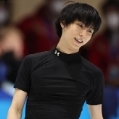
Recommended Posts
Create an account or sign in to comment
You need to be a member in order to leave a comment
Create an account
Sign up for a new account in our community. It's easy!
Register a new accountSign in
Already have an account? Sign in here.
Sign In Now