15 hours ago15 hr Info:https://web.archive.org/web/20150906013348/https://www.ifsmagazine.com/articles/32527-yuzuru-hanyuhttps://web.archive.org/web/20150905090231/http://www.ifsmagazine.com/issues/201210When Yuzuru Hanyu first hit the junior circuit during the 2008-09 season, he was barely a blip on the skating radar. Few had ever heard of him.After winning the Japanese junior title Hanyu placed a distant 12th at Junior Worlds that year.But the dynamic young man served notice when he claimed gold at every event he contested the following season, winning the Junior Grand Prix Final and running away with the 2010 World Junior title.Another Japanese phenom was on the horizon.
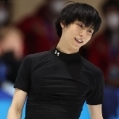
13 hours ago13 hr Author Source: https://ameblo.jp/yohoho29/entry-12162656532.html https://web.archive.org/web/20140814044438/https://ameblo.jp/stain-love/entry-11340893358.htmlhttps://web.archive.org/web/20140814044443/http://ameblo.jp/stain-love/entry-11341058695.html https://jp.mercari.com/item/m10844216614 Yuzuru Hanyu - Japan's Rising SonAs a child, Japan's Yuzuru Hanyu dreamed about becoming a figure skating star. As he watched his countrymen perform before global audiences, he was inspired to join their esteemed ranks. Making the national team, winning medals - it all seemed so surreal at the time. But what was once just a dream has now become a reality.Yuzuru Hanyu first appeared on the Junior Grand Prix circuit in the 2008–2009 season, when hardly anyone was paying attention to him. Only a handful of people knew who he was. Although he won that season’s Japanese Junior Championships, he finished 12th at the World Junior Championships. However, from the following season onward, this young, dynamic skater began attracting attention by winning a succession of competitions. He won the JGP Final and, carried forward by that momentum, went on to claim victory at the 2010 World Junior Championships. A new Japanese prodigy had arrived on the scene.Movin' On UpThe year after winning the World Junior Championships, Hanyu made his full-fledged debut at the senior level and won a silver medal at his first Four Continents Championships. This was the only international competition that year in which he reached the podium.Then, last season, he began with the Nebelhorn Trophy, winning by a substantial margin of more than 15 points over Czech star Michal Březina, who finished second. He delivered a performance that set him apart from the other competitors.However, something went wrong at the Cup of China, his first Grand Prix event. “I made a few mistakes, and I finished fourth, so it wasn’t a good start to the season,” Hanyu said.Even so, he quickly regained his form at his next Grand Prix event, the Rostelecom Cup, and won the competition, though he was not satisfied with his own skating. “I won the Russian Cup, but even though I won, I wasn’t happy. I made mistakes on the quad toe loop in both the short program and the free skate, so I wasn’t satisfied with my performance itself.”Based on his results at the two events, Hanyu qualified for the Grand Prix Final, where he finished fourth. “At the Final, I managed to do the quad in the short program, but I made a mistake on it in the free skate. Still, I was happy because I could feel that I had improved, and I was able to show that improvement to everyone.”At the Japanese Championships, things did not go the way he had hoped. “It wasn’t good. I made the same mistakes again as at the Final,” Hanyu explained. “I wanted everyone to see how I had grown and changed, but because I made mistakes, I wasn’t able to show them that.”Hanyu was not selected to compete at the Four Continents Championships, in accordance with the federation’s wishes that he get sufficient rest and prepare thoroughly for the World Championships. During that time, he would find inspiration from an unexpected source.“After the major earthquake and tsunami in 2011, I received letters from fans all over the world, but I hadn’t been able to find the time to read them,” Hanyu said. “In the months between the Japanese Championships and the World Championships, I was finally able to take my time and read all of those letters. The letters gave me a completely different way of thinking. Reading them made me realize just how many people were supporting me. I felt that I had to do something through my skating. I had to improve more, and I had to become more consistent. The letters I received became my greatest source of motivation.”And he evolved just as he had vowed to do. At the World Championships, Hanyu was in seventh place after the short program, but in the free skate, he sent the entire arena into a frenzy. Of the only two standing ovations given during the men’s event, one was for him.“When I went to Worlds, I did not think that I would win a medal. It was such a big surprise for me,” he said. “Brian Joubert did not make any mistakes, so I thought he would place higher. But when the results came out, I was so surprised that I was in third place. I was really happy with my performance and that was more important to me. Winning a World medal did not feel real for a long time."His success was even more surprising given that he had injured his ankle the day prior to the short program while attempting a quad during a practice session. "I came down on my ankle and twisted it," he explained. He did not want to miss the exhibition because of the injury. “I did a lot of shows before Worlds so I had skated my exhibition number many times. Going into that competition, my goal was to make the top five so I could skate in the gala. But in the end it was OK," he said with a laugh.The injury kept him off the ice for a month and forced him to skip the World Team Trophy. Overall, Hanyu said he was satisfied. “Things didn’t go well at times early in the season, but in the end I had really good results, so it was a successful year for me.”TransitionsFollowing Worlds, Hanyu knew he needed to make a change. At this training venue in Sendai he had to practice during public sessions with many other skaters, none of which were at his level."If I had any chance of improving and winning more medals, I had to find another place to train," he recalled.His first choice was to work with Brian Orser in Canada. The training environment at the Toronto Cricket Club was something he knew he could not get in Japan.When Orser received a call from the Japanese skating federation in early April asking if he was interested in coaching Hanyu, Orser was understandably perplexed."The person calling told me Yuzuru wanted to move here and work with me, and that this was totally instigated by him. In my mind, I was thinking of this kid who had had a great season and was on a roll. So it was a little bit of a surprise," Orser recalled."I did not say yes. I told the person I would have to talk to Javier Fernandez first. I did, and Javi was totally fine with it."A meeting was arranged during the World Team Trophy, which was held in Japan in late April."I wanted to sit down with him, his mom and the federation to discuss everything. My first question to Yuzuru was: 'Why do you want to do this?' He simply said he wanted to come and train with me, so I said OK. That was a good enough answer for me."Hanyu knew exactly why he wanted to work with the Canadian legend. "I wanted to train with Brian because he coached Yuna Kim to an Olympic gold medal, and that is what I want. I believed that he would be the coach I could continue working with all the way until 2014 Olympic. Shizuka Arakawa had also trained in Canada, and the other skaters he had coached had all achieved good results.”Hanyu spent 10 days working with Orser in early May. “During that time, Yuzuru and I sat down with Tracy Wilson to discuss the training schedule,” Orser said. “How many hours he would skate each week, and what his training sessions would involve. We learned that he really did not have much of a plan. We asked him, when does he do this run-throughs, when does he do this and that and he replied, 'Well, I don't know. When I feel like it.' Right then we knew we needed to get a more structured plan in place for him."Orser believes the transition has been a smooth one for everyone.“It all worked out. Yuzuru seemed to fit quickly to the environment and the other coaches and skaters," Orser said. "He is just a real friendly character. He is polite, has manners and he works hard."Hanyu agreed. “The first month was hard but now I am used to it. It is really good here, very stimulating," he said. "At first I think we were both checking each other out and especially Brian because I think he was quite nervous. But now I am a member of this club I feel very comfortable."For Orser, coaching his young protege is a pleasure. "What I enjoy most about him is that he really listens, he hangs on to every word we say. I feel like I am always teaching him something, and that he is always wanting to learn something from me. It feels great that I have that respect from him, and I feel like I am doing my job. He knows I am always watching him when he is on the ice so he likes to show off a little bit when I am there.""When Yuzuru first came to me he would be doing a simple move in a step sequence and he would just fall over because he kept pushing the edge so hard and because he did not know where he should be standing on the blade. He is now learning that and every day it gets better.""His federation has told me that he is obviously better since coming to train with me and that is heartening. We’re focusing on his skating skills, and he’s doing very well in his sessions with Tracy. But sometimes he feels so strongly about his own skating that he loses control. That’s why he needs to understand clearly that he must build a solid foundation.”“When you compete against skaters like Patrick Chan, who has more beautiful edge control and higher-quality skating than anyone else, you have to be able to control those things. Yuzuru is learning that now, and he’s devoting plenty of time to developing these skills.”“It’s important to understand how to maintain speed and flow effortlessly, how to finish a turn, and how to distribute your power. Where on the blade should you place your weight? I think these are things Yuzuru will naturally acquire over time.”Orser said Hanyu and Fernandez have developed a really good relationship. “They are rivals on the ice and they know that. But they have respect for each other and are becoming really good friends. I think it has been really great for Javier to have Yuzuru around because Javier all of a sudden is working harder and is really taking care of his body. He seems to be much more focused."Stepping Out Of The ZoneHanyu has two new programs crafted by two people he has never worked with before. Jeffrey Buttle designed a bluesy short program, while David Wilson choreographed a more traditional free set to the music of "Notre-Dame de Paris."“I had Jeff do the short to mix it up a little bit. David would not have had time to do both anyway,” Orser explained. "Jeff came up with the blues number because he thought it could bring out a different side of Yuzuru from what he had done before. Up until now, he’d been skating to dramatic music that he wanted to skate to himself, right? But we felt we needed to work in a different direction. The choreography incorporates elements that require him to perform and show his appeal, along with a variety of skating skills.”These new concepts present a challenge for Hanyu. “The short program is completely different from anything I’ve done before, so right now I’m still trying to get a feel for it. I’ve never skated in this style before, so it’s difficult. Until now, I’ve mostly skated to classical music or film scores, which make it easier for me to express my emotions. I’m looking forward to skating this program, but at the moment, I’m still feeling my way through it.”Orser emphasized that his student was eager to take on challenges. “David had never seen Yuzuru skate before, so I showed him a video on YouTube, and he was like, ‘Oh my God! This boy is the real deal!’ But before David started choreographing his program, I made sure Yuzuru had solid transitions leading into his jumps." "The free skate is dramatic, so in the end, it turned out the way he wanted it to,” Orser added with a laugh. “But this time, it has movement, passion, and a solid structure. All of those elements are intertwined. David did a great job.”When asked if the free skate was a fun program, Hanyu laughed. “No, it’s a serious program. The story is a little difficult for me to express, but this is a chance for me to grow and to change. It was a lot of fun working with both Jeffrey and David on these programs.”Hanyu’s exhibition program was "Hello, I Love You," choreographed by Kurt Browning.Orser said his only concern with the current arrangement is Hanyu’s travel schedule. “He has been back and forth to Japan three or four times so far. He went back for school, then he went back for shows, so it has been really hard for me to have things my way. And while great things are happening with him, there is some really amazing work I know that still needs to be done.”"As we get into this season he is going to have to slow down on the traveling, and next season as we head into the Olympics he is going to really have to focus on training, being rested and healthy."While no final decision has been made about where and when Hanyu will make his season debut, his team is leaning toward Finlandia Trophy in early October.Hanyu's Grand Prix assignments are Skate America and NHK Trophy. "I am excited about these competitions, but now that I am a World medalist I know I need to do well. Now a lot of people are expecting me to win so I want to do the best I can," he said.On A Personal NoteHanyu started skating at age 4 when his older sister Saya took up the sport and he tagged along. His sister quit not long after, but by then Hanyu had developed a passion for figure skating.Off the ice, he is a typical teenager who likes listening to music and playing computer games.Hanyu will enter Grade 12 this fall and plans to complete his high school education through an online correspondence program. He expects to graduate next March.His global popularity soared following his stunning long program performance in Nice, something Hanyu is still trying to comprehend."It's difficult, but I know that I always have to do my best now," the 17-year-old said."When I fell during my program at Worlds everyone was still clapping. That was very unreal for me. I see the fans in Japan and I know they are supporting me and that feels good. It is a very good motivation for me."An avid fan of the sport since childhood, Hanyu said he had always watched competitions on television. His number-one-idol has always been Evgeni Plushnko.“When I watched him on TV at age 4 or 5, he was the person who really made me want to be a figure skater," Hanyu said. "I always wanted to be just like him."This season, Hanyu knows there is a good chance he will go up against Plushenko. "I am not looking forward to that," Hanyu said with a laugh. “It feels really odd. I have always been dreaming about him and now to be competing against him does not seem real.”
Create an account or sign in to comment