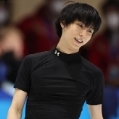
yuzurujenn Posted 2 hours ago Posted 2 hours ago *Machine translation. Inaccuracies exist* 2021.03.31 Source: https://www.tokyo-sports.co.jp/articles/-/27059 Archived: https://web.archive.org/web/20230123224443/https://www.tokyo-sports.co.jp/articles/-/27059 The "too-low score" issue for Yuzuru Hanyu: A living legend of the figure skating world points out the trends in judging. Skepticism is erupting from people involved in the sport both domestically and internationally regarding the scoring of Yuzuru Hanyu (26, ANA), the two-time Olympic gold medalist in men's figure skating. It had long been a common belief among fans that "Hanyu's scoring is harsh," but the low score he received in the short program (SP) at the recent World Championships (Stockholm) has caused a sudden surge in controversy. In this turbulent situation, we asked a living legend of the figure skating world for his opinion. Hanyu returned to Japan at Haneda Airport on the 30th. After testing negative in an antigen test before entering the country, he appeared at the arrival gate wearing a mask and commented, "Thank you very much. Thank you for your hard work. I will be quarantined (as a measure against the coronavirus). Thank you." According to the Japan Skating Federation, he was taken from the airport to a hotel for quarantine in a dedicated vehicle. At this year's World Championships, Hanyu made several mistakes in the free skate, allowing his rival Nathan Chen (21, USA) to win his third consecutive title and taking the bronze medal. He was not in perfect physical condition, suffering an asthma attack after his performance, and the jump mistakes were clearly his own fault, but the problem was the short program. He landed all his jumps perfectly—a quadruple Salchow, a quadruple-triple toe loop combination, and a triple Axel (a 3.5 rotation jump)—and took the lead, but his score was only 106.98 points. He also missed some levels in his step sequence, and some officials argued that “he should have received around 110 points.” When asked about this matter, former international judge Hideo Sugita (86), who is well-versed in the history of figure skating, said, "Honestly, when I saw the GOE (Grade of Execution), I thought, 'Why?' The evaluation wasn't the same as the skaters who performed in the first half. I felt like they should have looked more carefully." As he pointed out, the opening quadruple Salchow received only +2.22 GOE. Shockingly, two judges even awarded it 0, and this fact spread on social media. In addition, his program component score of 47.96 was only 1.53 points higher than Chen’s, who had fallen during his performance. Why did this happen? One active judge argues that "the bar has been raised to its limit for Hanyu's performance," but Sugita believes that "the absence of Japanese judges this time may also have had an effect. Also, judging has become extremely detailed recently, and it seems more like nitpicking mistakes rather than looking for the good points." He added, "Hanyu performs his jumps as part of a continuous flow. That kind of technique should be evaluated more highly. However, even if he is dissatisfied, he will never voice it. That's what's admirable about him." After the competition, Hanyu appeared to have moved on and even expressed a strong determination to achieve the first-ever quadruple Axel (a 4.5-rotation jump), even stating, “My ultimate goal is the quadruple Axel rather than Olympic gold.” If he felt he had reached the limits of what others could evaluate him on and decided to pursue a "dream" he could achieve on his own, how will the figure skating world receive this "silent message"? It is likely to continue to spark considerable debate.
Recommended Posts
Create an account or sign in to comment
You need to be a member in order to leave a comment
Create an account
Sign up for a new account in our community. It's easy!
Register a new accountSign in
Already have an account? Sign in here.
Sign In Now